Clinical Knowledge › Neurology › Cerebrovascular disease
Posterior circulation stroke
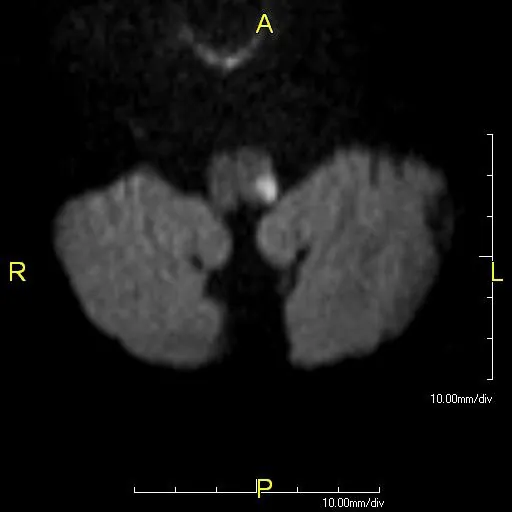
Posterior circulation stroke is ischaemia in the territory of the vertebral, basilar and posterior cerebral arteries and their branches, supplying the brainstem, cerebellum, thalamus and occipital and medial temporal lobes. It causes about 20–25% of ischaemic strokes. Causes include atherosclerosis at the vertebral origin or intracranial vessels, cardioembolism (often to the top of the basilar artery), dissection and small-vessel disease. Presentations are varied: vertigo, diplopia, dysarthria, dysphagia, ataxia, hemianopia, crossed sensory or motor signs and reduced consciousness, so the diagnosis is often missed and the NIHSS underestimates severity. Classic syndromes include lateral medullary (Wallenberg), Weber, locked-in and top-of-the-basilar syndromes. CT is insensitive, and diffusion MRI may be negative early. Treatment follows acute ischaemic stroke pathways: thrombolysis within 4.5 hours and thrombectomy for basilar artery occlusion up to 24 hours. Cerebellar infarcts can swell and compress the brainstem, sometimes needing decompressive surgery.
Patient case, mechanism, investigations, management, flashcards and exam-style questions.Open the lesson →
Key facts
- The posterior circulation (vertebral, basilar and posterior cerebral arteries) supplies brainstem, cerebellum, thalamus, occipital lobes and medial temporal lobes; 20–25% of ischaemic strokes
- Hallmarks: crossed signs (ipsilateral cranial nerve, contralateral long-tract), bilateral signs, vertigo, diplopia, dysarthria, dysphagia and ataxia
- Lateral medullary syndrome (PICA or vertebral artery): ipsilateral Horner syndrome, facial pain/temperature loss, ataxia and bulbar palsy with contralateral body pain/temperature loss
- Basilar artery occlusion causes coma, quadriparesis or locked-in syndrome and has a very poor prognosis without recanalisation
- Non-contrast CT misses most early posterior fossa infarcts; MRI DWI is best but can be falsely negative in the first 24–48 hours
- In acute vestibular syndrome, a HINTS examination suggesting a central cause (normal head impulse, direction-changing nystagmus, skew) outperforms early MRI
- Thrombectomy for basilar artery occlusion improves outcome (ATTENTION and BAOCHE, 2022), particularly with NIHSS ≥10, up to 24 hours from onset
- Large cerebellar infarcts can swell over 2–4 days, causing hydrocephalus and brainstem compression; suboccipital decompressive craniectomy may be life-saving
Differential diagnosis
| Condition | Clues | Key test |
|---|---|---|
| Vestibular neuritis | Acute continuous vertigo, unidirectional horizontal nystagmus, abnormal head impulse, can walk | HINTS peripheral pattern; no other signs |
| Benign paroxysmal positional vertigo | Brief positional vertigo, normal between episodes | Dix–Hallpike positive with torsional upbeating nystagmus |
| Vestibular migraine | Recurrent vertigo with migraine features, normal interictal examination | Clinical criteria; normal MRI |
| Cerebellar or brainstem haemorrhage | Headache, vomiting, high BP, reduced GCS | Non-contrast CT |
| Wernicke encephalopathy | Ophthalmoplegia, ataxia, confusion in alcohol use or malnutrition | Clinical response to IV thiamine; MRI mammillary bodies |
| Multiple sclerosis relapse (brainstem) | Younger, subacute onset over days, INO | MRI demyelinating lesions |
| Hypoglycaemia or drug toxicity | Ataxia and reduced consciousness, no focal crossed signs | Glucose, toxicology |
Exam pearls
Guideline
AHA/ASA 2026 Guideline for the Early Management of Patients With Acute Ischemic Stroke; ESO–ESMINT 2024 guideline on basilar artery occlusion; AHA/ASA 2021 secondary prevention guideline; NICE NG128
References
- Prabhakaran S, Gonzalez NR, Zachrison KS, et al.. 2026 Guideline for the Early Management of Patients With Acute Ischemic Stroke: a guideline from the American Heart Association/American Stroke Association. Stroke 2026.
- Strbian D, Tsivgoulis G, Ospel J, et al.. European Stroke Organisation (ESO) and European Society for Minimally Invasive Neurological Therapy (ESMINT) guideline on acute management of basilar artery occlusion. Eur Stroke J 2024.
- Kleindorfer DO, Towfighi A, Chaturvedi S, et al.. 2021 Guideline for the Prevention of Stroke in Patients With Stroke and Transient Ischemic Attack: a guideline from the American Heart Association/American Stroke Association. Stroke 2021.
- National Institute for Health and Care Excellence. Stroke and transient ischaemic attack in over 16s: diagnosis and initial management (NG128). NICE (last updated 2022) 2019.
- Tao C, Nogueira RG, Zhu Y, et al.. Trial of endovascular treatment of acute basilar-artery occlusion (ATTENTION). N Engl J Med 2022.
- Jovin TG, Li C, Wu L, et al.. Trial of thrombectomy 6 to 24 hours after stroke due to basilar-artery occlusion (BAOCHE). N Engl J Med 2022.
Related topics
By Dr Khalid Seidi (B.Sc., M.D.) · MedEd World Clinical Knowledge library. Original teaching content checked against current guidelines (November 2026); confirm the latest local guidance before clinical use. Not a substitute for clinical judgement.