Clinical Knowledge › Neurology › Cerebrovascular disease
Cerebral venous sinus thrombosis
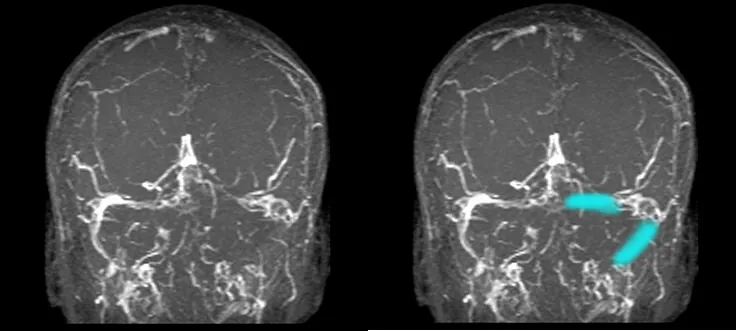
Cerebral venous sinus thrombosis (CVT) is thrombosis of the dural venous sinuses and/or cerebral veins. It causes 0.5–3% of strokes and mainly affects young adults, about three-quarters of them women, in association with oral oestrogens, pregnancy and the puerperium, inherited or acquired thrombophilia, cancer, infection of the ear or face, dehydration and, rarely, vaccine-induced immune thrombotic thrombocytopenia. Impaired venous drainage raises intracranial pressure and causes venous infarction and haemorrhage. The typical patient has a progressive headache over days, often with papilloedema, seizures, focal deficits or encephalopathy; deep venous thrombosis can cause bilateral thalamic involvement and coma. Non-contrast CT may be normal, so CT venography or MRI with MR venography is needed. Treatment is anticoagulation with heparin even when venous haemorrhage is present, followed by oral anticoagulation (warfarin or a DOAC such as dabigatran) for 3–12 months; endovascular treatment and decompressive surgery are reserved for deterioration. Most patients recover well.
Patient case, mechanism, investigations, management, flashcards and exam-style questions.Open the lesson →
Key facts
- CVT accounts for 0.5–3% of strokes; median age around 37 years; women outnumber men about 3:1
- Major risk factors: oral contraceptives, pregnancy and puerperium, thrombophilia, cancer, local infection (mastoiditis, sinusitis), dehydration, head injury
- Headache is present in about 90%, typically progressive over days and worse lying down; seizures occur in about 40%
- The superior sagittal and transverse sinuses are most often involved; deep venous thrombosis causes bilateral thalamic oedema and reduced consciousness
- CT may show a dense sinus (cord sign) and contrast CT an 'empty delta' sign; CT venography or MRI with MR venography confirms the diagnosis
- A normal D-dimer does not exclude CVT, especially with isolated headache or long symptom duration
- Anticoagulate with LMWH or unfractionated heparin even if there is intracerebral haemorrhage, then warfarin or a DOAC for 3–12 months
- About 80% recover fully or nearly; death or dependence occurs in 10–15%
Differential diagnosis
| Condition | Clues | Key test |
|---|---|---|
| Idiopathic intracranial hypertension | Obese young woman, headache, papilloedema, normal neurology | MR or CT venography normal (apart from transverse sinus stenosis) |
| Arterial ischaemic stroke | Sudden onset in an arterial territory, vascular risk factors | CTA/MRI: arterial territory infarct, patent venous sinuses |
| Subarachnoid haemorrhage | Thunderclap headache, meningism | CT showing basal cistern blood; CTA for aneurysm |
| Meningitis or encephalitis | Fever, neck stiffness, CSF pleocytosis | LP after imaging; MRV to exclude CVT |
| Brain tumour or abscess | Subacute headache, seizures, focal signs | Contrast MRI showing mass or ring enhancement |
| Pre-eclampsia/eclampsia or PRES | Pregnancy, hypertension, seizures, posterior oedema | BP, proteinuria, MRI posterior white matter oedema with patent sinuses |
| Migraine | Recurrent headache with typical features, normal examination | History; imaging only if red flags |
Exam pearls
Guideline
AHA 2024 scientific statement on diagnosis and management of cerebral venous thrombosis; ESO 2017 guideline for diagnosis and treatment of cerebral venous thrombosis
References
- Saposnik G, Bushnell C, Coutinho JM, et al.. Diagnosis and management of cerebral venous thrombosis: a scientific statement from the American Heart Association. Stroke 2024.
- Ferro JM, Bousser MG, Canhão P, et al.. European Stroke Organization guideline for the diagnosis and treatment of cerebral venous thrombosis – endorsed by the European Academy of Neurology. Eur J Neurol 2017.
- Ferro JM, Canhão P, Stam J, Bousser MG, Barinagarrementeria F. Prognosis of cerebral vein and dural sinus thrombosis: results of the International Study on Cerebral Vein and Dural Sinus Thrombosis (ISCVT). Stroke 2004.
- Ferro JM, Coutinho JM, Dentali F, et al.. Safety and efficacy of dabigatran etexilate vs dose-adjusted warfarin in patients with cerebral venous thrombosis (RE-SPECT CVT): a randomized clinical trial. JAMA Neurol 2019.
- Coutinho JM, Zuurbier SM, Bousser MG, et al.. Effect of endovascular treatment with medical management vs standard care on severe cerebral venous thrombosis: the TO-ACT randomized clinical trial. JAMA Neurol 2020.
- Stam J. Cerebral venous thrombosis. N Engl J Med 2005.
Related topics
By Dr Khalid Seidi (B.Sc., M.D.) · MedEd World Clinical Knowledge library. Original teaching content checked against current guidelines (November 2026); confirm the latest local guidance before clinical use. Not a substitute for clinical judgement.