Clinical Knowledge › Neurology › Cerebrovascular disease
Moyamoya disease
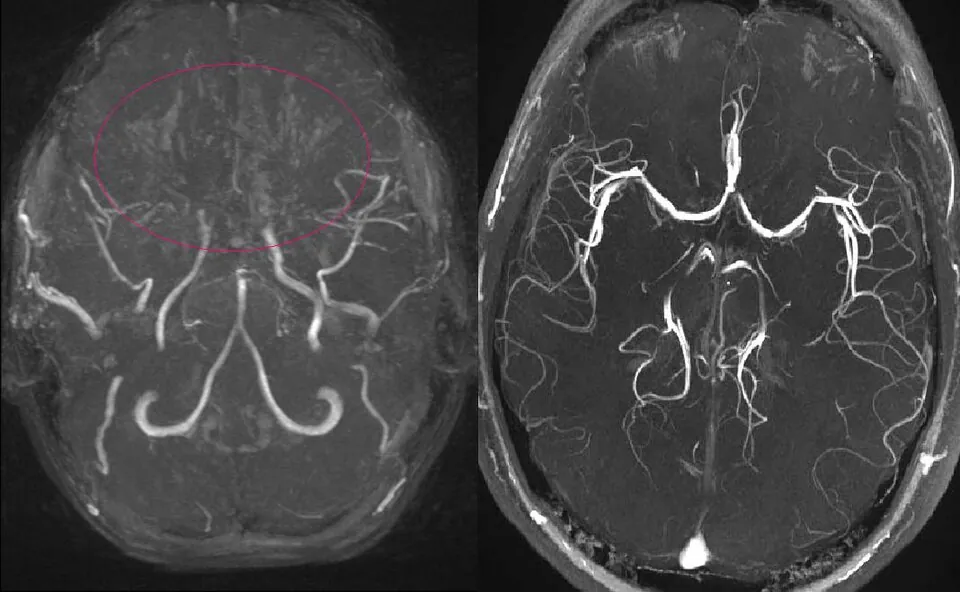
Moyamoya angiopathy is a progressive, non-atherosclerotic narrowing and occlusion of the terminal internal carotid arteries and the proximal anterior and middle cerebral arteries, with a compensatory network of fragile collateral vessels that looks like a 'puff of smoke' (moyamoya in Japanese) on angiography. Moyamoya disease is the idiopathic form, most common in East Asia and linked to the RNF213 p.R4810K variant; moyamoya syndrome describes the same arteriopathy with an associated condition such as sickle cell disease, Down syndrome, neurofibromatosis type 1 or cranial irradiation. It has a bimodal age distribution: children present with TIAs, ischaemic strokes, seizures or headaches, often triggered by hyperventilation, whereas adults present with ischaemia or intracranial haemorrhage from fragile collaterals. MRI and MR angiography suggest the diagnosis and catheter angiography confirms it. Antiplatelet therapy is used for ischaemic disease, and surgical revascularisation (direct or indirect bypass) reduces stroke in patients with impaired perfusion or haemorrhage.
Patient case, mechanism, investigations, management, flashcards and exam-style questions.Open the lesson →
Key facts
- Progressive bilateral stenosis or occlusion of terminal ICAs and proximal ACA/MCA with basal collateral network ('puff of smoke')
- Moyamoya disease = idiopathic; moyamoya syndrome = associated with sickle cell disease, Down syndrome, NF1, cranial irradiation, autoimmune thyroid disease and others
- Highest prevalence in Japan and Korea; RNF213 p.R4810K is the main susceptibility variant in East Asians
- Bimodal age peaks: around 5–10 years (ischaemic events) and 30–40 years (ischaemia or haemorrhage)
- In children, TIAs are classically triggered by hyperventilation (crying, blowing, eating hot food) because hypocapnia causes vasoconstriction
- Catheter digital subtraction angiography confirms the diagnosis and Suzuki staging; MRI may show the FLAIR 'ivy sign' and multiple flow voids in the basal ganglia
- Surgical revascularisation (direct STA–MCA bypass, indirect EDAS, or combined) reduces stroke in symptomatic patients with haemodynamic impairment and in haemorrhagic adults
- Avoid hypotension, dehydration and hypocapnia (e.g. during anaesthesia) because perfusion depends on fragile collaterals
Differential diagnosis
| Condition | Clues | Key test |
|---|---|---|
| Intracranial atherosclerotic stenosis | Older adult with vascular risk factors, irregular stenoses, no extensive collaterals | Vessel-wall MRI showing eccentric plaque; angiography |
| Primary angiitis of the CNS | Headache, encephalopathy, multifocal infarcts, beaded vessels | CSF pleocytosis, vessel-wall enhancement, biopsy |
| Focal cerebral arteriopathy of childhood | Unilateral, monophasic distal ICA/MCA stenosis after varicella | Serial imaging: stabilises or improves |
| Sickle cell vasculopathy | Known sickle cell disease, abnormal transcranial Doppler | Haemoglobin electrophoresis; TCD velocities |
| Cerebral vasculitis secondary to infection (TB, VZV) | Fever, meningitis, basal enhancement | CSF, VZV PCR/antibodies |
| Hemiplegic migraine | Recurrent hemiparesis with headache, family history | Normal angiography; CACNA1A/ATP1A2 |
| Epilepsy with Todd paresis | Seizures followed by transient weakness | EEG; normal vessel imaging |
Exam pearls
Guideline
ESO 2023 guidelines on moyamoya angiopathy (endorsed by VASCERN); Japanese 2021 diagnostic criteria for moyamoya disease; AHA/ASA paediatric stroke statements
References
- Bersano A, Khan N, Fuentes B, et al.. European Stroke Organisation (ESO) guidelines on moyamoya angiopathy endorsed by Vascular European Reference Network (VASCERN). Eur Stroke J 2023.
- Kuroda S, Fujimura M, Takahashi J, et al.. Diagnostic criteria for moyamoya disease – 2021 revised version. Neurol Med Chir (Tokyo) 2022.
- Miyamoto S, Yoshimoto T, Hashimoto N, et al.. Effects of extracranial–intracranial bypass for patients with hemorrhagic moyamoya disease: results of the Japan Adult Moyamoya Trial. Stroke 2014.
- Scott RM, Smith ER. Moyamoya disease and moyamoya syndrome. N Engl J Med 2009.
- Suzuki J, Takaku A. Cerebrovascular 'moyamoya' disease: disease showing abnormal net-like vessels in base of brain. Arch Neurol 1969.
- Ferriero DM, Fullerton HJ, Bernard TJ, et al.. Management of stroke in neonates and children: a scientific statement from the American Heart Association/American Stroke Association. Stroke 2019.
Related topics
By Dr Khalid Seidi (B.Sc., M.D.) · MedEd World Clinical Knowledge library. Original teaching content checked against current guidelines (November 2026); confirm the latest local guidance before clinical use. Not a substitute for clinical judgement.