Clinical Knowledge › Internal medicine › Cardiology and angiology › Coronary artery disease
Cardiac rehabilitation and secondary prevention
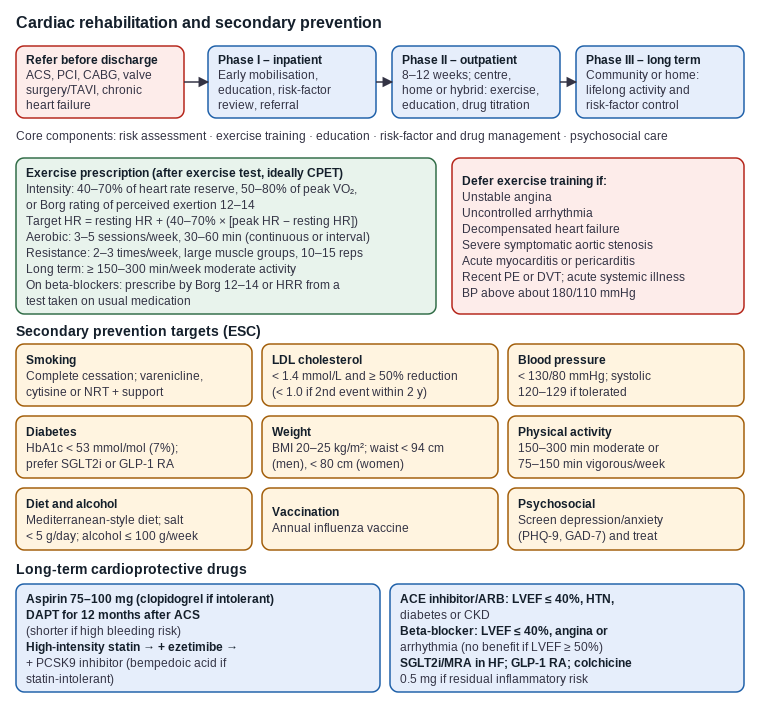
Cardiac rehabilitation is a structured, multidisciplinary programme of supervised exercise training, education, risk-factor management and psychological support that begins after an acute coronary syndrome, revascularisation, heart surgery or a diagnosis of heart failure. Combined with evidence-based drugs, it forms secondary prevention: the measures that stop atherosclerotic disease from causing further events. Exercise-based rehabilitation reduces cardiovascular death, reinfarction and hospital admission and improves fitness, quality of life and mood, yet fewer than half of eligible patients take part. Key targets are stopping smoking, LDL cholesterol below 1.4 mmol/L with at least a 50% reduction, blood pressure below 130/80 mmHg, good glycaemic control, a healthy weight and at least 150 minutes of moderate activity a week. Core drugs include antiplatelet therapy, high-intensity statin with ezetimibe or PCSK9 inhibition when needed, and, depending on the indication, ACE inhibitors, beta-blockers, SGLT2 inhibitors, GLP-1 receptor agonists and low-dose colchicine.
Patient case, mechanism, investigations, management, flashcards and exam-style questions.Open the lesson →
Key facts
- Refer every patient after ACS, PCI, CABG, valve surgery and with chronic heart failure to cardiac rehabilitation before discharge
- Core components: risk assessment, exercise training, education, risk-factor and medication management, and psychosocial support
- Exercise prescription: moderate intensity (40–70% of heart rate reserve, Borg RPE 12–14), 3–5 sessions a week plus resistance training 2–3 times a week
- Exercise-based rehabilitation lowers cardiovascular mortality, reinfarction and hospital admission and improves quality of life
- LDL-C goal after ACS or in chronic coronary disease: below 1.4 mmol/L (55 mg/dL) and at least 50% reduction from baseline
- Stopping smoking is the single most effective lifestyle measure; offer varenicline, cytisine or nicotine replacement with behavioural support
- Beta-blockers are indicated long term when LVEF is 40% or less; routine use with LVEF 50% or more and no other indication gives no outcome benefit
- Home-based and digitally supported programmes are effective alternatives for selected patients and improve uptake
Differential diagnosis
| Condition | Clues | Key test |
|---|---|---|
| Recurrent ischaemia during rehabilitation | Exertional chest pain or ST depression at low workload | Exercise ECG or stress imaging; angiography |
| Chronotropic incompetence from beta-blockade | Heart rate fails to rise; target rate unreachable | Use RPE or CPET-based prescription |
| Deconditioning | Breathlessness with no ischaemia or HF | CPET showing reduced peak VO2 with normal cardiac response |
| Depression after MI | Low mood, fatigue, poor adherence | PHQ-9 screening |
| Statin-associated muscle symptoms | Myalgia limiting exercise | Creatine kinase; rechallenge or alternative lipid-lowering |
| Heart failure decompensation | Weight gain, oedema, falling exercise tolerance | Clinical review, NT-proBNP, echo |
Exam pearls
Guideline
2026 ESC Guidelines on cardiac rehabilitation, 2021 ESC cardiovascular prevention guideline, 2024 ESC chronic coronary syndromes guideline and 2025 ESC/EAS dyslipidaemia focused update (with the 2023 AHA/ACC chronic coronary disease guideline)
References
- European Society of Cardiology. 2026 ESC Guidelines on cardiac rehabilitation. Eur Heart J 2026.
- Visseren FLJ, Mach F, Smulders YM, et al.. 2021 ESC Guidelines on cardiovascular disease prevention in clinical practice. Eur Heart J 2021.
- Vrints C, Andreotti F, Koskinas KC, et al.. 2024 ESC Guidelines for the management of chronic coronary syndromes. Eur Heart J 2024.
- Byrne RA, Rossello X, Coughlan JJ, et al.. 2023 ESC Guidelines for the management of acute coronary syndromes. Eur Heart J 2023.
- Mach F, Koskinas KC, Roeters van Lennep JE, et al.. 2025 Focused Update of the 2019 ESC/EAS Guidelines for the management of dyslipidaemias. Eur Heart J 2025.
- Virani SS, Newby LK, Arnold SV, et al.. 2023 AHA/ACC/ACCP/ASPC/NLA/PCNA Guideline for the Management of Patients With Chronic Coronary Disease. Circulation 2023.
Related topics
By Dr Khalid Seidi (B.Sc., M.D.) · MedEd World Clinical Knowledge library. Original teaching content checked against current guidelines (November 2026); confirm the latest local guidance before clinical use. Not a substitute for clinical judgement.