Clinical Knowledge › Obstetrics and gynaecology › Gynaecological oncology
Cervical cancer
Cervical cancer is the fourth most common cancer in women worldwide, with most deaths in low- and middle-income countries, and almost all cases are caused by persistent high-risk HPV. About three-quarters are squamous cell carcinomas. It arises from CIN over 10–15 years, so vaccination and HPV-based screening can eliminate it (WHO strategy). Typical symptoms are post-coital, intermenstrual or postmenopausal bleeding and offensive discharge; advanced disease causes pelvic pain, leg oedema, fistula and obstructive renal failure. Diagnosis is by biopsy, and staging uses FIGO 2018, which incorporates MRI and PET-CT and adds nodal stage IIIC. Early disease (IA–IB2) is treated surgically, with open radical hysterectomy and sentinel or pelvic node assessment (minimally invasive surgery worsened survival in the LACC trial), simple hysterectomy for selected low-risk tumours (SHAPE) and fertility-sparing trachelectomy for small tumours. Locally advanced disease receives cisplatin-based chemoradiotherapy with brachytherapy, now improved by induction chemotherapy (INTERLACE) or pembrolizumab (KEYNOTE-A18) in selected women.
Patient case, mechanism, investigations, management, flashcards and exam-style questions.Open the lesson →
Key facts
- Persistent high-risk HPV (16 and 18 about 70%) causes over 95% of cases; squamous cell carcinoma about 75%, adenocarcinoma about 20–25%
- Classic symptoms: post-coital bleeding, intermenstrual or postmenopausal bleeding, offensive discharge; a visibly abnormal cervix needs a suspected cancer referral
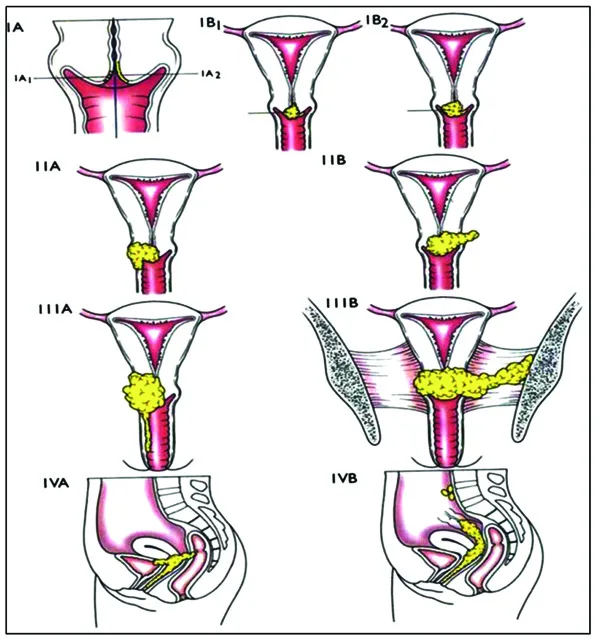
- FIGO 2018: IA ≤5 mm invasion (IA1 <3 mm, IA2 3–5 mm); IB1 ≤2 cm, IB2 >2–4 cm, IB3 >4 cm; IIB parametrium; IIIB pelvic wall or hydronephrosis; IIIC nodes; IVA bladder or rectal mucosa; IVB distant
- MRI pelvis assesses local extent; PET-CT assesses nodes and distant spread; imaging and pathology findings may change the stage (r and p notation for IIIC)
- Early disease: open radical hysterectomy with nodal assessment; minimally invasive radical hysterectomy had worse survival (LACC 2018)
- Low-risk tumours (≤2 cm, limited stromal invasion): simple hysterectomy is non-inferior (SHAPE 2024); radical trachelectomy preserves fertility for selected tumours ≤2 cm
- Locally advanced (IB3–IVA): external beam RT + weekly cisplatin 40 mg/m² + image-guided brachytherapy, completed within about 7–8 weeks (teaching dose; check local protocol)
- Uraemia from bilateral ureteric obstruction is a leading cause of death in advanced disease
Differential diagnosis
| Condition | Clues | Key test |
|---|---|---|
| Cervical ectropion | Contact bleeding in young or pregnant women; smooth red columnar epithelium | Speculum; colposcopy if doubt |
| Cervical polyp | Pedunculated smooth lesion from the os | Polypectomy with histology |
| Cervicitis (chlamydia, gonorrhoea) | Post-coital bleeding with mucopurulent discharge | NAAT |
| Endometrial cancer | Postmenopausal bleeding, obesity, thickened endometrium | Transvaginal ultrasound and endometrial biopsy |
| Atrophic vaginitis | Postmenopausal spotting, thin pale mucosa | Examination; exclude endometrial cause |
| Nabothian cysts | Smooth translucent cysts on the ectocervix | Clinical; ultrasound if deep |
| Cervical metastasis or other primary (lymphoma, sarcoma) | Atypical mass with systemic features | Biopsy with immunohistochemistry |
Exam pearls
Guideline
ESGO/ESTRO/ESP guidelines for the management of patients with cervical cancer (2023 update); FIGO 2018 staging (revised 2019); NCCN Cervical Cancer guideline (current 2026 version); WHO global strategy for cervical cancer elimination (2020); NICE NG12 suspected cancer
References
- Bhatla N, Berek JS, Cuello Fredes M, et al.. Revised FIGO staging for carcinoma of the cervix uteri. Int J Gynaecol Obstet 2019.
- Cibula D, Raspollini MR, Planchamp F, et al.. ESGO/ESTRO/ESP guidelines for the management of patients with cervical cancer – update 2023. Int J Gynecol Cancer 2023.
- Bray F, Laversanne M, Sung H, et al.. Global cancer statistics 2022: GLOBOCAN estimates of incidence and mortality worldwide for 36 cancers in 185 countries. CA Cancer J Clin 2024.
- National Comprehensive Cancer Network. NCCN Clinical Practice Guidelines in Oncology: Cervical Cancer. NCCN 2026.
- Ramirez PT, Frumovitz M, Pareja R, et al.. Minimally invasive versus abdominal radical hysterectomy for cervical cancer. N Engl J Med 2018.
- Plante M, Kwon JS, Ferguson S, et al.. Simple versus radical hysterectomy in women with low-risk cervical cancer. N Engl J Med 2024.
Related topics
By Dr Khalid Seidi (B.Sc., M.D.) · MedEd World Clinical Knowledge library. Original teaching content checked against current guidelines (November 2026); confirm the latest local guidance before clinical use. Not a substitute for clinical judgement.