Clinical Knowledge › Obstetrics and gynaecology › Gynaecological oncology
Endometrial cancer
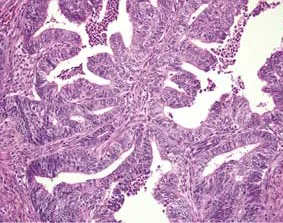
Endometrial cancer is the commonest gynaecological cancer in high-income countries. Most tumours are endometrioid adenocarcinomas driven by unopposed oestrogen (obesity, anovulation, nulliparity, tamoxifen) and arise from atypical hyperplasia; serous, clear cell and carcinosarcoma types are oestrogen-independent, occur in older women and behave aggressively. Lynch syndrome causes about 3% of cases, so every tumour is tested for mismatch repair deficiency. About 90% of women present with postmenopausal bleeding, which allows early diagnosis: transvaginal ultrasound (endometrium 4 mm or more needs sampling) is followed by pipelle biopsy or hysteroscopy. The FIGO 2023 staging adds histological type, lymphovascular space invasion and molecular class (POLE-mutated, MMR-deficient, no specific molecular profile, p53-abnormal) to anatomical extent. Treatment is total hysterectomy with bilateral salpingo-oophorectomy, usually laparoscopic, with sentinel node mapping; adjuvant radiotherapy, chemotherapy and, for advanced disease, a PD-1 inhibitor are tailored to the molecular risk group. Five-year survival exceeds 90% for stage I disease.
Patient case, mechanism, investigations, management, flashcards and exam-style questions.Open the lesson →
Key facts
- About 90% present with postmenopausal bleeding (PMB); any PMB in a woman aged 55 or over warrants an urgent suspected-cancer referral (NICE NG12)
- Transvaginal ultrasound: endometrial thickness 4 mm or more (or any focal lesion) in PMB needs histological sampling; ultrasound is unreliable on tamoxifen, so use hysteroscopy
- Risk factors are mostly unopposed oestrogen: obesity (the strongest modifiable factor), PCOS/anovulation, nulliparity, late menopause, oestrogen-only HRT, tamoxifen, oestrogen-secreting granulosa cell tumour; diabetes and Lynch syndrome also raise risk
- Combined oral contraception, parity, breastfeeding and LNG-IUS use lower risk; the COC roughly halves risk, with protection lasting more than a decade after stopping
- Endometrioid (about 80%) arises from atypical hyperplasia; serous carcinoma (p53-abnormal) arises in atrophic endometrium and spreads transperitoneally like ovarian cancer
- Four molecular classes: POLE-mutated (excellent prognosis), MMR-deficient (about 25–30%; screen for Lynch), no specific molecular profile (NSMP, commonest) and p53-abnormal (worst prognosis)
- FIGO 2023: stage I confined to corpus, II cervical stroma, substantial LVSI or aggressive histology with myometrial invasion, III local/regional (adnexa, vagina, pelvic peritoneum, nodes), IV bladder/bowel mucosa or distant
- Primary treatment: total hysterectomy + bilateral salpingo-oophorectomy (minimally invasive preferred) with sentinel lymph node biopsy; omentectomy for serous, carcinosarcoma and undifferentiated types
Differential diagnosis
| Condition | Clues | Key test |
|---|---|---|
| Endometrial atrophy | Commonest cause of PMB; thin, dry vaginal mucosa | TVUS endometrium below 4 mm |
| Endometrial hyperplasia (with or without atypia) | Obesity, PCOS, unopposed oestrogen; thickened endometrium | Endometrial biopsy histology |
| Endometrial polyp | Intermittent bleeding, focal lesion on ultrasound, tamoxifen use | Saline infusion sonography or hysteroscopy with polypectomy |
| Cervical cancer | Postcoital bleeding, visible cervical lesion | Speculum examination, colposcopy and biopsy |
| Uterine sarcoma | Rapidly enlarging uterus or 'fibroid' after menopause | MRI pelvis; histology |
| Ovarian granulosa cell tumour | Adnexal mass with oestrogen effects (hyperplasia, breast tenderness) | Pelvic ultrasound; inhibin B |
| HRT-related bleeding | Unscheduled bleeding on sequential or continuous combined HRT | TVUS and biopsy if persistent beyond 6 months or after amenorrhoea |
| Genitourinary syndrome of menopause or haematuria | Spotting after intercourse, dysuria or blood in urine | Examination, urinalysis; TVUS still needed for PMB |
Exam pearls
Guideline
ESGO–ESTRO–ESP guidelines for endometrial carcinoma (update 2025), FIGO staging of endometrial cancer 2023, NICE NG12 suspected cancer and NICE DG42 Lynch syndrome testing (2020)
References
- Concin N, Matias-Guiu X, Cibula D, et al.. ESGO-ESTRO-ESP guidelines for the management of patients with endometrial carcinoma: update 2025. Lancet Oncol 2025.
- Berek JS, Matias-Guiu X, Creutzberg C, et al.. FIGO staging of endometrial cancer: 2023. Int J Gynaecol Obstet 2023.
- National Institute for Health and Care Excellence. Suspected cancer: recognition and referral (NG12). NICE 2015.
- National Institute for Health and Care Excellence. Testing strategies for Lynch syndrome in people with endometrial cancer (DG42). NICE 2020.
- Mirza MR, Chase DM, Slomovitz BM, et al.. Dostarlimab for primary advanced or recurrent endometrial cancer. N Engl J Med 2023.
- Eskander RN, Sill MW, Beffa L, et al.. Pembrolizumab plus chemotherapy in advanced endometrial cancer. N Engl J Med 2023.
Related topics
By Dr Khalid Seidi (B.Sc., M.D.) · MedEd World Clinical Knowledge library. Original teaching content checked against current guidelines (November 2026); confirm the latest local guidance before clinical use. Not a substitute for clinical judgement.