Clinical Knowledge › Obstetrics and gynaecology › Gynaecological oncology
Germ cell and sex cord-stromal ovarian tumours
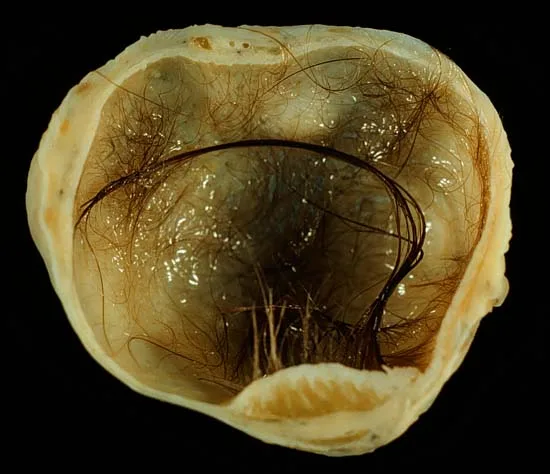
Non-epithelial ovarian tumours arise from germ cells or from the sex cord-stromal cells that make ovarian hormones. Germ cell tumours mainly affect girls and young women: the mature cystic teratoma (dermoid cyst) is the commonest ovarian neoplasm under 30 and is benign, whereas malignant germ cell tumours (dysgerminoma, yolk sac tumour, immature teratoma, embryonal carcinoma, non-gestational choriocarcinoma) grow rapidly, often present with pain or torsion and secrete LDH, AFP or hCG. Sex cord-stromal tumours include the oestrogen-secreting adult granulosa cell tumour (FOXL2 mutation, inhibin B, postmenopausal bleeding, endometrial hyperplasia or cancer), androgen-secreting Sertoli–Leydig cell tumours (rapid virilisation, DICER1) and benign fibromas and thecomas (Meigs syndrome). Most malignant tumours are diagnosed at stage I. Fertility-sparing unilateral salpingo-oophorectomy with staging is standard in young women, and malignant germ cell tumours are highly curable with bleomycin–etoposide–cisplatin (BEP) when chemotherapy is needed.
Patient case, mechanism, investigations, management, flashcards and exam-style questions.Open the lesson →
Key facts
- Mature cystic teratoma (dermoid) is the commonest ovarian neoplasm in women under 30; about 10–15% are bilateral; malignant transformation (usually squamous carcinoma) occurs in about 1–2%, mainly after menopause
- Malignant germ cell tumours peak at 10–30 years; dysgerminoma is the commonest (LDH, sometimes hCG; bilateral in about 10–15%)
- Tumour markers: yolk sac tumour → AFP; choriocarcinoma → hCG; embryonal carcinoma → AFP + hCG; dysgerminoma → LDH (± modest hCG); granulosa cell tumour → inhibin B and AMH
- Dysgerminoma and gonadoblastoma arise in dysgenetic gonads with a Y chromosome (e.g. Swyer syndrome 46,XY): prophylactic gonadectomy is advised
- Adult granulosa cell tumour: perimenopausal or postmenopausal; FOXL2 c.402C>G mutation in about 95%; oestrogen causes PMB, endometrial hyperplasia (about 25–50%) or carcinoma (about 5–10%); late recurrences
- Sertoli–Leydig cell tumour: young women with rapid-onset virilisation; testosterone markedly raised; associated with DICER1 syndrome
- Fibroma + ascites + right pleural effusion that resolve after excision = Meigs syndrome; bilateral fibromas suggest Gorlin syndrome
- BEP for 3–4 cycles cures most malignant germ cell tumours; surveillance is acceptable for stage IA dysgerminoma and stage IA grade 1 immature teratoma
Differential diagnosis
| Condition | Clues | Key test |
|---|---|---|
| Epithelial ovarian cancer | Older woman, bilateral complex mass, ascites | CA-125, RMI, histology |
| Functional or haemorrhagic cyst | Young woman, simple or reticular cyst, resolves | Repeat ultrasound in 6–12 weeks |
| Endometrioma | Dysmenorrhoea, ground-glass cyst | Ultrasound appearance, CA-125 mildly raised |
| Ectopic pregnancy | Positive pregnancy test with adnexal mass and pain | Serum hCG and transvaginal ultrasound |
| Gestational trophoblastic neoplasia | Very high hCG after a pregnancy | Pregnancy history, uterine findings, hCG trend |
| Ovarian torsion of a benign cyst | Sudden severe pain, vomiting, enlarged oedematous ovary | Ultrasound (whirlpool sign) and laparoscopy |
| Congenital adrenal hyperplasia / PCOS (androgen excess) | Gradual hirsutism, irregular cycles | 17-hydroxyprogesterone, DHEAS, testosterone only mildly raised |
| Adrenal androgen-secreting tumour | Virilisation with very high DHEAS | DHEAS, adrenal CT |
Exam pearls
Guideline
ESMO Clinical Practice Guidelines for non-epithelial ovarian cancer (2018), ESGO–SIOPE guidelines for adolescents and young adults with non-epithelial ovarian cancers (2020), NICE CG122 (2011) and FIGO 2014 staging
References
- Ray-Coquard I, Morice P, Lorusso D, et al.. Non-epithelial ovarian cancer: ESMO Clinical Practice Guidelines for diagnosis, treatment and follow-up. Ann Oncol 2018.
- Sessa C, Schneider DT, Planchamp F, et al.. ESGO-SIOPE guidelines for the management of adolescents and young adults with non-epithelial ovarian cancers. Lancet Oncol 2020.
- National Institute for Health and Care Excellence. Ovarian cancer: recognition and initial management (CG122). NICE 2011.
- Prat J; FIGO Committee on Gynecologic Oncology. Staging classification for cancer of the ovary, fallopian tube, and peritoneum. Int J Gynaecol Obstet 2014.
- Shah SP, Köbel M, Senz J, et al.. Mutation of FOXL2 in granulosa-cell tumors of the ovary. N Engl J Med 2009.
- Heravi-Moussavi A, Anglesio MS, Cheng SW, et al.. Recurrent somatic DICER1 mutations in nonepithelial ovarian cancers. N Engl J Med 2012.
Related topics
By Dr Khalid Seidi (B.Sc., M.D.) · MedEd World Clinical Knowledge library. Original teaching content checked against current guidelines (November 2026); confirm the latest local guidance before clinical use. Not a substitute for clinical judgement.