Clinical Knowledge › Obstetrics and gynaecology › Gynaecological oncology
Uterine sarcoma
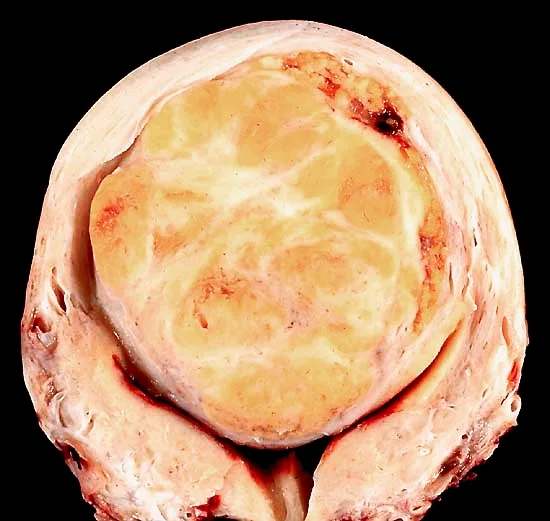
Uterine sarcomas are rare mesenchymal cancers of the myometrium or endometrial stroma, making up about 3–7% of uterine malignancies. Leiomyosarcoma is the commonest and most aggressive; low-grade endometrial stromal sarcoma is hormone-sensitive and indolent with late recurrences; high-grade endometrial stromal sarcoma, undifferentiated uterine sarcoma and adenosarcoma are less common. Carcinosarcoma is now classified as a carcinoma. Women present with abnormal or postmenopausal bleeding, pelvic pain or an enlarging 'fibroid', and many sarcomas are diagnosed unexpectedly after surgery for presumed leiomyomas. No blood test or imaging reliably excludes sarcoma, but MRI with diffusion-weighted and contrast sequences helps; endometrial biopsy often misses leiomyosarcoma. Treatment is total hysterectomy removed intact, avoiding uncontained morcellation; oophorectomy is needed for low-grade stromal sarcoma. Adjuvant therapy does not clearly improve survival in early leiomyosarcoma; advanced disease is treated with doxorubicin-based or gemcitabine–docetaxel chemotherapy, and stromal sarcoma with aromatase inhibitors or progestogens.
Patient case, mechanism, investigations, management, flashcards and exam-style questions.Open the lesson →
Key facts
- Uterine sarcomas: about 3–7% of uterine cancers; leiomyosarcoma (LMS) is the commonest type
- WHO 2020 types: leiomyosarcoma, low-grade and high-grade endometrial stromal sarcoma (ESS), undifferentiated uterine sarcoma, adenosarcoma; carcinosarcoma is a metaplastic carcinoma, not a sarcoma
- Risk factors: older age, Black ethnicity (LMS), tamoxifen, previous pelvic radiotherapy, hereditary leiomyomatosis and renal cell cancer (FH), Li–Fraumeni and hereditary retinoblastoma
- Unexpected sarcoma is found in roughly 1 in several hundred to a few thousand operations for presumed fibroids; uncontained power morcellation spreads tumour and worsens survival
- Growth of a 'fibroid' after menopause (without HRT) is a red flag; rapid growth before menopause is not a reliable sign of sarcoma
- MRI features suggesting sarcoma: heterogeneous intermediate-to-high T2 signal, high diffusion signal with low ADC, irregular margins, necrosis and haemorrhage
- FIGO 2009 (LMS and ESS): IA ≤5 cm, IB >5 cm confined to uterus; II pelvic extension; III abdominal spread or nodes; IV bladder/rectum or distant
- Low-grade ESS is ER/PR-positive with JAZF1–SUZ12 fusion: BSO and anti-oestrogen therapy; avoid oestrogen HRT and tamoxifen
Differential diagnosis
| Condition | Clues | Key test |
|---|---|---|
| Leiomyoma (fibroid) | Premenopausal, slow growth, well-defined, low T2 signal | MRI; histology (low mitoses, no atypia or tumour necrosis) |
| Degenerating fibroid | Pain and growth in pregnancy or with red degeneration | MRI shows typical degeneration patterns; settles over time |
| STUMP (smooth muscle tumour of uncertain malignant potential) | Fibroid-like mass with some worrying histological features | Histology; long-term imaging follow-up |
| Endometrial carcinoma / carcinosarcoma | PMB, thick endometrium, older age | Endometrial biopsy; epithelial component on histology |
| Adenomyosis | Diffusely enlarged tender uterus, dysmenorrhoea | MRI junctional zone thickening |
| Ovarian or adnexal mass | Pelvic mass separate from uterus | Ultrasound and MRI showing ovarian origin |
| Intravenous leiomyomatosis | Benign smooth muscle growth in pelvic veins, may extend to heart | CT/MRI venography; histology |
Exam pearls
Guideline
ESGO/EURACAN/GCIG guidelines for the management of patients with uterine sarcomas (2024), FIGO 2009 staging for uterine sarcomas and ESMO–EURACAN–GENTURIS soft tissue sarcoma guidelines (2021)
References
- Ray-Coquard I, Casali PG, Croce S, et al.. ESGO/EURACAN/GCIG guidelines for the management of patients with uterine sarcomas. Int J Gynecol Cancer 2024.
- Prat J. FIGO staging for uterine sarcomas. Int J Gynaecol Obstet 2009.
- Gronchi A, Miah AB, Dei Tos AP, et al.. Soft tissue and visceral sarcomas: ESMO-EURACAN-GENTURIS Clinical Practice Guidelines for diagnosis, treatment and follow-up. Ann Oncol 2021.
- D'Angelo E, Prat J. Uterine sarcomas: a review. Gynecol Oncol 2010.
- US Food and Drug Administration. Laparoscopic power morcellation during uterine surgery for fibroids: safety communication. FDA 2020.
- WHO Classification of Tumours Editorial Board. Female Genital Tumours. WHO Classification of Tumours, 5th edition. 2020.
Related topics
By Dr Khalid Seidi (B.Sc., M.D.) · MedEd World Clinical Knowledge library. Original teaching content checked against current guidelines (November 2026); confirm the latest local guidance before clinical use. Not a substitute for clinical judgement.