Clinical Knowledge › Obstetrics and gynaecology › Gynaecological oncology
Cervical intraepithelial neoplasia
Cervical intraepithelial neoplasia (CIN) is a histological diagnosis of squamous dysplasia confined to the cervical epithelium at the transformation zone, caused by persistent high-risk HPV (especially types 16 and 18). CIN1 corresponds to a low-grade squamous intraepithelial lesion and usually regresses; CIN2 and CIN3 are high-grade lesions, and untreated CIN3 carries about a 30% long-term risk of invasive cancer. CIN is found through HPV-primary screening and colposcopy: acetic acid shows acetowhite epithelium with mosaicism or punctation and Lugol's iodine leaves abnormal areas unstained; biopsy confirms the grade. CIN1 is observed; CIN3 is treated, usually by large loop excision of the transformation zone (LLETZ); CIN2 may be observed in young women with 6-monthly colposcopy. Ablation is acceptable when the whole transformation zone is visible and invasion and glandular disease are excluded. After treatment, an HPV test of cure at 6 months guides recall. Excision increases preterm birth risk with cone depth, and in pregnancy treatment is deferred unless invasion is suspected.
Patient case, mechanism, investigations, management, flashcards and exam-style questions.Open the lesson →
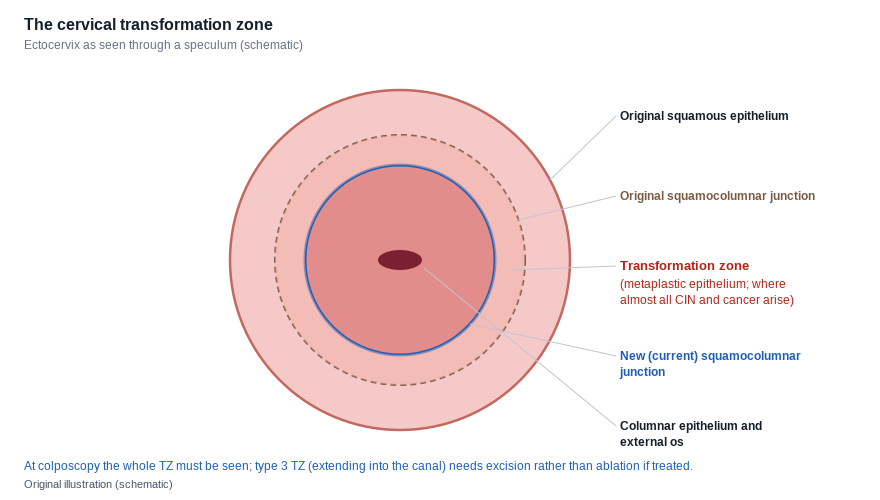
Key facts
- CIN is confined to the epithelium (basement membrane intact); grade = proportion of epithelial thickness with atypia (CIN1 lower third, CIN2 up to two-thirds, CIN3 more than two-thirds or full thickness)
- Two-tier terminology (LAST/WHO): LSIL = CIN1; HSIL = CIN2 and CIN3; p16 immunostaining helps classify equivocal CIN2
- Persistent hrHPV (16 and 18 cause about 70% of cancers) is necessary; HPV E6 degrades p53 and E7 inactivates Rb
- Colposcopy: 3–5% acetic acid shows acetowhite epithelium; coarse mosaicism or punctation suggests high grade; atypical vessels suggest invasion
- CIN1 usually regresses: observe with repeat HPV testing; untreated CIN3 carries about a 30% risk of invasion over 30 years
- LLETZ is the standard treatment for CIN2/3 (aim for a single specimen of about 7–10 mm depth for a type 1 transformation zone)
- Test of cure: HPV test about 6 months after treatment; if negative, recall in 3 years
- Excisional treatment raises preterm birth risk, more so with deeper or repeat excisions; in pregnancy, colposcopy aims only to exclude invasion
Differential diagnosis
| Condition | Clues | Key test |
|---|---|---|
| Cervical ectropion | Red, well-demarcated columnar epithelium around the os; normal screening | Colposcopy normal; no acetowhite change |
| Atrophic or reactive changes | Postmenopausal; cytology borderline, HPV negative | Vaginal oestrogen then repeat cytology |
| Cervicitis (chlamydia, gonorrhoea, trichomonas) | Contact bleeding, discharge, inflammatory cytology | NAAT |
| Immature squamous metaplasia | Thin acetowhite change without coarse vessels | Biopsy histology |
| Cervical glandular intraepithelial neoplasia (adenocarcinoma in situ) | Glandular abnormality on cytology; may be high in canal | Excisional (cone) biopsy |
| Invasive cervical carcinoma | Contact bleeding, atypical vessels, irregular surface | Biopsy; staging |
Exam pearls
Guideline
NHS Cervical Screening Programme: colposcopy and programme management guidance (England, current edition); ASCCP 2019 risk-based management consensus guidelines (with 2024 updates); WHO guideline for screening and treatment of cervical pre-cancer lesions (2nd edition, 2021)
References
- Perkins RB, Guido RS, Castle PE, et al.. 2019 ASCCP risk-based management consensus guidelines for abnormal cervical cancer screening tests and cancer precursors. J Low Genit Tract Dis 2020.
- Falcaro M, Castañon A, Ndlela B, et al.. The effects of the national HPV vaccination programme in England, UK, on cervical cancer and grade 3 cervical intraepithelial neoplasia incidence: a register-based observational study. Lancet 2021.
- NHS England. Cervical screening: programme and colposcopy management. NHS Cervical Screening Programme guidance 2025.
- World Health Organization. WHO guideline for screening and treatment of cervical pre-cancer lesions for cervical cancer prevention, second edition. WHO, Geneva 2021.
- Darragh TM, Colgan TJ, Cox JT, et al.. The Lower Anogenital Squamous Terminology Standardization Project for HPV-associated lesions: background and consensus recommendations. Arch Pathol Lab Med 2012.
- McCredie MR, Sharples KJ, Paul C, et al.. Natural history of cervical neoplasia and risk of invasive cancer in women with cervical intraepithelial neoplasia 3: a retrospective cohort study. Lancet Oncol 2008.
Related topics
By Dr Khalid Seidi (B.Sc., M.D.) · MedEd World Clinical Knowledge library. Original teaching content checked against current guidelines (November 2026); confirm the latest local guidance before clinical use. Not a substitute for clinical judgement.