Clinical Knowledge › Ear, nose and throat › Nose and paranasal sinuses
Choanal atresia
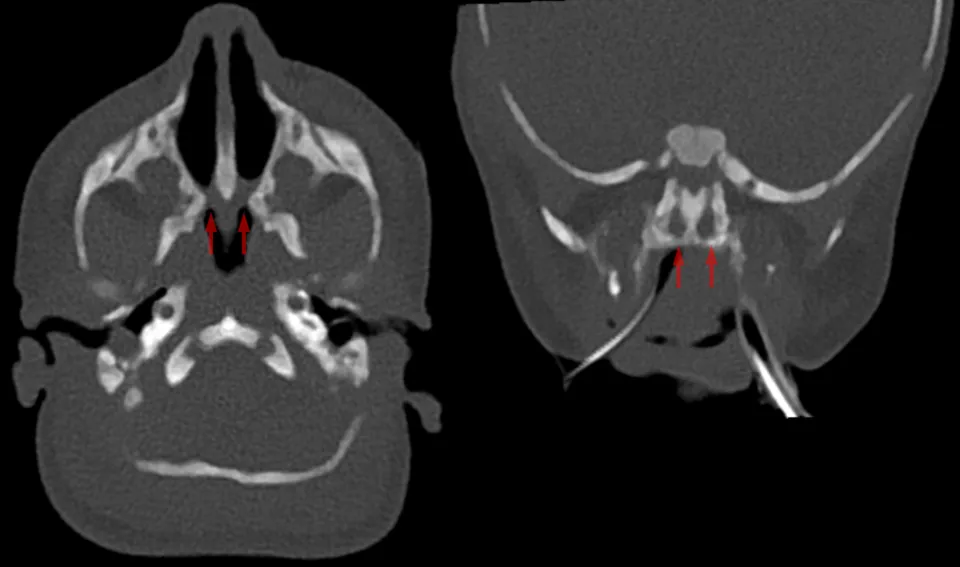
Choanal atresia is a congenital obstruction of the posterior nasal aperture (choana), usually mixed bony-membranous and less often purely bony. It affects about 1 in 5,000–8,000 births, is commoner in girls and is more often unilateral. Because neonates are preferential nasal breathers, bilateral atresia presents at birth with cyclical cyanosis and respiratory distress that improves when the baby cries and worsens during feeding; it is an airway emergency managed with an oral airway or McGovern nipple, or intubation. Unilateral atresia presents later with persistent one-sided mucoid rhinorrhoea and obstruction. A catheter that cannot be passed into the nasopharynx suggests the diagnosis, which is confirmed by nasendoscopy and thin-slice CT after suction and decongestion. About half of affected infants, especially with bilateral disease, have other anomalies, most importantly CHARGE syndrome (CHD7). Transnasal endoscopic repair is preferred: early for bilateral atresia, and usually after 6 months of age for unilateral disease. Restenosis is the main complication.
Patient case, mechanism, investigations, management, flashcards and exam-style questions.Open the lesson →
Key facts
- Incidence about 1 in 5,000–8,000 live births; female predominance; unilateral (often right-sided) is commoner than bilateral
- About 70% are mixed bony-membranous and about 30% purely bony; pure membranous atresia is rare
- Bilateral atresia: cyclical cyanosis relieved by crying and worse with feeding in a newborn
- Failure to pass a 6 Fr catheter through the nose into the nasopharynx is the bedside screening test
- Diagnosis is confirmed by nasendoscopy and axial thin-slice CT after suction and topical decongestion
- CHARGE syndrome: Coloboma, Heart defects, Atresia of choanae, Retardation of growth and development, Genital hypoplasia, Ear anomalies and deafness; CHD7 variants
- Emergency airway in bilateral atresia: oropharyngeal (Guedel) airway or McGovern nipple; intubate if needed
- Transnasal endoscopic repair is the preferred operation; unilateral repair is usually delayed until at least 6 months of age (IPOG 2019)
Differential diagnosis
| Condition | Clues | Key test |
|---|---|---|
| Congenital nasal pyriform aperture stenosis | Narrow anterior nasal aperture; single central maxillary incisor | CT: pyriform aperture width under about 11 mm in term infants |
| Neonatal rhinitis or mucosal oedema | Bilateral congestion that improves with saline and decongestant | Catheter passes after suction |
| Nasal septal dislocation | Deviated columella and asymmetric nostrils after delivery | Examination; reduction |
| Nasolacrimal duct cyst (dacryocystocele) | Medial canthal swelling and cyst in the inferior meatus | Endoscopy, CT |
| Midline nasal mass (encephalocele, glioma, dermoid) | Mass in the nose or at the glabella; enlarges with crying (encephalocele) | MRI before any biopsy |
| Laryngomalacia | Inspiratory stridor worse when feeding and supine, not cyanosis relieved by crying | Flexible laryngoscopy |
| Nasal foreign body (older child) | Unilateral foul-smelling discharge | Anterior rhinoscopy |
Exam pearls
Guideline
International Pediatric Otolaryngology Group (IPOG) consensus recommendations on paediatric choanal atresia care (2019), with 2016 proposal to broaden CHARGE syndrome criteria
References
- Moreddu E, Rizzi M, Adil E, et al.. International Pediatric Otolaryngology Group (IPOG) consensus recommendations: diagnosis, pre-operative, operative and post-operative pediatric choanal atresia care. Int J Pediatr Otorhinolaryngol 2019.
- Hale CL, Niederriter AN, Green GE, Martin DM. Atypical phenotypes associated with pathogenic CHD7 variants and a proposal for broadening CHARGE syndrome clinical diagnostic criteria. Am J Med Genet A 2016.
- Brown OE, Pownell P, Manning SC. Choanal atresia: a new anatomic classification and clinical management applications. Laryngoscope 1996.
- Kwong KM. Current updates on choanal atresia. Front Pediatr 2015.
- Blake KD, Prasad C. CHARGE syndrome. Orphanet J Rare Dis 2006.
- Watkinson JC, Clarke RW, eds.. Scott-Brown's Otorhinolaryngology Head and Neck Surgery. 2018.
Related topics
By Dr Khalid Seidi (B.Sc., M.D.) · MedEd World Clinical Knowledge library. Original teaching content checked against current guidelines (November 2026); confirm the latest local guidance before clinical use. Not a substitute for clinical judgement.