Clinical Knowledge › Ear, nose and throat › Nose and paranasal sinuses
Juvenile nasopharyngeal angiofibroma
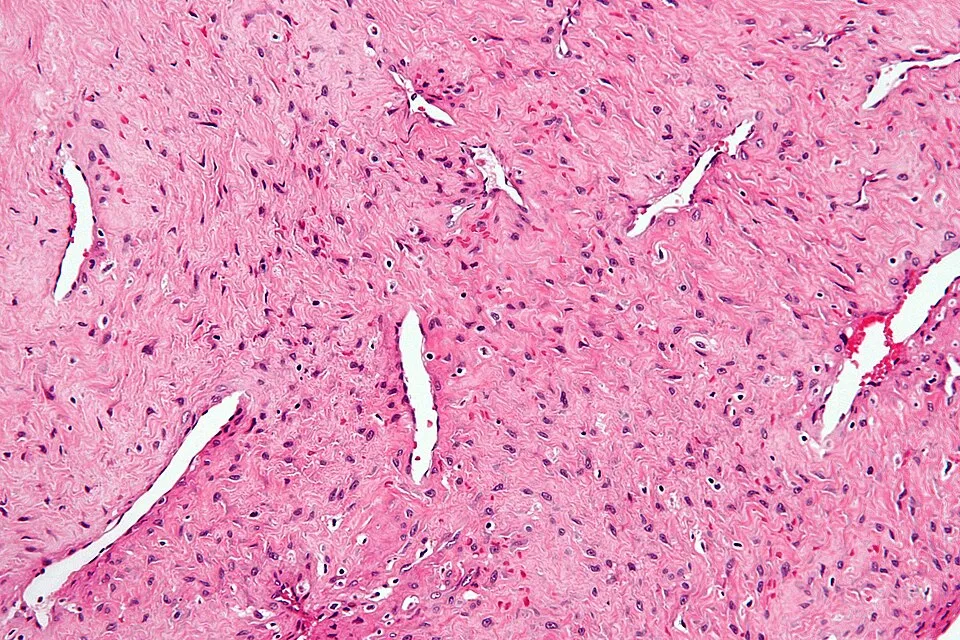
Juvenile nasopharyngeal angiofibroma (JNA) is a benign but locally aggressive, highly vascular fibrovascular tumour that arises at the sphenopalatine foramen and pterygopalatine fossa and occurs almost exclusively in adolescent boys. It presents with progressive unilateral nasal obstruction and recurrent unilateral epistaxis; larger tumours cause rhinorrhoea, hyponasal speech, otitis media with effusion, cheek swelling, proptosis and cranial nerve palsies through spread into the sinuses, infratemporal fossa, orbit and skull base. Endoscopy shows a smooth, red-purple nasopharyngeal mass. Contrast CT and MRI are diagnostic, showing an enhancing mass with flow voids, widening of the pterygopalatine fossa and anterior bowing of the posterior maxillary wall; biopsy is avoided because of the risk of severe bleeding. Treatment is surgical excision, now usually endoscopic, often after preoperative embolisation of the maxillary artery branches. Radiotherapy is reserved for unresectable residual disease. Recurrence is related to stage and skull base invasion and is detected with MRI surveillance.
Patient case, mechanism, investigations, management, flashcards and exam-style questions.Open the lesson →
Key facts
- Occurs almost exclusively in males aged about 10–25 years, peak in mid-adolescence; androgen receptors are expressed
- Originates near the sphenopalatine foramen at the posterolateral nasal wall and pterygopalatine fossa
- Classic presentation: adolescent boy with unilateral nasal obstruction and recurrent profuse unilateral epistaxis
- Imaging: intensely enhancing mass with flow voids; widened pterygopalatine fossa and anterior bowing of the posterior maxillary wall (Holman–Miller sign)
- Avoid biopsy outside theatre because of the risk of torrential haemorrhage; diagnosis is radiological in typical cases
- Main blood supply: internal maxillary artery (external carotid); internal carotid branches supply larger tumours
- Treatment: endoscopic or open excision, usually after preoperative embolisation; radiotherapy for unresectable residual disease
- Staging (Radkowski, Andrews–Fisch, UPMC) predicts blood loss and recurrence; patients with familial adenomatous polyposis have a higher risk
Differential diagnosis
| Condition | Clues | Key test |
|---|---|---|
| Antrochoanal polyp | Unilateral obstruction, no epistaxis, pale mass into the choana | CT: opacified maxillary antrum, no enhancement |
| Adenoid hypertrophy | Bilateral obstruction, younger child, no heavy bleeding | Endoscopy: midline lymphoid tissue |
| Nasopharyngeal carcinoma | Older adult or endemic region, neck nodes, otitis media with effusion | Endoscopic biopsy; EBV DNA |
| Rhabdomyosarcoma | Child, rapidly enlarging mass, cranial nerve palsies | MRI and biopsy |
| Simple anterior epistaxis | Little's area bleeding, no obstruction or mass | Anterior rhinoscopy |
| Pyogenic granuloma or haemangioma | Anterior septal or turbinate red mass | Endoscopy, imaging |
| Encephalocele | Mass enlarging with crying or straining, CSF leak | MRI |
Exam pearls
Guideline
No formal international guideline; expert consensus and staging systems (Radkowski 1996; UPMC endoscopic staging 2010) with systematic reviews of surgical outcomes (2013) and imaging (2023)
References
- Radkowski D, McGill T, Healy GB, Ohlms L, Jones DT. Angiofibroma. Changes in staging and treatment. Arch Otolaryngol Head Neck Surg 1996.
- Snyderman CH, Pant H, Carrau RL, Gardner P. A new endoscopic staging system for angiofibromas. Arch Otolaryngol Head Neck Surg 2010.
- Boghani Z, Husain Q, Kanumuri VV, et al.. Juvenile nasopharyngeal angiofibroma: a systematic review and comparison of endoscopic, endoscopic-assisted, and open resection in 1047 cases. Laryngoscope 2013.
- Baba A, Kurokawa R, Kurokawa M, Srinivasan A. MRI features of sinonasal tract angiofibroma/juvenile nasopharyngeal angiofibroma: case series and systematic review. J Neuroimaging 2023.
- Lim AE, Hurley R, Slim MAM, Melia L. A narrative review of flutamide in juvenile nasopharyngeal angiofibroma. Indian J Otolaryngol Head Neck Surg 2023.
- Felippu AWD, Fontes EB, Felippu AWD, et al.. Juvenile nasopharyngeal angiofibroma: a series of 96 surgical cases. Int Arch Otorhinolaryngol 2024.
Related topics
By Dr Khalid Seidi (B.Sc., M.D.) · MedEd World Clinical Knowledge library. Original teaching content checked against current guidelines (November 2026); confirm the latest local guidance before clinical use. Not a substitute for clinical judgement.