Clinical Knowledge › Ear, nose and throat › Nose and paranasal sinuses
Deviated nasal septum
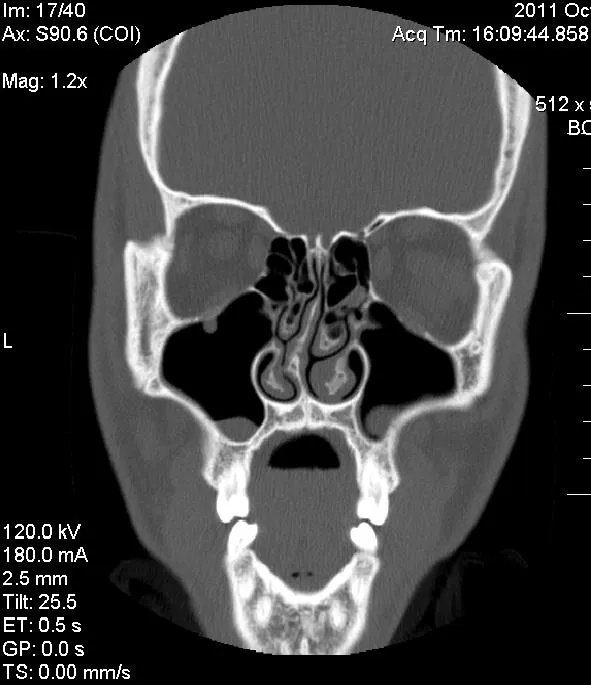
A deviated nasal septum is a displacement of the septal cartilage or bone from the midline. Some deviation is present in most adults and is usually asymptomatic; it matters when it narrows the nasal airway, especially at the internal nasal valve, the narrowest part of the airway. Deviation may be developmental or follow trauma at birth, in childhood or in adulthood. Typical symptoms are chronic nasal obstruction, often one-sided but sometimes worse on the opposite side because of compensatory inferior turbinate hypertrophy, mouth breathing, snoring and, with spurs, epistaxis. Assessment includes external inspection, the Cottle manoeuvre, anterior rhinoscopy before and after decongestant, nasendoscopy and a symptom score such as NOSE or SNOT-22; imaging is not needed for diagnosis. Coexisting rhinitis is treated first with intranasal corticosteroid and saline. Septoplasty, with or without inferior turbinate reduction, is offered for persistent, bothersome obstruction; two randomised trials (Netherlands 2019, UK NAIROS 2024) showed better outcomes than medical treatment alone.
Patient case, mechanism, investigations, management, flashcards and exam-style questions.Open the lesson →
Key facts
- The septum is formed by the quadrangular cartilage, perpendicular plate of the ethmoid, vomer and the maxillary and palatine crests
- Most adults have some septal deviation; only deviation causing symptoms needs treatment
- The internal nasal valve (angle about 10–15°) is the narrowest part of the airway; small deviations here cause large resistance changes
- Contralateral inferior turbinate hypertrophy often fills the wider side, causing bilateral or paradoxical obstruction
- Diagnosis is clinical (rhinoscopy and endoscopy); CT is not required and may misrepresent the degree of deviation
- Treat coexisting allergic or non-allergic rhinitis with intranasal steroid before surgery
- Septoplasty preserves an L-shaped dorsal and caudal strut of at least about 1 cm to prevent saddling
- RCTs (2019 Netherlands; 2024 UK NAIROS) showed septoplasty improves quality of life more than medical management
Differential diagnosis
| Condition | Clues | Key test |
|---|---|---|
| Allergic rhinitis | Itch, sneezing, watery rhinorrhoea, seasonal; pale swollen mucosa | Skin prick tests or specific IgE; response to steroid |
| Non-allergic rhinitis or rhinitis medicamentosa | Decongestant overuse, rebound congestion | History; mucosa shrinks with decongestant |
| Nasal polyps | Bilateral obstruction with anosmia; grey glistening masses | Nasendoscopy; CT sinuses |
| Nasal valve collapse | Lateral wall collapses on inspiration; positive Cottle | Inspection during deep inspiration |
| Adenoid hypertrophy (children) | Mouth breathing, snoring, hyponasal voice | Flexible nasendoscopy |
| Sinonasal tumour | Unilateral obstruction with bloody discharge, pain, cranial nerve signs | Endoscopy, biopsy, CT and MRI |
| Septal haematoma or perforation | Recent trauma or surgery; whistling, crusting | Anterior rhinoscopy |
Exam pearls
Guideline
AAO-HNS Clinical Consensus Statement: Septoplasty with or without inferior turbinate reduction (2015), informed by the 2019 Dutch and 2024 UK NAIROS randomised trials
References
- Han JK, Stringer SP, Rosenfeld RM, et al.. Clinical consensus statement: septoplasty with or without inferior turbinate reduction. Otolaryngol Head Neck Surg 2015.
- van Egmond MMHT, Rovers MM, Hannink G, Hendriks CTM, van Heerbeek N. Septoplasty with or without concurrent turbinate surgery versus non-surgical management for nasal obstruction in adults with a deviated septum: a pragmatic, randomised controlled trial. Lancet 2019.
- Carrie S, Fouweather T, Homer T, et al.. Effectiveness of septoplasty compared to medical management in adults with obstruction associated with a deviated nasal septum: the NAIROS RCT. Health Technol Assess 2024.
- Stewart MG, Witsell DL, Smith TL, et al.. Development and validation of the Nasal Obstruction Symptom Evaluation (NOSE) scale. Otolaryngol Head Neck Surg 2004.
- Watkinson JC, Clarke RW, eds.. Scott-Brown's Otorhinolaryngology Head and Neck Surgery. 2018.
- Papadakis MA, Rabow MW, McQuaid KR, eds.. CURRENT Medical Diagnosis & Treatment 2026. 2026.
Related topics
By Dr Khalid Seidi (B.Sc., M.D.) · MedEd World Clinical Knowledge library. Original teaching content checked against current guidelines (November 2026); confirm the latest local guidance before clinical use. Not a substitute for clinical judgement.