Clinical Knowledge › Ear, nose and throat › Nose and paranasal sinuses
Nasal fracture
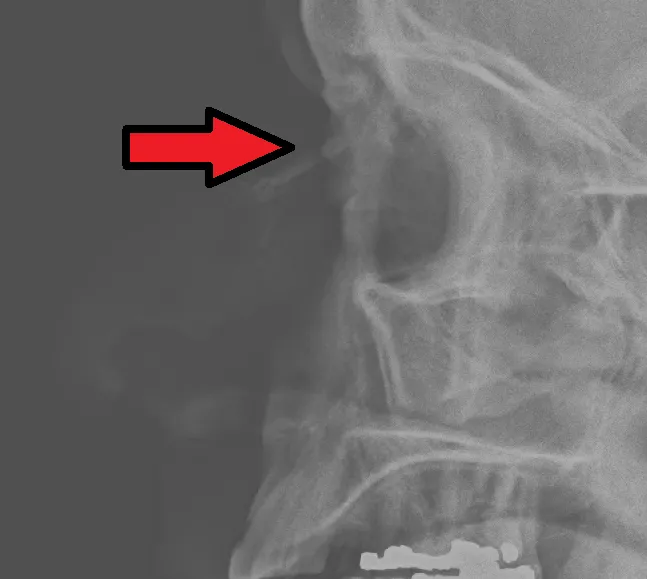
A nasal fracture is a break of the paired nasal bones, often with the frontal processes of the maxillae and the cartilaginous or bony septum. It is the commonest facial fracture and usually follows assault, contact sport, falls or road traffic collisions, mostly in young men. The patient has epistaxis, pain, swelling, periorbital bruising, nasal obstruction and a new deviation or flattening of the nasal dorsum. Assessment first excludes head and cervical spine injury, other facial fractures (naso-orbito-ethmoid, orbital, zygomatic), CSF rhinorrhoea and, above all, a septal haematoma, which needs same-day drainage. Diagnosis is clinical: plain radiographs do not change management and CT is reserved for suspected complex facial injury. Because swelling hides the true shape, patients with suspected displacement are reviewed at about 5–7 days, and displaced fractures with cosmetic or airway problems are treated by closed reduction within about 2 weeks in adults (sooner in children). Fractures that have set are corrected later by septorhinoplasty.
Patient case, mechanism, investigations, management, flashcards and exam-style questions.Open the lesson →
Key facts
- The nasal bones are the most frequently fractured facial bones; assault and sport account for most injuries
- Always look inside the nose: a boggy, fluctuant, bilateral septal swelling is a septal haematoma and needs drainage the same day
- Nasal bone X-rays are not indicated for isolated nasal injury; diagnosis is clinical
- CT of the face is indicated when a naso-orbito-ethmoid, orbital or midface fracture, or CSF leak is suspected
- Swelling masks deformity: reassess displacement at about 5–7 days after injury
- Closed reduction (manipulation under local or general anaesthesia) works best within about 14 days in adults and 7–10 days in children
- Clear watery rhinorrhoea after nasal trauma suggests a CSF leak (test for beta-2 transferrin or beta-trace protein)
- Established deformity after the bones have set is treated by septorhinoplasty, usually at least 3–6 months later
Differential diagnosis
| Condition | Clues | Key test |
|---|---|---|
| Soft tissue nasal contusion | Swelling and bruising without deformity once swelling settles | Reassessment at 5–7 days |
| Septal haematoma | Nasal obstruction with bilateral fluctuant septal swelling | Anterior rhinoscopy; needle aspiration or incision |
| Naso-orbito-ethmoid fracture | Telecanthus, flattened nasal bridge, CSF leak, epiphora | CT face with fine slices |
| Orbital floor (blowout) fracture | Diplopia on upgaze, infraorbital numbness, enophthalmos | CT orbits with coronal views |
| Zygomatic complex fracture | Flattened cheek, step in orbital rim, trismus, cheek numbness | CT face or occipitomental radiographs |
| Pre-existing deviation | Patient photos show the same shape before the injury | Compare with old photographs |
| Le Fort fracture | Mobile midface, malocclusion, extensive swelling | CT face |
Exam pearls
Guideline
UK ENT nasal injury referral pathways (ENT UK/RCEM-aligned regional guidance, 2020s) with NICE NG232 Head injury (2023)
References
- National Institute for Health and Care Excellence. Head injury: assessment and early management (NG232). NICE 2023.
- Sharma SD, Kwame I, Almeyda J. Patient aesthetic satisfaction with timing of nasal fracture manipulation. Surg Res Pract 2014.
- Hollins A, Pyfer B, Breeze J, et al.. Closed reduction of nasoseptal fractures: key concepts for predictable results. Br J Oral Maxillofac Surg 2023.
- Adra B, Al Sheibani S. Nasal bone fracture (NBF): a retrospective study on epidemiology and treatment outcomes in the Omani population. Cureus 2024.
- Stranc MF, Robertson GA. A classification of injuries of the nasal skeleton. Ann Plast Surg 1979.
- Jackson R, Jia W, Edafe O. Evaluation of the management of nasal septal haematoma and abscess: a systematic review. J Laryngol Otol 2025.
Related topics
By Dr Khalid Seidi (B.Sc., M.D.) · MedEd World Clinical Knowledge library. Original teaching content checked against current guidelines (November 2026); confirm the latest local guidance before clinical use. Not a substitute for clinical judgement.