Clinical Knowledge › Ear, nose and throat › Nose and paranasal sinuses
Chronic rhinosinusitis
Chronic rhinosinusitis (CRS) is inflammation of the nose and paranasal sinuses lasting 12 weeks or more, with at least two symptoms – one being nasal blockage or discharge (anterior or posterior), plus facial pain or pressure or reduced smell – confirmed by nasal endoscopy or CT. It affects roughly 5–12% of adults and severely impairs quality of life. EPOS 2020 classifies CRS as primary or secondary, localised or diffuse, and by endotype: type 2 (eosinophilic, usually with nasal polyps, asthma and aspirin sensitivity) or non-type 2. Secondary causes include dental infection, fungal ball, cystic fibrosis, primary ciliary dyskinesia, immunodeficiency and vasculitis. First-line care is daily saline irrigation and an intranasal corticosteroid used with correct technique for at least 6–12 weeks. Failure leads to ENT assessment, CT, short courses of oral steroid for polyps, selective long-term macrolide, endoscopic sinus surgery and, for severe uncontrolled polyposis, biologics such as dupilumab, omalizumab, mepolizumab or tezepelumab. Unilateral symptoms, bleeding and orbital or neurological signs are red flags.
Patient case, mechanism, investigations, management, flashcards and exam-style questions.Open the lesson →
Key facts
- Diagnosis: 2 or more symptoms for 12 weeks or more (one must be blockage or discharge) PLUS endoscopic or CT evidence
- EPOS 2020 classifies by primary/secondary, localised/diffuse and type 2/non-type 2 endotype, beyond 'with or without polyps'
- First line: large-volume saline irrigation and intranasal corticosteroid for 6–12 weeks with correct technique
- Do not use systemic antifungals, and avoid routine long antibiotic courses; macrolides only in selected non-type-2 disease
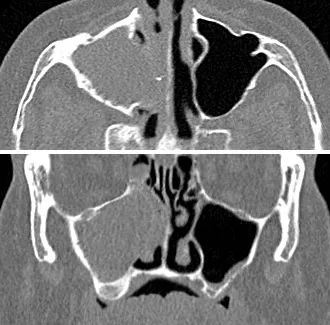
- CT sinuses is the key imaging before surgery and when diagnosis is uncertain, not for routine primary care diagnosis
- Endoscopic sinus surgery is for disease uncontrolled by appropriate medical therapy
- Biologics (anti-IL-4Rα, anti-IgE, anti-IL-5, anti-TSLP) are for severe uncontrolled CRS with nasal polyps after or unsuitable for surgery
- Unilateral disease suggests odontogenic sinusitis, fungal ball, inverted papilloma or malignancy
Differential diagnosis
| Condition | Clues | Key test |
|---|---|---|
| Allergic or non-allergic rhinitis | Congestion and rhinorrhoea without sinus disease | Normal endoscopy and CT; allergy tests |
| Recurrent acute rhinosinusitis | Four or more episodes a year with symptom-free intervals | Endoscopy during episode; CT between episodes |
| Odontogenic sinusitis | Unilateral maxillary, foul smell, dental history | Dental assessment, CT |
| Sinonasal inverted papilloma or malignancy | Unilateral mass, epistaxis, pain, numbness | Endoscopy, CT/MRI, biopsy |
| Granulomatosis with polyangiitis | Crusting, bloody discharge, septal perforation, renal involvement | ANCA, urinalysis, biopsy |
| Midfacial segment pain (tension-type) | Facial pressure with normal endoscopy and CT, no nasal symptoms | Normal CT; neurological pain |
| Cystic fibrosis or primary ciliary dyskinesia | Childhood onset, polyps in a child, bronchiectasis, infertility | Sweat test/CFTR genetics; nasal nitric oxide, ciliary studies |
Exam pearls
Guideline
EPOS 2020 (with EPOS/EUFOREA 2023 biologics update) and AAO-HNS Clinical Practice Guideline: Adult Sinusitis Update (2025)
References
- Fokkens WJ, Lund VJ, Hopkins C, et al.. European Position Paper on Rhinosinusitis and Nasal Polyps 2020. Rhinology 2020.
- Payne SC, McKenna M, Buckley J, et al.. Clinical Practice Guideline: Adult Sinusitis Update. Otolaryngol Head Neck Surg 2025.
- Orlandi RR, Kingdom TT, Smith TL, et al.. International consensus statement on allergy and rhinology: rhinosinusitis 2021. Int Forum Allergy Rhinol 2021.
- Fokkens WJ, Viskens AS, Backer V, et al.. EPOS/EUFOREA update on indication and evaluation of biologics in chronic rhinosinusitis with nasal polyps 2023. Rhinology 2023.
- Chong LY, Head K, Hopkins C, et al.. Saline irrigation for chronic rhinosinusitis. Cochrane Database Syst Rev 2016.
- Chong LY, Head K, Hopkins C, et al.. Intranasal steroids versus placebo or no intervention for chronic rhinosinusitis. Cochrane Database Syst Rev 2016.
Related topics
By Dr Khalid Seidi (B.Sc., M.D.) · MedEd World Clinical Knowledge library. Original teaching content checked against current guidelines (November 2026); confirm the latest local guidance before clinical use. Not a substitute for clinical judgement.