Clinical Knowledge › Ear, nose and throat › Nose and paranasal sinuses
Complications of sinusitis
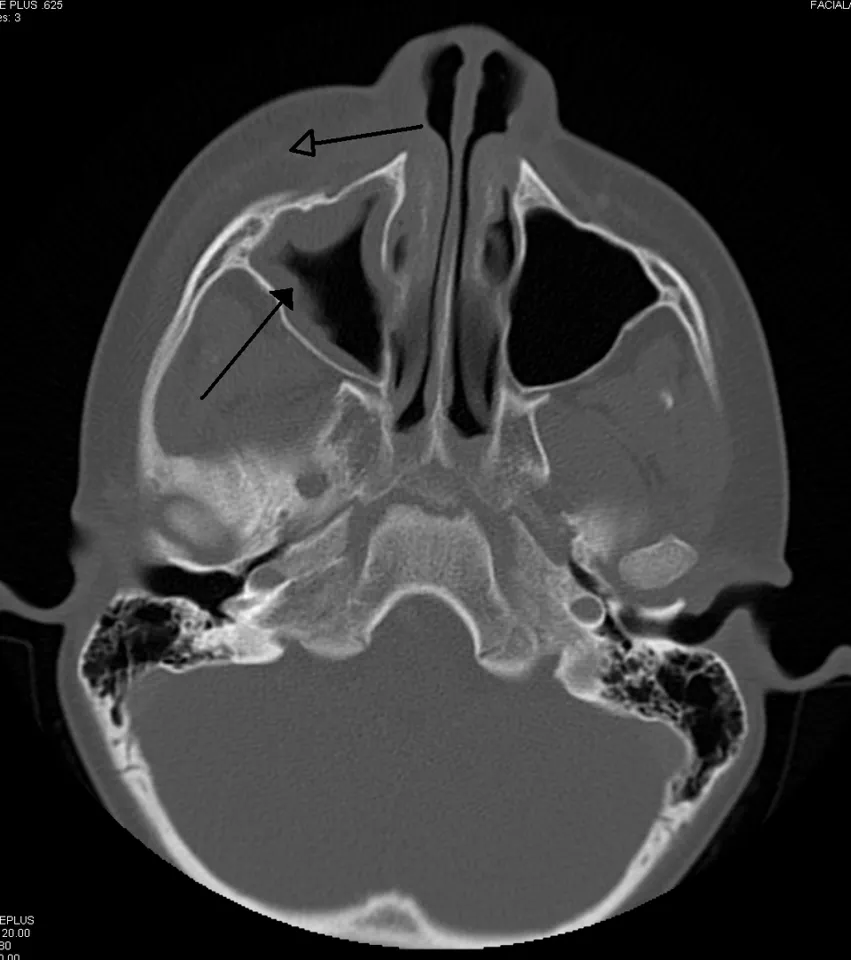
Complications of rhinosinusitis are uncommon but can threaten sight and life. They are orbital (most common, especially in children), intracranial (typically adolescent boys with frontal sinusitis) and bony (frontal osteomyelitis with a subperiosteal abscess – Pott puffy tumour), plus chronic mucoceles. Infection spreads directly through the thin lamina papyracea and dehiscences, or via valveless diploic and ophthalmic veins. Chandler classification grades orbital spread: preseptal cellulitis, orbital cellulitis, subperiosteal abscess, orbital abscess and cavernous sinus thrombosis. Red flags are periorbital swelling, proptosis, painful or restricted eye movements, diplopia, reduced acuity or colour vision, severe frontal headache, forehead swelling, meningism, seizures and reduced consciousness. Management is admission, joint ENT, ophthalmology and (if intracranial) neurosurgical care, IV antibiotics covering streptococci (including the anginosus group), staphylococci and anaerobes, contrast CT (and MRI for intracranial disease), hourly eye observations, and surgical drainage of abscesses or failure to improve.
Patient case, mechanism, investigations, management, flashcards and exam-style questions.Open the lesson →
Key facts
- Orbital complications are the most common; most begin in the ethmoid sinuses via the lamina papyracea
- Chandler I–V: preseptal cellulitis, orbital cellulitis, subperiosteal abscess, orbital abscess, cavernous sinus thrombosis
- Proptosis, painful or restricted eye movement, chemosis, reduced acuity or colour vision = postseptal (orbital) involvement
- Contrast CT of orbits and sinuses is required if postseptal signs, eye cannot be examined, no improvement in 24–48 h, or CNS signs
- Intracranial complications (subdural empyema, epidural abscess, brain abscess, meningitis, venous sinus thrombosis) mainly affect adolescent males with frontal sinusitis
- Pott puffy tumour: frontal bone osteomyelitis with a doughy forehead swelling; image the brain for associated intracranial abscess
- Streptococcus anginosus group, Staphylococcus aureus and anaerobes predominate; use IV ceftriaxone plus metronidazole (± vancomycin)
- Antibiotics for uncomplicated acute sinusitis do not reliably prevent complications; safety-net and refer red flags urgently
Differential diagnosis
| Condition | Clues | Key test |
|---|---|---|
| Allergic periorbital oedema or angioedema | Bilateral, itchy, no fever or tenderness | Clinical; response to antihistamine |
| Dacryocystitis | Tender swelling over the medial canthus below the tendon | Clinical; regurgitation of pus from punctum |
| Insect bite or skin infection | Puncture mark, localised lid cellulitis, no sinusitis | Clinical |
| Orbital tumour or rhabdomyosarcoma | Progressive painless proptosis in a child, no fever | MRI and biopsy |
| Thyroid eye disease | Bilateral, chronic, lid retraction | Thyroid tests, CT muscles |
| Acute invasive fungal sinusitis | Diabetic ketoacidosis or neutropenia, black eschar, cranial neuropathies | Urgent endoscopy and biopsy |
| Bacterial meningitis (non-sinogenic) | Fever, neck stiffness, rash | LP if safe; CT/MRI to look for a sinus source |
Exam pearls
Guideline
NICE NG79 Sinusitis (acute): antimicrobial prescribing (2017), EPOS 2020 red flags and AAO-HNS Adult Sinusitis CPG Update (2025), with Chandler classification
References
- Chandler JR, Langenbrunner DJ, Stevens ER. The pathogenesis of orbital complications in acute sinusitis. Laryngoscope 1970.
- National Institute for Health and Care Excellence. Sinusitis (acute): antimicrobial prescribing (NG79). NICE 2017.
- Fokkens WJ, Lund VJ, Hopkins C, et al.. European Position Paper on Rhinosinusitis and Nasal Polyps 2020. Rhinology 2020.
- Payne SC, McKenna M, Buckley J, et al.. Clinical Practice Guideline: Adult Sinusitis Update. Otolaryngol Head Neck Surg 2025.
- Patel NA, Garber D, Hu S, Kamat A. Systematic review and case report: intracranial complications of pediatric sinusitis. Int J Pediatr Otorhinolaryngol 2016.
- Milinis K, Thompson N, Atsmoni SC, Sharma SD. Sinogenic intracranial suppuration in children: systematic review and meta-analysis. Otolaryngol Head Neck Surg 2022.
Related topics
By Dr Khalid Seidi (B.Sc., M.D.) · MedEd World Clinical Knowledge library. Original teaching content checked against current guidelines (November 2026); confirm the latest local guidance before clinical use. Not a substitute for clinical judgement.