Clinical Knowledge › Surgery › Trauma and emergency surgery
Compartment syndrome
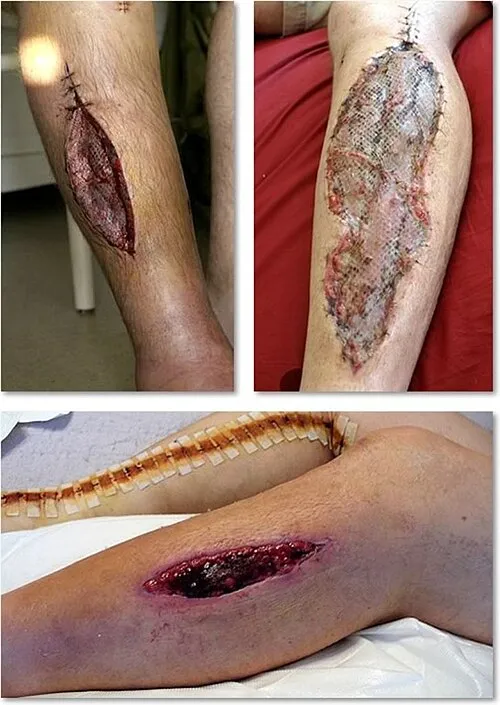
Acute compartment syndrome is a surgical emergency: pressure inside a closed osteofascial compartment rises until capillary perfusion stops and muscle and nerve become ischaemic within hours. Tibial shaft fractures are the commonest cause, followed by forearm and distal radius fractures, crush injury, tight casts or dressings, reperfusion after vascular repair and circumferential burns. The key symptom is pain out of proportion to the injury that escalates despite analgesia, with pain on passive stretch of the compartment muscles and a tense swollen limb; paraesthesia follows, while pallor, paralysis and pulselessness are late signs and distal pulses are usually present. Diagnosis is clinical; pressure measurement helps when the patient cannot be assessed (perfusion gradient below 30 mmHg supports it). Management is to release all dressings and casts to skin, keep the limb at heart level, correct hypotension and, if signs persist, perform emergency fasciotomy of all compartments, followed by debridement, delayed closure and treatment of rhabdomyolysis.
Patient case, mechanism, investigations, management, flashcards and exam-style questions.Open the lesson →
Key facts
- Pain out of proportion to the injury and pain on passive stretch are the earliest and most sensitive clinical features
- Distal pulses and capillary refill are usually normal: arterial pressure far exceeds compartment pressure until very late
- Tibial shaft fracture is the commonest cause; young men with large muscle bulk are at highest risk
- A perfusion gradient (ΔP = diastolic BP − compartment pressure) below 30 mmHg supports the diagnosis; BOAST also advises considering decompression if absolute pressure exceeds 40 mmHg
- First step for a suspected case: split casts and remove circumferential dressings down to skin and keep the limb at heart level, then reassess within 30 minutes
- Fasciotomy must release every compartment (four in the leg via two incisions) and should follow the decision without delay
- Irreversible muscle necrosis begins after about 6 hours of ischaemia; the result is contracture, nerve palsy, infection or amputation
- Rhabdomyolysis from muscle necrosis causes hyperkalaemia, myoglobinuria and acute kidney injury
Differential diagnosis
| Condition | Clues | Key test |
|---|---|---|
| Pain from the fracture alone | Pain settles with splintage and analgesia, soft compartments | Serial examination; pressure if doubt |
| Acute arterial injury or acute limb ischaemia | Pulseless, pale, cold limb early | Ankle-brachial index, CT angiography |
| Deep vein thrombosis | Calf swelling and tenderness, no stretch pain, soft compartments | Compression ultrasound |
| Cellulitis or necrotising fasciitis | Fever, erythema, crepitus, rapid systemic toxicity | CRP, CK, imaging, surgical exploration |
| Peripheral nerve injury (e.g. common peroneal) | Isolated deficit from injury time, compartment soft | Clinical; nerve studies later |
| Rhabdomyolysis without compartment syndrome | Myalgia, very high CK, compartments soft | Clinical examination and pressures |
| Chronic exertional compartment syndrome | Reproducible exercise pain relieved by rest | Pre- and post-exercise pressure testing |
Exam pearls
Guideline
BOAST Diagnosis and management of compartment syndrome of the extremities (British Orthopaedic Association, 2014, updated July 2025) and AAOS Management of acute compartment syndrome clinical practice guideline (2018)
References
- British Orthopaedic Association. BOAST: Diagnosis and management of compartment syndrome of the extremities. British Orthopaedic Association Standards for Trauma and Orthopaedics 2025.
- American Academy of Orthopaedic Surgeons. Management of acute compartment syndrome: evidence-based clinical practice guideline. AAOS 2018.
- McQueen MM, Court-Brown CM. Compartment monitoring in tibial fractures. The pressure threshold for decompression. J Bone Joint Surg Br 1996.
- Via AG, Oliva F, Spoliti M, Maffulli N. Acute compartment syndrome. Muscles Ligaments Tendons J 2015.
- Bosch X, Poch E, Grau JM. Rhabdomyolysis and acute kidney injury. N Engl J Med 2009.
- American College of Surgeons Committee on Trauma. Advanced Trauma Life Support (ATLS) Student Course Manual, 11th edition. 2025.
Related topics
By Dr Khalid Seidi (B.Sc., M.D.) · MedEd World Clinical Knowledge library. Original teaching content checked against current guidelines (November 2026); confirm the latest local guidance before clinical use. Not a substitute for clinical judgement.