Clinical Knowledge › Surgery › Trauma and emergency surgery
Penetrating trauma
Penetrating trauma is injury caused by an object breaching the skin, most commonly knives (low energy) and firearms (low or high energy). The damage depends on the track and on the energy transferred: stab wounds injure only the structures they touch, whereas bullets cause cavitation, fragmentation and injury remote from the track. The neck, chest, abdomen and limbs each have predictable life-threatening patterns: airway and vascular injury in the neck, cardiac tamponade and massive haemothorax in the chest, haemorrhage and hollow viscus perforation in the abdomen, and arterial bleeding in the limbs. Management follows the ATLS xABCDE primary survey with early control of external bleeding, blood-based resuscitation and a decision driven by physiology. Unstable patients, peritonitis, evisceration and hard signs of vascular injury mean the operating theatre. Stable patients with abdominal stab wounds can often be managed selectively with serial examination, CT or laparoscopy. Resuscitative thoracotomy is reserved mainly for penetrating chest injury with recent loss of output. Tetanus, antibiotics, forensic documentation and safeguarding complete care.
Patient case, mechanism, investigations, management, flashcards and exam-style questions.Open the lesson →
Key facts
- Stab wounds cause injury along the track only; gunshot wounds transfer energy (kinetic energy = ½mv²), causing temporary cavitation, fragmentation and remote injury
- Haemodynamic instability, peritonitis, evisceration and impalement are indications for immediate laparotomy in penetrating abdominal trauma
- Most stable patients with abdominal stab wounds and no peritonitis can be managed selectively with serial examination, CT or diagnostic laparoscopy
- A wound inside the 'cardiac box' with shock suggests cardiac tamponade (Beck triad: hypotension, raised JVP, muffled heart sounds); surgical decompression is definitive
- Chest drain output of 1500 mL immediately, or about 200 mL/h for 2–4 hours, or persistent transfusion need indicates thoracotomy
- Hard signs of vascular injury (pulsatile bleeding, expanding haematoma, absent distal pulses, bruit or thrill, distal ischaemia) mean direct operative exploration
- Stable penetrating neck injuries that breach platysma without hard signs are assessed with CT angiography (the 'no-zone' approach)
- Leave impaled objects in place until removed in theatre; give tetanus prophylaxis and antibiotics as indicated
Differential diagnosis
| Condition | Clues | Key test |
|---|---|---|
| Cardiac tamponade | Wound in cardiac box, hypotension, raised JVP, muffled heart sounds | eFAST: pericardial fluid |
| Tension pneumothorax | Hypotension, absent breath sounds, tracheal deviation, hyper-resonance | Clinical; immediate decompression |
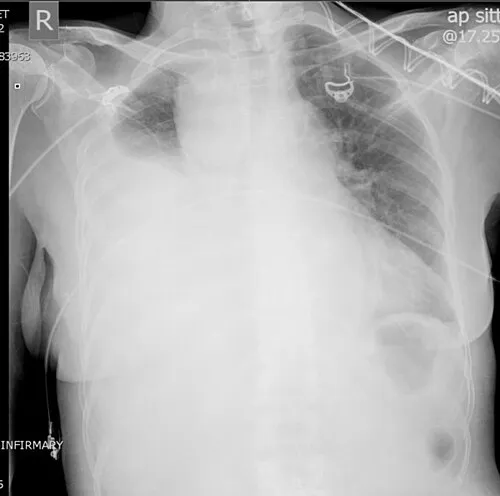
| Massive haemothorax | Shock, dull percussion, absent breath sounds | eFAST or chest X-ray; chest drain output |
| Intra-abdominal haemorrhage | Shock, distension, positive FAST | FAST; laparotomy if unstable |
| Hollow viscus injury | Evolving peritonism, fever, free air | Serial examination, CT with contrast, laparoscopy |
| Diaphragmatic injury | Left thoracoabdominal stab; often silent | Diagnostic laparoscopy |
| Peripheral arterial injury | Pulsatile bleeding, absent pulses, ABPI below 0.9 | Clinical hard signs; CT angiography if soft signs |
| Superficial wound not breaching fascia or peritoneum | No peritonism, stable | Local wound exploration, observation |
Exam pearls
Guideline
ATLS 11th edition (American College of Surgeons, 2025); EAST guideline on selective non-operative management of penetrating abdominal trauma (2010) and emergency department thoracotomy (2015); WSES-AAST thoracic trauma guidelines (2025); WSES bowel injury guidelines (2022); European bleeding and coagulopathy guideline, 6th edition (2023)
References
- American College of Surgeons Committee on Trauma. Advanced Trauma Life Support (ATLS) Student Course Manual. 2025.
- National Institute for Health and Care Excellence. Major trauma: assessment and initial management (NG39). NICE 2016.
- Como JJ, Bokhari F, Chiu WC, et al.. Practice management guidelines for selective nonoperative management of penetrating abdominal trauma. J Trauma 2010.
- Seamon MJ, Haut ER, Van Arendonk K, et al.. An evidence-based approach to patient selection for emergency department thoracotomy: a practice management guideline from the Eastern Association for the Surgery of Trauma. J Trauma Acute Care Surg 2015.
- Coccolini F, Cremonini C, Moore EE, et al.. Thoracic trauma WSES-AAST guidelines. World J Emerg Surg 2025.
- Smyth L, Bendinelli C, Lee N, et al.. WSES guidelines on blunt and penetrating bowel injury: diagnosis, investigations, and treatment. World J Emerg Surg 2022.
Related topics
By Dr Khalid Seidi (B.Sc., M.D.) · MedEd World Clinical Knowledge library. Original teaching content checked against current guidelines (November 2026); confirm the latest local guidance before clinical use. Not a substitute for clinical judgement.