Clinical Knowledge › Surgery › Trauma and emergency surgery
Liver injury
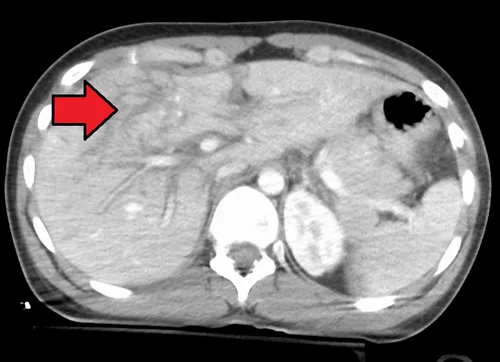
The liver is one of the two solid organs most often injured in abdominal trauma and the organ most commonly injured by penetrating wounds of the upper abdomen. Its size, fixed position under the right lower ribs and friable parenchyma make it vulnerable to compression and deceleration, and its dual blood supply and short hepatic veins can cause torrential bleeding. Patients present with right upper quadrant pain, right lower rib fractures and haemorrhagic shock. Haemodynamically unstable patients with haemoperitoneum need laparotomy, where bleeding is controlled by manual compression, the Pringle manoeuvre and perihepatic packing as part of damage-control surgery. Stable patients have contrast-enhanced CT, graded by the AAST 2018 Organ Injury Scale and WSES 2020 classes; most are managed non-operatively, with angioembolisation for active extravasation or pseudoaneurysm. Complications of high-grade injury include bile leak and biloma, bile peritonitis, haemobilia, abscess and delayed bleeding, usually treated by percutaneous drainage, ERCP or embolisation rather than open surgery.
Patient case, mechanism, investigations, management, flashcards and exam-style questions.Open the lesson →
Key facts
- The liver is commonly injured in both blunt and penetrating abdominal trauma; the right lobe (posterior segments VI and VII) is most often affected in blunt injury
- Physiology decides management: unstable with haemoperitoneum = laparotomy; stable = CT with IV contrast and usually non-operative management
- Non-operative management succeeds in most haemodynamically stable patients, including many high-grade injuries
- Angioembolisation treats arterial contrast extravasation or pseudoaneurysm in stable or responding patients
- The Pringle manoeuvre (clamping the hepatoduodenal ligament) controls hepatic artery and portal venous inflow; continued bleeding suggests hepatic vein or retrohepatic IVC injury
- Perihepatic packing is the cornerstone of damage control for severe liver haemorrhage; packs are removed at a planned re-look after physiology is restored
- Bile leak and biloma are the commonest complications of high-grade injury; treat with percutaneous drainage and ERCP with sphincterotomy or stent
- Haemobilia (Quincke triad: right upper quadrant pain, jaundice, upper GI bleeding) is treated by angioembolisation
Differential diagnosis
| Condition | Clues | Key test |
|---|---|---|
| Splenic injury | Left upper quadrant pain, Kehr sign, left rib fractures | CT with IV contrast |
| Right renal injury | Flank pain, haematuria | CT with delayed excretory phase |
| Duodenal or pancreatic head injury | Epigastric blow, retroperitoneal air or fluid | CT; repeat imaging; amylase |
| Gallbladder injury | Right upper quadrant pain, pericholecystic fluid, bile peritonitis | CT; HIDA scan; laparoscopy |
| Right haemothorax or diaphragmatic injury | Right basal dullness, hypoxia | eFAST, chest X-ray, CT |
| Spontaneous hepatic haemorrhage | Minimal trauma, pregnancy with HELLP syndrome, hepatic adenoma or HCC | Ultrasound or CT; platelets and liver tests |
Exam pearls
Guideline
WSES-AAST liver trauma guidelines (2020), EAST non-operative management of blunt hepatic injury (2012), APSA updated paediatric liver and spleen injury guidelines (2023), AAST Organ Injury Scale 2018 update, ATLS 11th edition (2025), European bleeding guideline 6th edition (2023)
References
- Coccolini F, Coimbra R, Ordonez C, et al.. Liver trauma: WSES 2020 guidelines. World J Emerg Surg 2020.
- Stassen NA, Bhullar I, Cheng JD, et al.. Nonoperative management of blunt hepatic injury: an Eastern Association for the Surgery of Trauma practice management guideline. J Trauma Acute Care Surg 2012.
- Kozar RA, Crandall M, Shanmuganathan K, et al.. Organ injury scaling 2018 update: Spleen, liver, and kidney. J Trauma Acute Care Surg 2018.
- Williams RF, Grewal H, Jamshidi R, et al.. Updated APSA Guidelines for the Management of Blunt Liver and Spleen Injuries. J Pediatr Surg 2023.
- American College of Surgeons Committee on Trauma. Advanced Trauma Life Support (ATLS) Student Course Manual. 2025.
- Rossaint R, Afshari A, Bouillon B, et al.. The European guideline on management of major bleeding and coagulopathy following trauma: sixth edition. Crit Care 2023.
Related topics
By Dr Khalid Seidi (B.Sc., M.D.) · MedEd World Clinical Knowledge library. Original teaching content checked against current guidelines (November 2026); confirm the latest local guidance before clinical use. Not a substitute for clinical judgement.