Clinical Knowledge › Surgery › Trauma and emergency surgery
Flail chest and rib fractures
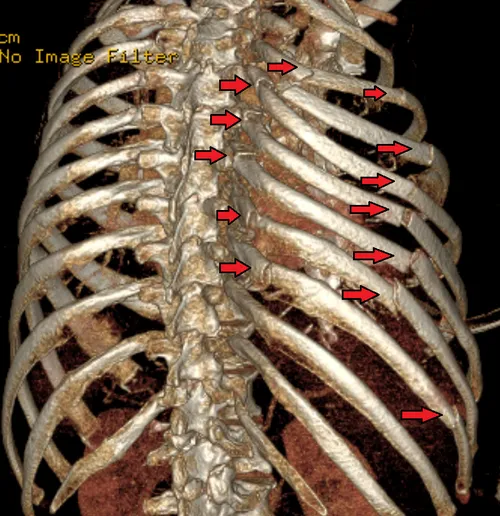
Rib fractures are the commonest injury after blunt chest trauma, and in older adults even a few fractured ribs can be lethal: pain stops deep breathing and coughing, leading to atelectasis, pneumonia and respiratory failure, and each additional fracture increases the risk. Flail chest occurs when three or more adjacent ribs are each broken in two or more places, so a segment of chest wall moves paradoxically, inward on inspiration; the underlying pulmonary contusion usually causes more hypoxia than the flail itself. Fractures of the first and second ribs signal high-energy injury and possible great vessel or brachial plexus damage, whereas lower rib fractures accompany liver, spleen and kidney injuries. CT is more sensitive than a chest radiograph. Management centres on multimodal analgesia (often regional blocks or epidural), physiotherapy and early detection of pneumothorax, haemothorax and respiratory failure. Surgical stabilisation of rib fractures (SSRF) is recommended for selected flail chest, particularly in ventilated patients, where it shortens ventilation and lowers pneumonia; for non-flail fractures benefit is uncertain and selection is key.
Patient case, mechanism, investigations, management, flashcards and exam-style questions.Open the lesson →
Key facts
- Flail chest: 3 or more adjacent ribs each fractured in 2 or more places, giving a segment that moves paradoxically
- Pulmonary contusion beneath the flail is the main cause of hypoxia and may worsen over 24–72 hours
- Older adults with 3 or more rib fractures need admission, often to a monitored bed: pneumonia and mortality rise with each additional fracture
- First and second rib fractures indicate high-energy injury: look for aortic, subclavian vessel and brachial plexus injury
- Ribs 9–12 fractures: suspect liver (right), spleen (left) and kidney injury
- CT chest detects far more rib fractures, pneumothoraces and contusions than a chest radiograph
- Analgesia is the cornerstone: paracetamol, NSAIDs if safe, opioids and regional techniques (thoracic epidural, paravertebral, erector spinae or serratus anterior plane blocks)
- SSRF for flail chest, especially in ventilated patients, reduces ventilator days, pneumonia, ICU stay and tracheostomy (EAST 2017); routine fixation of non-flail fractures is not supported
Differential diagnosis
| Condition | Clues | Key test |
|---|---|---|
| Simple rib fracture(s) | Localised tenderness, pain on breathing, no paradoxical movement | Chest X-ray; CT if multiple or high-risk |
| Flail chest | Paradoxical segment, crepitus, hypoxia, multiple fractures on CT | CT chest with 3D reconstruction |
| Pulmonary contusion | Hypoxia and patchy opacity developing over hours, haemoptysis | CT chest, serial ABG |
| Haemothorax / pneumothorax | Reduced breath sounds, dullness or hyper-resonance | Chest X-ray, eFAST, CT |
| Sternal fracture with blunt cardiac injury | Anterior chest pain after steering wheel impact, arrhythmia | ECG and troponin; lateral sternal X-ray or CT |
| Costochondral injury or chest wall contusion | Tenderness without fracture on imaging | CT or ultrasound |
| Pathological rib fracture | Minimal trauma, known malignancy, myeloma, osteoporosis | CT, bone profile, protein electrophoresis |
Exam pearls
Guideline
EAST practice management guideline: operative fixation of rib fractures after blunt trauma (2017); EAST/TSACO guideline on pain management for blunt thoracic trauma (2016); ATLS 11th edition (American College of Surgeons, 2025); NICE NG39 Major trauma (2016)
References
- Kasotakis G, Hasenboehler EA, Streib EW, et al.. Operative fixation of rib fractures after blunt trauma: a practice management guideline from the Eastern Association for the Surgery of Trauma. J Trauma Acute Care Surg 2017.
- Galvagno SM Jr, Smith CE, Varon AJ, et al.. Pain management for blunt thoracic trauma: a joint practice management guideline from the Eastern Association for the Surgery of Trauma and Trauma Anesthesiology Society. J Trauma Acute Care Surg 2016.
- American College of Surgeons Committee on Trauma. Advanced Trauma Life Support (ATLS) Student Course Manual. 11th ed. Chicago: American College of Surgeons 2025.
- Tanaka H, Yukioka T, Yamaguti Y, et al.. Surgical stabilization of internal pneumatic stabilization? A prospective randomized study of management of severe flail chest patients. J Trauma 2002.
- Marasco SF, Balogh ZJ, Wullschleger ME, et al.. Rib fixation in non-ventilator-dependent chest wall injuries: a prospective randomized trial. J Trauma Acute Care Surg 2022.
- Meyer DE, Harvin JA, Vincent L, et al.. Randomized controlled trial of surgical rib fixation to nonoperative management in severe chest wall injury. Ann Surg 2023.
Related topics
By Dr Khalid Seidi (B.Sc., M.D.) · MedEd World Clinical Knowledge library. Original teaching content checked against current guidelines (November 2026); confirm the latest local guidance before clinical use. Not a substitute for clinical judgement.