Clinical Knowledge › Internal medicine › Pulmonology › Respiratory infections
COVID-19
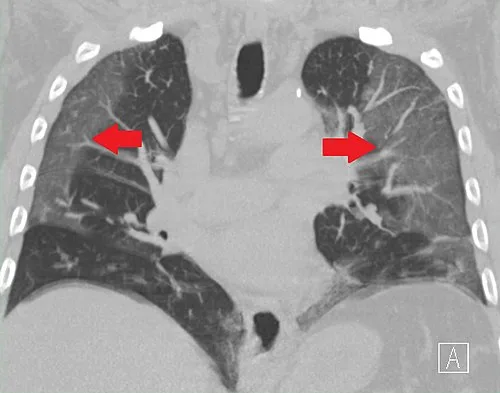
COVID-19 is the illness caused by SARS-CoV-2, an enveloped RNA betacoronavirus that enters cells through the ACE2 receptor and spreads by respiratory droplets and aerosols. Most Omicron-lineage infections are mild, but older adults, immunocompromised people and those with chronic heart, lung, kidney or metabolic disease remain at risk of viral pneumonia, hypoxaemic respiratory failure, ARDS, thrombosis and death. Diagnosis is by nucleic acid amplification (RT-PCR) or rapid antigen testing; chest imaging typically shows bilateral, peripheral ground-glass opacities. Management is stratified by severity and risk. Non-severe illness in high-risk patients is treated early with an oral antiviral, usually nirmatrelvir–ritonavir within 5 days of symptom onset. Patients who need oxygen receive dexamethasone, with an IL-6 receptor blocker or baricitinib if they are deteriorating, plus thromboprophylaxis and oxygen escalation. Antibiotics are not given routinely. Vaccination and infection control prevent disease.
Patient case, mechanism, investigations, management, flashcards and exam-style questions.Open the lesson →
Key facts
- SARS-CoV-2 binds ACE2 via its spike protein; host TMPRSS2 primes entry into respiratory epithelium and type II pneumocytes
- Incubation is usually 2–5 days with Omicron lineages (up to 14 days); infectiousness peaks around symptom onset
- RT-PCR on a nasopharyngeal or combined nose–throat swab is the reference test; antigen tests are fast but less sensitive
- WHO severe disease: SpO2 below 90% on air, respiratory rate above 30/min or signs of severe respiratory distress
- High-risk non-severe patients: nirmatrelvir–ritonavir 300/100 mg twice daily for 5 days, started within 5 days of symptoms
- Dexamethasone 6 mg daily for up to 10 days reduces mortality only in patients needing oxygen or ventilation (RECOVERY)
- Add tocilizumab or baricitinib to corticosteroids in severe or critical disease with rising oxygen needs
- Ivermectin, hydroxychloroquine, convalescent plasma and routine empirical antibiotics are not recommended
Differential diagnosis
| Condition | Clues | Key test |
|---|---|---|
| Influenza | Abrupt fever and myalgia in winter season; often indistinguishable clinically | Multiplex respiratory PCR (SARS-CoV-2, influenza, RSV) |
| Bacterial community-acquired pneumonia | Purulent sputum, lobar consolidation, high neutrophil count and procalcitonin | Chest X-ray, sputum and blood cultures, urinary antigens |
| Pulmonary embolism | Sudden breathlessness or pleuritic pain, hypoxaemia out of proportion to imaging | CT pulmonary angiography |
| Acute heart failure | Orthopnoea, raised JVP, bilateral basal crackles, cardiomegaly | NT-proBNP, echocardiography |
| Pneumocystis pneumonia | HIV or immunosuppression, subacute dyspnoea, desaturation on exertion | Induced sputum or BAL PCR, beta-D-glucan, CD4 count |
| Atypical pneumonia (Mycoplasma, Legionella) | Legionella: hyponatraemia, diarrhoea, travel; Mycoplasma: young adults, cold agglutinins | Legionella urinary antigen, respiratory PCR |
| Organising pneumonia | Migratory consolidation that persists weeks after infection, steroid-responsive | HRCT pattern, bronchoscopy or biopsy |
Exam pearls
Guideline
WHO Therapeutics and COVID-19 living guideline (August 2025) and WHO Clinical management of COVID-19 living guideline (June 2025), with IDSA COVID-19 treatment guideline (living)
References
- World Health Organization. Therapeutics and COVID-19: living guideline, August 2025. 2025.
- World Health Organization. Clinical management of COVID-19: living guideline, June 2025. 2025.
- Bhimraj A, Morgan RL, Shumaker AH, et al.. Infectious Diseases Society of America guidelines on the treatment and management of patients with COVID-19. Clin Infect Dis 2020.
- RECOVERY Collaborative Group; Horby P, Lim WS, Emberson JR, et al.. Dexamethasone in hospitalized patients with Covid-19. N Engl J Med 2021.
- RECOVERY Collaborative Group. Tocilizumab in patients admitted to hospital with COVID-19 (RECOVERY): a randomised, controlled, open-label, platform trial. Lancet 2021.
- Hammond J, Leister-Tebbe H, Gardner A, et al.. Oral nirmatrelvir for high-risk, nonhospitalized adults with Covid-19. N Engl J Med 2022.
Related topics
By Dr Khalid Seidi (B.Sc., M.D.) · MedEd World Clinical Knowledge library. Original teaching content checked against current guidelines (November 2026); confirm the latest local guidance before clinical use. Not a substitute for clinical judgement.