Clinical Knowledge › Internal medicine › Pulmonology › Respiratory infections
Non-tuberculous mycobacterial lung disease
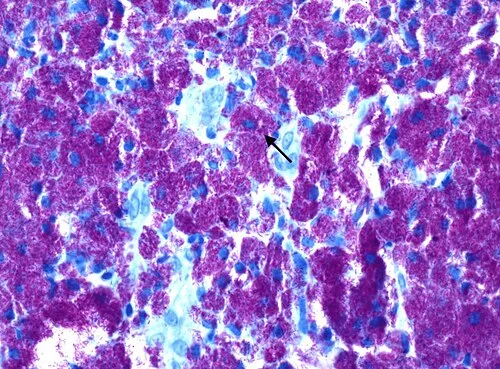
Non-tuberculous mycobacteria (NTM) are environmental acid-fast bacilli found in soil and water, including household plumbing. They are inhaled from the environment and are not normally spread from person to person. Mycobacterium avium complex (MAC) causes most lung disease worldwide, followed by M. abscessus, M. kansasii and M. xenopi. Disease affects people with damaged airways or weak defences: bronchiectasis, COPD, cystic fibrosis, previous tuberculosis and immunosuppression. There are two classic patterns: fibrocavitary upper-lobe disease in older male smokers, which mimics tuberculosis, and nodular-bronchiectatic disease in slender older women without prior lung disease. Diagnosis needs symptoms, typical imaging, exclusion of other causes and repeated positive cultures, because a single isolate may be colonisation or contamination. Not every patient needs treatment. When treatment is indicated, MAC gets azithromycin, rifampicin and ethambutol until 12 months after cultures turn negative, with amikacin added for cavitary or refractory disease. Never give macrolide monotherapy.
Patient case, mechanism, investigations, management, flashcards and exam-style questions.Open the lesson →
Key facts
- NTM come from soil and water; MAC causes most NTM lung disease and person-to-person spread is not a feature (except possibly M. abscessus in cystic fibrosis)
- Two phenotypes: fibrocavitary (older male smokers with COPD) and nodular-bronchiectatic (thin postmenopausal women, middle lobe and lingula)
- Diagnosis needs symptoms, compatible imaging, exclusion of other disease and at least 2 positive sputum cultures (or 1 bronchoscopic sample) with the same species
- A diagnosis of NTM disease does not automatically mean treatment: decide on severity, progression, species and patient goals
- MAC regimen: azithromycin + rifampicin + ethambutol; three times weekly for non-cavitary nodular disease, daily with IV amikacin for cavitary or severe disease
- Treat for 12 months after sputum culture conversion; test macrolide and amikacin susceptibility
- Amikacin liposome inhalation suspension is added for refractory MAC (CONVERT) and improved culture conversion in newly diagnosed MAC (ENCORE, 2026)
- M. abscessus is the hardest to treat: inducible erm(41) macrolide resistance needs multidrug IV induction and often surgery
Differential diagnosis
| Condition | Clues | Key test |
|---|---|---|
| Pulmonary tuberculosis | Contact or endemic exposure, upper-lobe cavities, faster progression | Xpert MTB/RIF or other NAAT on sputum; culture speciation |
| Lung cancer | Smoker with enlarging solitary mass, weight loss, haemoptysis | CT, PET-CT, biopsy |
| Bronchiectasis exacerbation with Pseudomonas | Purulent sputum, recurrent exacerbations, no AFB growth | Sputum bacterial culture |
| Chronic pulmonary aspergillosis | Cavity with fungal ball or pleural thickening, positive Aspergillus IgG | Aspergillus-specific IgG, CT |
| Granulomatosis with polyangiitis | Nodules that cavitate, sinus and renal disease | ANCA (PR3), urinalysis, biopsy |
| Hypersensitivity pneumonitis ('hot tub lung') | Hot tub exposure, diffuse centrilobular nodules, improves with avoidance | HRCT, BAL lymphocytosis, exposure history |
Exam pearls
Guideline
ATS/ERS/ESCMID/IDSA clinical practice guideline on treatment of NTM pulmonary disease (2020), BTS NTM-PD guideline (2017) and ATS/IDSA diagnostic criteria (2007)
References
- Daley CL, Iaccarino JM, Lange C, et al.. Treatment of nontuberculous mycobacterial pulmonary disease: an official ATS/ERS/ESCMID/IDSA clinical practice guideline. Clin Infect Dis 2020.
- Haworth CS, Banks J, Capstick T, et al.. British Thoracic Society guidelines for the management of non-tuberculous mycobacterial pulmonary disease (NTM-PD). Thorax 2017.
- Griffith DE, Aksamit T, Brown-Elliott BA, et al.. An official ATS/IDSA statement: diagnosis, treatment, and prevention of nontuberculous mycobacterial diseases. Am J Respir Crit Care Med 2007.
- Jeong BH, Jeon K, Park HY, et al.. Intermittent antibiotic therapy for nodular bronchiectatic Mycobacterium avium complex lung disease. Am J Respir Crit Care Med 2015.
- Griffith DE, Eagle G, Thomson R, et al.. Amikacin liposome inhalation suspension for treatment-refractory lung disease caused by Mycobacterium avium complex (CONVERT): a prospective, open-label, randomized study. Am J Respir Crit Care Med 2018.
- Daley CL, Morimoto K, Thomson R, et al.. Amikacin liposome inhalation suspension in newly diagnosed Mycobacterium avium complex lung disease: a phase 3b, double-blind, randomized clinical trial (ENCORE). Am J Respir Crit Care Med 2026.
Related topics
By Dr Khalid Seidi (B.Sc., M.D.) · MedEd World Clinical Knowledge library. Original teaching content checked against current guidelines (November 2026); confirm the latest local guidance before clinical use. Not a substitute for clinical judgement.