Clinical Knowledge › Internal medicine › Pulmonology › Respiratory infections
Endemic fungal lung infections (histoplasmosis, blastomycosis, coccidioidomycosis)
Histoplasmosis, blastomycosis and coccidioidomycosis are infections by thermally dimorphic fungi: moulds in soil, yeasts or spherules in human tissue. Spores are inhaled from disturbed soil, so geography and exposure history are central. Histoplasma lives in bird and bat droppings and is common in the Ohio and Mississippi valleys, Latin America, Africa and Asia. Blastomyces lives in moist soil and decaying wood around the Great Lakes and in Canada. Coccidioides lives in desert soil of the south-western USA and northern Mexico ('valley fever'). Most infections are mild or silent, but each can cause pneumonia that mimics bacterial infection, chronic cavities that mimic tuberculosis, nodules that mimic cancer, and dissemination in immunocompromised hosts. Diagnosis uses antigen tests (especially Histoplasma urine antigen), serology, histology and culture. Mild disease in healthy people often needs no treatment; moderate disease is treated with itraconazole (or fluconazole for coccidioidomycosis), and severe or disseminated disease with liposomal amphotericin B followed by an azole.
Patient case, mechanism, investigations, management, flashcards and exam-style questions.Open the lesson →
Key facts
- Dimorphic fungi: mould in the environment at 25 °C, yeast (or spherule) in tissue at 37 °C
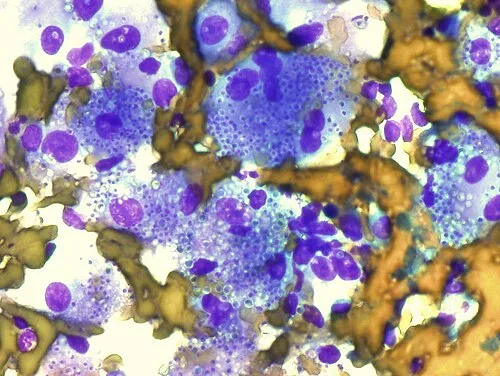
- Histoplasma: bird and bat droppings, caves, demolition; small intracellular yeasts in macrophages; urine and serum antigen are key tests
- Blastomyces: moist soil and woodland near the Great Lakes and Canada; large broad-based budding yeast; lungs, skin and bone
- Coccidioides: arid soil and dust in the south-western USA and northern Mexico; spherules with endospores; erythema nodosum and eosinophilia
- All three mimic community-acquired pneumonia, tuberculosis, sarcoidosis or lung cancer; ask about travel and outdoor exposure
- Mild acute pulmonary disease in immunocompetent people usually needs no antifungal; moderate disease is treated with itraconazole
- Severe or disseminated disease: liposomal amphotericin B 3–5 mg/kg/day, then oral itraconazole (histoplasmosis, blastomycosis) or fluconazole (coccidioidomycosis)
- Advanced HIV, transplant, TNF inhibitors and pregnancy raise the risk of dissemination; azoles are teratogenic in early pregnancy
Differential diagnosis
| Condition | Clues | Key test |
|---|---|---|
| Pulmonary tuberculosis | Endemic exposure, upper-lobe cavities, weight loss; AFB on smear | Sputum NAAT and culture for M. tuberculosis |
| Sarcoidosis | Bilateral hilar lymphadenopathy, erythema nodosum, raised ACE, non-caseating granulomas | Biopsy with fungal stains and culture to exclude infection |
| Lung cancer | Smoker with spiculated mass, mediastinal nodes, weight loss | CT, PET-CT, biopsy |
| Bacterial community-acquired pneumonia | Acute lobar consolidation, high neutrophils, responds to antibiotics | Cultures, urinary antigens; reconsider fungus if no response |
| Lymphoma | Lymphadenopathy, fever, night sweats, cytopenias | Lymph node biopsy |
| Talaromycosis or paracoccidioidomycosis | Talaromyces in South-East Asia with HIV and umbilicated skin papules; Paracoccidioides in Brazil with mouth ulcers | Histology and culture |
Exam pearls
Guideline
IDSA histoplasmosis guideline update (2025) with IDSA histoplasmosis (2007), blastomycosis (2008) and coccidioidomycosis (2016) guidelines, the ECMM/ISHAM/ASM global endemic mycoses guideline (2021) and WHO/PAHO disseminated histoplasmosis in HIV guideline (2020)
References
- Arnold SR, Spec A, Baddley JW, et al.. 2025 clinical practice guideline update by the Infectious Diseases Society of America on histoplasmosis: treatment of asymptomatic Histoplasma pulmonary nodules (histoplasmomas) and mild or moderate acute pulmonary histoplasmosis in adults, children, and pregnant people. Clin Infect Dis 2025.
- Wheat LJ, Freifeld AG, Kleiman MB, et al.. Clinical practice guidelines for the management of patients with histoplasmosis: 2007 update by the Infectious Diseases Society of America. Clin Infect Dis 2007.
- Chapman SW, Dismukes WE, Proia LA, et al.. Clinical practice guidelines for the management of blastomycosis: 2008 update by the Infectious Diseases Society of America. Clin Infect Dis 2008.
- Galgiani JN, Ampel NM, Blair JE, et al.. 2016 Infectious Diseases Society of America (IDSA) clinical practice guideline for the treatment of coccidioidomycosis. Clin Infect Dis 2016.
- Thompson GR 3rd, Le T, Chindamporn A, et al.. Global guideline for the diagnosis and management of the endemic mycoses: an initiative of the European Confederation of Medical Mycology in cooperation with the International Society for Human and Animal Mycology. Lancet Infect Dis 2021.
- Mazi PB, Sahrmann JM, Olsen MA, et al.. The geographic distribution of dimorphic mycoses in the United States for the modern era. Clin Infect Dis 2023.
Related topics
By Dr Khalid Seidi (B.Sc., M.D.) · MedEd World Clinical Knowledge library. Original teaching content checked against current guidelines (November 2026); confirm the latest local guidance before clinical use. Not a substitute for clinical judgement.