Clinical Knowledge › Obstetrics and gynaecology › Early pregnancy problems
Ectopic pregnancy
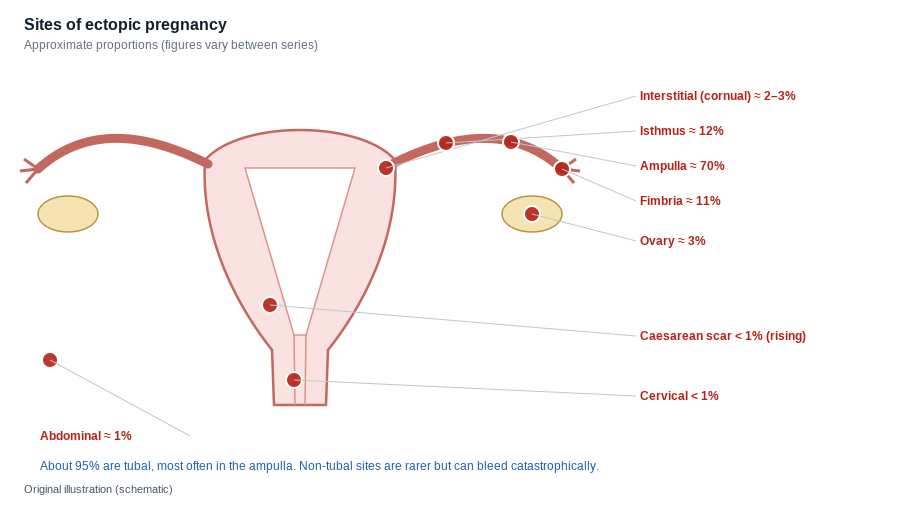
Ectopic pregnancy is implantation of a pregnancy outside the endometrial cavity; over 95% are in the fallopian tube, most often the ampulla. It affects 1–2% of pregnancies and is a leading cause of first-trimester maternal death. Risk factors are tubal damage (previous pelvic inflammatory disease, especially chlamydia; tubal surgery or sterilisation), previous ectopic pregnancy, pregnancy with an intrauterine device in place, assisted reproduction, smoking and older age, but a third of women have none. Typical presentation is at 6–8 weeks with abdominal or pelvic pain, vaginal bleeding and amenorrhoea; shoulder-tip pain, dizziness, collapse or diarrhoea suggest haemoperitoneum. Diagnosis is by transvaginal ultrasound showing an adnexal mass separate from the ovary (inhomogeneous mass, empty 'bagel' sac, or sac with yolk sac or embryo) with an empty uterus, supported by serum hCG. Management follows NICE NG126: expectant for stable women with hCG up to 1000 IU/L and a small mass; single-dose methotrexate 50 mg/m² for unruptured ectopics under 35 mm without heartbeat and hCG below 1500 IU/L (option up to 5000); and laparoscopic salpingectomy (salpingotomy if the other tube is damaged) for pain, a mass of 35 mm or more, a heartbeat, hCG of 5000 IU/L or more, or rupture.
Patient case, mechanism, investigations, management, flashcards and exam-style questions.Open the lesson →
Key facts
- Over 95% of ectopic pregnancies are tubal (ampulla about 70%); others are interstitial, cervical, caesarean scar, ovarian, abdominal and heterotopic
- Incidence about 1–2% of pregnancies; heterotopic pregnancy is about 1 in 30 000 spontaneous pregnancies but up to 1 in 100 after IVF
- Classic triad: amenorrhoea of 6–8 weeks, abdominal pain and vaginal bleeding; shoulder-tip pain and collapse indicate haemoperitoneum
- TVUS: adnexal mass separate from and moving independently of the ovary, with an empty uterus; echogenic free fluid suggests blood
- Expectant management (NICE): stable and pain free, tubal mass below 35 mm, no heartbeat, hCG 1000 IU/L or less, able to return for follow-up
- Methotrexate 50 mg/m² IM if no significant pain, unruptured mass below 35 mm without heartbeat, hCG below 1500 IU/L (choice with surgery at 1500–5000); hCG on days 4 and 7, needs a fall of 15% or more
- Surgery first-line if significant pain, mass 35 mm or more, visible heartbeat or hCG 5000 IU/L or more; salpingectomy unless the other tube is damaged (then salpingotomy)
- Anti-D 250 IU for Rh D-negative women having surgery; avoid pregnancy for 3 months after methotrexate
Differential diagnosis
| Condition | Clues | Key test |
|---|---|---|
| Miscarriage | Central crampy pain, bleeding, intrauterine sac or retained products | TVUS |
| Pregnancy of unknown location | Positive test, no pregnancy seen | Serial hCG at 0 and 48 hours |
| Ruptured or haemorrhagic corpus luteum cyst | Sudden pain, free fluid, cyst within the ovary, IUP may be present | TVUS: mass inside ovary |
| Ovarian torsion | Sudden severe unilateral pain with vomiting, enlarged ovary | TVUS with Doppler; laparoscopy |
| Acute appendicitis | Migratory right iliac fossa pain, fever, anorexia | Ultrasound or MRI in pregnancy; inflammatory markers |
| Pelvic inflammatory disease | Bilateral pain, fever, discharge, cervical motion tenderness (pregnancy test usually negative) | Pregnancy test, swabs (NAAT) |
| Urinary tract infection or renal colic | Dysuria, loin pain, haematuria | Urinalysis, ultrasound |
Exam pearls
Guideline
NICE NG126 Ectopic pregnancy and miscarriage (2019, updated 2023); RCOG/AEPU Green-top Guideline No. 21 Diagnosis and management of ectopic pregnancy (2016); ACOG Practice Bulletin No. 193 Tubal ectopic pregnancy (2018); ESHRE ultrasound terminology (2020)
References
- National Institute for Health and Care Excellence. Ectopic pregnancy and miscarriage: diagnosis and initial management (NG126). NICE guideline NG126 2019.
- Royal College of Obstetricians and Gynaecologists and Association of Early Pregnancy Units. Diagnosis and management of ectopic pregnancy (Green-top Guideline No. 21). BJOG 2016.
- American College of Obstetricians and Gynecologists. Tubal ectopic pregnancy (Practice Bulletin No. 193). Obstet Gynecol 2018.
- Kirk E, Ankum P, Jakab A, et al.. Terminology for describing normally sited and ectopic pregnancies on ultrasound: ESHRE recommendations for good practice. Hum Reprod Open 2020.
- Mol F, van Mello NM, Strandell A, et al.. Salpingotomy versus salpingectomy in women with tubal pregnancy (ESEP study): an open-label, multicentre, randomised controlled trial. Lancet 2014.
- Horne AW, Tong S, Moakes CA, et al.. Combination of gefitinib and methotrexate to treat tubal ectopic pregnancy (GEM3): a multicentre, randomised, double-blind, placebo-controlled trial. Lancet 2023.
Related topics
By Dr Khalid Seidi (B.Sc., M.D.) · MedEd World Clinical Knowledge library. Original teaching content checked against current guidelines (November 2026); confirm the latest local guidance before clinical use. Not a substitute for clinical judgement.