Clinical Knowledge › Obstetrics and gynaecology › Early pregnancy problems
Pregnancy of unknown location
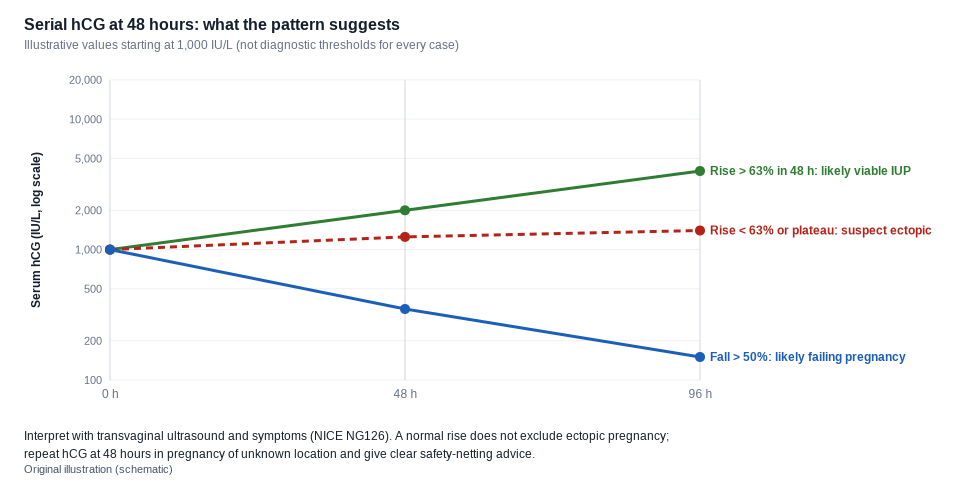
A pregnancy of unknown location (PUL) is a positive pregnancy test with no intrauterine or extrauterine pregnancy seen on transvaginal ultrasound. It is a temporary working label, not a diagnosis. Its final outcomes are a failed pregnancy (about half or more), an intrauterine pregnancy (about a third), an ectopic pregnancy (about 7–20%) or, rarely, a persistent PUL. The main aim is to identify ectopic pregnancy safely without harming a possible viable intrauterine pregnancy. NICE NG126 uses serum hCG at 0 and 48 hours: a rise of more than 63% suggests a developing intrauterine pregnancy (scan within 7–14 days, or earlier if hCG is 1500 IU/L or more), a fall of more than 50% suggests a failing pregnancy (urine pregnancy test after 14 days), and anything in between needs review in the early pregnancy unit within 24 hours. A single hCG value cannot locate a pregnancy, and NICE does not recommend serum progesterone, although prediction models such as M6 (hCG ratio with or without progesterone) are used in many units. Unstable women or those in significant pain need urgent senior review. Persistent PUL with plateauing hCG may need uterine aspiration, methotrexate or laparoscopy, decided by a senior clinician. Clear safety-netting and emotional support are essential.
Patient case, mechanism, investigations, management, flashcards and exam-style questions.Open the lesson →
Key facts
- PUL = positive pregnancy test with no intrauterine or extrauterine pregnancy (and no retained products) on TVUS
- Outcomes: failed PUL about 50–70%, intrauterine pregnancy about 30–40%, ectopic about 7–20%, persistent PUL about 2%
- NICE: serum hCG at 0 and 48 hours; a single hCG cannot determine location or viability
- hCG rise above 63% in 48 hours: likely developing IUP (ectopic still possible) – TVUS within 7–14 days, sooner if hCG 1500 IU/L or more
- hCG fall above 50% in 48 hours: likely failing pregnancy – urine pregnancy test after 14 days; return within 24 hours if positive
- hCG change between a 50% fall and a 63% rise: clinical review in the early pregnancy unit within 24 hours
- Prediction models (M6) using initial hCG, the 48-hour hCG ratio and optionally progesterone classify PUL as low or high risk of ectopic
- Never give methotrexate for PUL until a viable intrauterine pregnancy has been confidently excluded
Differential diagnosis
| Condition | Clues | Key test |
|---|---|---|
| Very early intrauterine pregnancy | Recent last period, low hCG, rising more than 63% in 48 hours | Repeat TVUS in 7–14 days |
| Failing pregnancy (complete miscarriage or resolving) | Bleeding settling, hCG falling more than 50% | Urine pregnancy test after 14 days |
| Ectopic pregnancy not yet visible | Pain, suboptimal rise or plateau of hCG | Senior review, repeat TVUS, hCG trend |
| Heterotopic pregnancy | After IVF; IUP plus adnexal mass | Detailed TVUS of both adnexa |
| Gestational trophoblastic disease | Very high or persistent hCG, previous molar pregnancy | TVUS, hCG trend, histology |
| Biochemical pregnancy | Positive test with low hCG that falls before any scan finding | Serial hCG |
| False-positive hCG (rare) | Persistently low hCG with no pregnancy, heterophile antibodies or pituitary hCG | Urine hCG and laboratory dilution tests |
Exam pearls
Guideline
NICE NG126 Ectopic pregnancy and miscarriage (2019, updated 2023); Barnhart et al. PUL consensus nomenclature (2011); ESHRE ultrasound terminology for early pregnancy (2020); ACOG Practice Bulletin No. 193 Tubal ectopic pregnancy (2018)
References
- National Institute for Health and Care Excellence. Ectopic pregnancy and miscarriage: diagnosis and initial management (NG126). NICE guideline NG126 2019.
- Barnhart K, van Mello NM, Bourne T, et al.. Pregnancy of unknown location: a consensus statement of nomenclature, definitions, and outcome. Fertil Steril 2011.
- Kirk E, Ankum P, Jakab A, et al.. Terminology for describing normally sited and ectopic pregnancies on ultrasound: ESHRE recommendations for good practice. Hum Reprod Open 2020.
- Christodoulou E, Bobdiwala S, Kyriacou C, et al.. External validation of models to predict the outcome of pregnancies of unknown location: a multicentre cohort study. BJOG 2021.
- American College of Obstetricians and Gynecologists. Tubal ectopic pregnancy (Practice Bulletin No. 193). Obstet Gynecol 2018.
- Royal College of Obstetricians and Gynaecologists and Association of Early Pregnancy Units. Diagnosis and management of ectopic pregnancy (Green-top Guideline No. 21). BJOG 2016.
Related topics
By Dr Khalid Seidi (B.Sc., M.D.) · MedEd World Clinical Knowledge library. Original teaching content checked against current guidelines (November 2026); confirm the latest local guidance before clinical use. Not a substitute for clinical judgement.