Clinical Knowledge › Neurology › Movement disorders and ataxias
Essential tremor
Essential tremor (ET) is the commonest adult movement disorder, affecting about 1% of people and 5% of those over 65. The MDS 2018 consensus defines it as an isolated tremor syndrome of bilateral upper-limb action (postural and kinetic) tremor for at least 3 years, with or without head, voice or leg tremor, and without dystonia, ataxia or parkinsonism; 'ET-plus' allows soft signs such as impaired tandem gait. Tremor is 4–12 Hz, worsens with anxiety and caffeine, often improves with alcohol, and is familial in about half. Diagnosis is clinical after excluding enhanced physiological tremor from drugs or thyrotoxicosis; DaT-SPECT is normal. Treat only when tremor impairs function: propranolol or primidone first line, then topiramate or gabapentin; botulinum toxin for head and voice tremor; and VIM thalamic deep brain stimulation or MR-guided focused ultrasound thalamotomy for disabling refractory tremor.
Patient case, mechanism, investigations, management, flashcards and exam-style questions.Open the lesson →
Key facts
- Commonest adult movement disorder; prevalence about 1% overall and 5% over 65; bimodal onset (second and sixth decades)
- Bilateral upper-limb postural and kinetic tremor for at least 3 years; head ('no-no' or 'yes-yes'), voice and leg tremor may occur
- No dystonia, ataxia or parkinsonism (if present, consider another tremor syndrome); 'ET-plus' allows soft signs
- Family history in about 50–70%; alcohol improves tremor transiently in many
- Exclude enhanced physiological tremor: caffeine, beta-agonists, valproate, lithium, SSRIs, thyroxine, thyrotoxicosis, hypoglycaemia, alcohol withdrawal
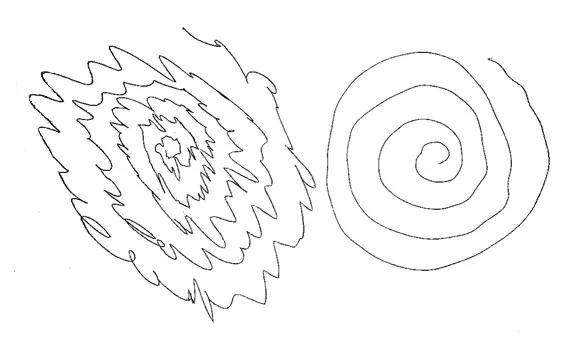
- Archimedes spiral drawing shows a fixed axis of tremor; handwriting is large and tremulous (not micrographic)
- First line: propranolol (avoid in asthma, heart block) or primidone (start low at night); second line topiramate, gabapentin
- Refractory disabling tremor: VIM thalamic DBS or MR-guided focused ultrasound thalamotomy
Differential diagnosis
| Condition | Clues | Key test |
|---|---|---|
| Parkinson disease | Rest tremor, asymmetric, bradykinesia, micrographia | Clinical; DaT-SPECT abnormal |
| Enhanced physiological tremor | Fine, fast (8–12 Hz), drug or metabolic cause, short history | TSH, glucose, drug review |
| Dystonic tremor | Irregular, jerky, position-specific, null point, with dystonia (e.g., torticollis) | Clinical |
| Cerebellar tremor | Intention tremor worse near target, ataxia, dysmetria | MRI brain |
| Wilson disease | Age under 40, wing-beating tremor, liver disease | Caeruloplasmin, urine copper |
| Functional tremor | Sudden onset, variable frequency, entrains, distractible | Clinical; electrophysiology |
| Fragile X-associated tremor/ataxia syndrome | Older man, intention tremor, ataxia, grandchild with intellectual disability | FMR1 premutation, MRI MCP sign |
Exam pearls
Guideline
MDS consensus statement on the classification of tremors (2018); AAN evidence-based guideline on ET treatment (2011, reaffirmed) and later focused ultrasound evidence
References
- Bhatia KP, Bain P, Bajaj N, et al.. Consensus statement on the classification of tremors, from the task force on tremor of the International Parkinson and Movement Disorder Society. Mov Disord 2018.
- Elias WJ, Lipsman N, Ondo WG, et al.. A randomized trial of focused ultrasound thalamotomy for essential tremor. N Engl J Med 2016.
- Papadakis MA, Rabow MW, McQuaid KR, eds.. CURRENT Medical Diagnosis & Treatment 2026. 2026.
- Ropper AH, Samuels MA, Klein JP, Prasad S.. Adams and Victor's Principles of Neurology. 2023.
- Jankovic J, Mazziotta JC, Pomeroy SL, Newman NJ, eds.. Bradley and Daroff's Neurology in Clinical Practice. 2022.
- Simpson DM, Hallett M, Ashman EJ, et al.. Practice guideline update summary: botulinum neurotoxin for the treatment of blepharospasm, cervical dystonia, adult spasticity, and headache. Neurology 2016.
Related topics
By Dr Khalid Seidi (B.Sc., M.D.) · MedEd World Clinical Knowledge library. Original teaching content checked against current guidelines (November 2026); confirm the latest local guidance before clinical use. Not a substitute for clinical judgement.