Clinical Knowledge › Neurology › Movement disorders and ataxias
Parkinson disease
Parkinson disease (PD) is a progressive neurodegenerative disorder caused by loss of dopaminergic neurones in the substantia nigra pars compacta with alpha-synuclein Lewy pathology, affecting about 1% of people over 60. Diagnosis is clinical (MDS 2015 criteria): bradykinesia with decrement plus rest tremor and/or rigidity, usually asymmetric, with supportive features such as a clear levodopa response and absence of red flags. Non-motor features – REM sleep behaviour disorder, constipation, hyposmia and depression – often precede motor signs; later come autonomic failure, falls, psychosis and dementia. DaT-SPECT helps only when the diagnosis is uncertain. Levodopa with a decarboxylase inhibitor is the most effective drug; dopamine agonists and MAO-B inhibitors are alternatives in early disease, and COMT inhibitors, amantadine, apomorphine, continuous infusions and deep brain stimulation treat motor complications. Exercise and multidisciplinary therapy are central. Never stop levodopa abruptly, and avoid dopamine-blocking antiemetics and antipsychotics.
Patient case, mechanism, investigations, management, flashcards and exam-style questions.Open the lesson →
Key facts
- Core motor syndrome: bradykinesia plus rest tremor (4–6 Hz, pill-rolling) and/or rigidity (lead-pipe or cogwheel); usually asymmetric onset
- Postural instability is a late feature; early falls or symmetrical onset suggest a Parkinson-plus syndrome
- Prodromal features: REM sleep behaviour disorder, hyposmia, constipation, depression – often years before motor onset
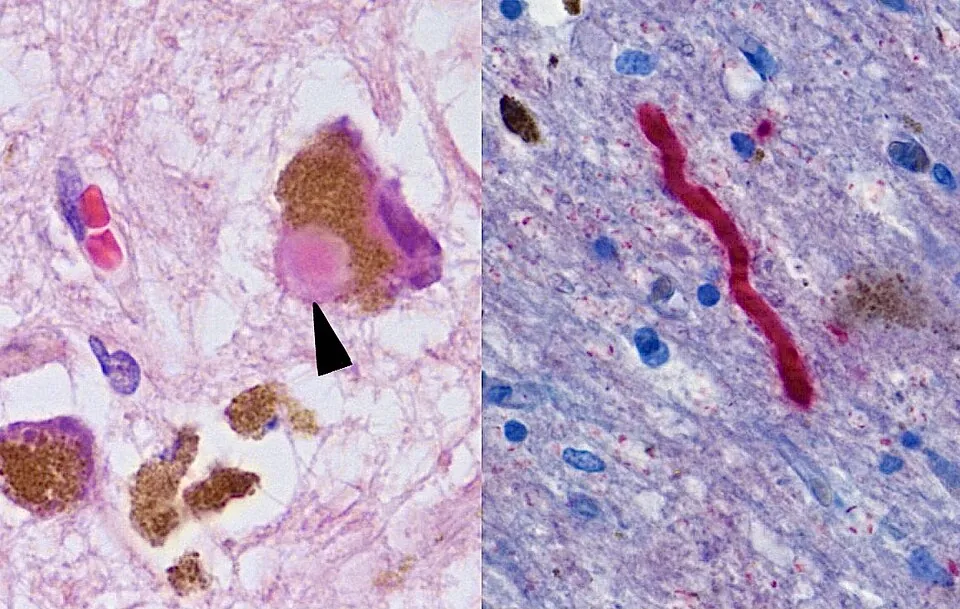
- Pathology: loss of pigmented dopaminergic neurones in substantia nigra pars compacta with Lewy bodies (alpha-synuclein)
- Levodopa (with carbidopa or benserazide) is the most effective drug; first line when motor symptoms affect quality of life (NICE NG71)
- Dopamine agonists cause impulse control disorders (gambling, hypersexuality, compulsive shopping), sleep attacks and hallucinations; warn and monitor
- Abrupt levodopa withdrawal can cause parkinsonism–hyperpyrexia syndrome; if nil by mouth use dispersible levodopa via NG tube or a rotigotine patch
- Avoid dopamine antagonist antiemetics and antipsychotics (metoclopramide, prochlorperazine, haloperidol); use domperidone, and quetiapine or clozapine for psychosis
Differential diagnosis
| Condition | Clues | Key test |
|---|---|---|
| Essential tremor | Bilateral postural/action tremor, head or voice tremor, alcohol response, no bradykinesia | Clinical; DaT-SPECT normal |
| Drug-induced parkinsonism | Antipsychotic or metoclopramide exposure, symmetrical, early onset | Drug history; DaT-SPECT normal |
| Multiple system atrophy | Early autonomic failure, cerebellar signs, poor levodopa response | MRI hot cross bun, autonomic tests |
| Progressive supranuclear palsy | Early falls backwards, vertical gaze palsy, axial rigidity | MRI midbrain atrophy (hummingbird) |
| Dementia with Lewy bodies | Dementia before or within 1 year of parkinsonism, hallucinations, fluctuations | Clinical; DaT-SPECT abnormal |
| Vascular parkinsonism | Lower-body parkinsonism, shuffling gait, stepwise course, vascular risk | MRI extensive white matter disease |
| Normal pressure hydrocephalus | Magnetic gait, urinary incontinence, cognitive decline | MRI ventriculomegaly; CSF tap test |
| Wilson disease | Age under 40, liver disease, psychiatric features | Caeruloplasmin, 24-h urine copper, slit lamp |
Exam pearls
Guideline
NICE NG71 Parkinson's disease in adults (2017); MDS clinical diagnostic criteria (2015); biological staging proposals (NSD-ISS and SynNeurGe, 2024, research use)
References
- Postuma RB, Berg D, Stern M, et al.. MDS clinical diagnostic criteria for Parkinson's disease. Mov Disord 2015.
- National Institute for Health and Care Excellence. Parkinson's disease in adults (NG71). NICE 2017.
- Bloem BR, Okun MS, Klein C.. Parkinson's disease. Lancet 2021.
- Simuni T, Chahine LM, Poston K, et al.. A biological definition of neuronal α-synuclein disease: towards an integrated staging system for research. Lancet Neurol 2024.
- Driver and Vehicle Licensing Agency. Assessing fitness to drive: a guide for medical professionals. DVLA 2025.
- Ropper AH, Samuels MA, Klein JP, Prasad S.. Adams and Victor's Principles of Neurology. 2023.
Related topics
By Dr Khalid Seidi (B.Sc., M.D.) · MedEd World Clinical Knowledge library. Original teaching content checked against current guidelines (November 2026); confirm the latest local guidance before clinical use. Not a substitute for clinical judgement.