Clinical Knowledge › Internal medicine › Rheumatology and immunology › Vasculitis
Giant cell arteritis (GCA)
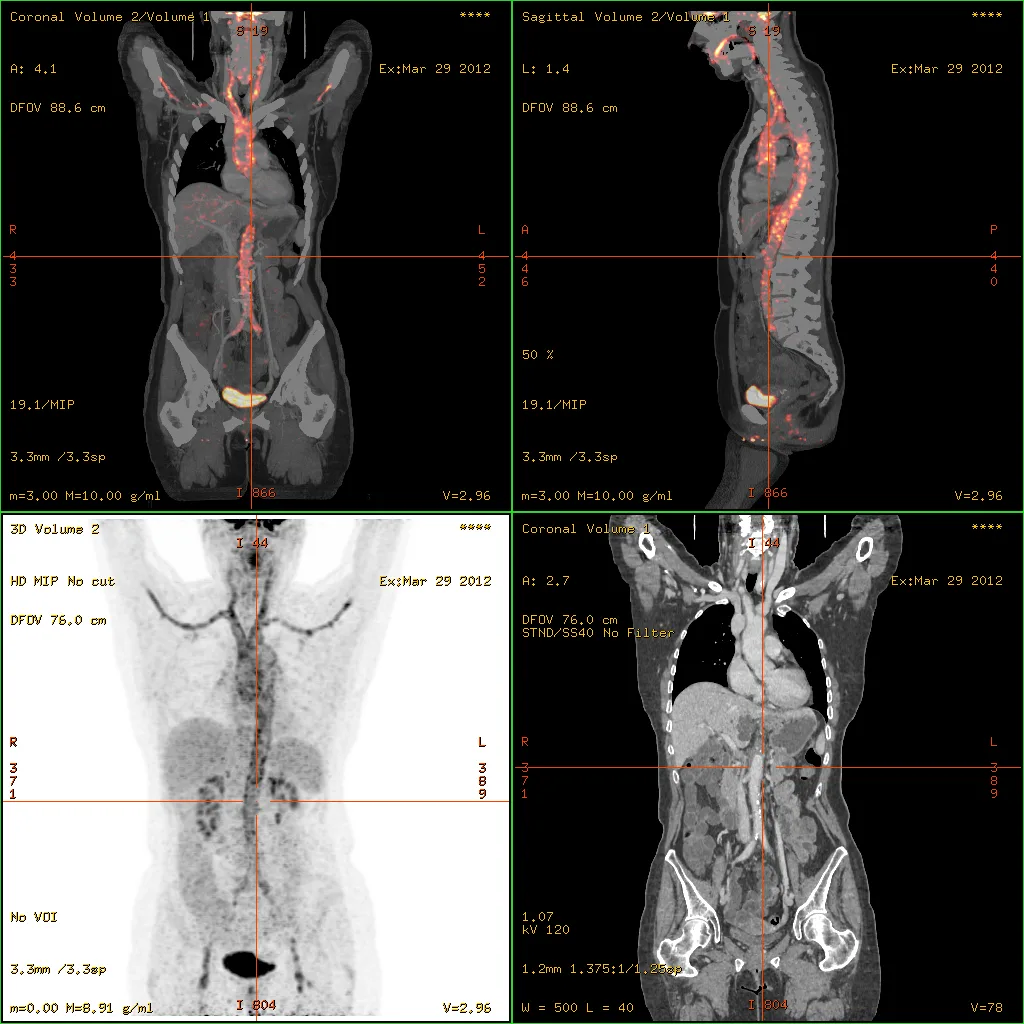
Giant cell arteritis is a granulomatous vasculitis of large and medium arteries that occurs almost only after the age of 50, peaking in the 70s, and is the commonest primary systemic vasculitis in older people of European descent. It affects the aorta and its branches, especially the extracranial carotid branches. Classic cranial disease causes a new headache, scalp tenderness, jaw claudication and visual symptoms; large-vessel disease causes arm claudication, absent pulses and aortic aneurysm. Up to half of patients also have polymyalgia rheumatica symptoms. Its most feared complication is sudden, often permanent, visual loss from arteritic anterior ischaemic optic neuropathy. ESR and CRP are almost always raised. Diagnosis is confirmed urgently by temporal and axillary artery ultrasound (halo sign) in a fast-track clinic or by temporal artery biopsy, with PET-CT or MRI for large vessels. Glucocorticoids must start immediately on strong suspicion, before tests, and are tapered over 12–18 months. Tocilizumab or upadacitinib reduce relapses and steroid exposure in refractory, relapsing or high-risk patients.
Patient case, mechanism, investigations, management, flashcards and exam-style questions.Open the lesson →
Key facts
- Age 50 or over is an absolute requirement for classification; incidence peaks at 70–80 and women are affected 2–3 times more often
- Jaw claudication is the most specific symptom; visual loss, diplopia or amaurosis fugax demand same-day treatment
- ESR or CRP is raised in about 95%; normocytic anaemia, thrombocytosis and raised ALP are common
- Start prednisolone 40–60 mg daily immediately on strong suspicion; give IV methylprednisolone for visual loss; do not wait for biopsy
- Fast-track ultrasound of temporal and axillary arteries (halo and compression signs) is first-line; biopsy remains positive for up to about 2 weeks on steroids
- Temporal artery biopsy shows granulomatous panarteritis with giant cells at the internal elastic lamina, but skip lesions cause false negatives
- 2025 EULAR: taper to 15–20 mg by 2–3 months and stop within 12–18 months; add tocilizumab or upadacitinib for refractory, relapsing or high-risk disease
- Long-term risk of thoracic aortic aneurysm and dissection; about 40–50% have PMR symptoms
Differential diagnosis
| Condition | Clues | Key test |
|---|---|---|
| Non-arteritic anterior ischaemic optic neuropathy | Painless vision loss on waking, crowded disc, vascular risk factors, normal ESR/CRP | Normal inflammatory markers; fundoscopy |
| Migraine or tension-type headache | Long history, normal markers, no jaw claudication | Normal ESR/CRP |
| Trigeminal neuralgia or dental disease | Paroxysmal shooting facial pain or tooth pain, no claudication | Clinical and dental examination |
| Polymyalgia rheumatica alone | Girdle pain and stiffness without cranial or vascular features | Ultrasound or PET negative for vasculitis |
| Takayasu arteritis | Younger than 40–60, subclavian and aortic stenoses | CT/MR angiography; age at onset |
| Infection or malignancy (e.g. endocarditis, lymphoma) | Fever, weight loss, high CRP without cranial features | Blood cultures, imaging |
| ANCA vasculitis | Sinus, lung or kidney involvement; may involve temporal artery | ANCA; urinalysis |
| Cervical spondylosis or occipital neuralgia | Occipital pain with neck movement | Normal markers; imaging |
Exam pearls
Guideline
2025 EULAR recommendations for the management of polymyalgia rheumatica and primary large vessel vasculitis (published 2026), EULAR 2023 imaging recommendations for LVV, BSR 2020 GCA guideline and 2022 ACR/EULAR GCA classification criteria
References
- Mukhtyar CB, Nikiphorou E, Bartoletti A, Dey M, et al.. 2025 EULAR recommendations for the management of polymyalgia rheumatica and primary large vessel vasculitis. Ann Rheum Dis 2026.
- Mackie SL, Dejaco C, Appenzeller S, et al.. British Society for Rheumatology guideline on diagnosis and treatment of giant cell arteritis. Rheumatology (Oxford) 2020.
- Ponte C, Grayson PC, Robson JC, et al.. 2022 American College of Rheumatology/EULAR classification criteria for giant cell arteritis. Ann Rheum Dis 2022.
- Dejaco C, Ramiro S, Bond M, et al.. EULAR recommendations for the use of imaging in large vessel vasculitis in clinical practice: 2023 update. Ann Rheum Dis 2024.
- Stone JH, Tuckwell K, Dimonaco S, et al.. Trial of tocilizumab in giant-cell arteritis. N Engl J Med 2017.
- Blockmans D, Penn SK, Setty AR, et al.. A phase 3 trial of upadacitinib for giant-cell arteritis. N Engl J Med 2025.
Related topics
By Dr Khalid Seidi (B.Sc., M.D.) · MedEd World Clinical Knowledge library. Original teaching content checked against current guidelines (November 2026); confirm the latest local guidance before clinical use. Not a substitute for clinical judgement.