Clinical Knowledge › Internal medicine › Rheumatology and immunology › Vasculitis
Polymyalgia rheumatica (PMR)
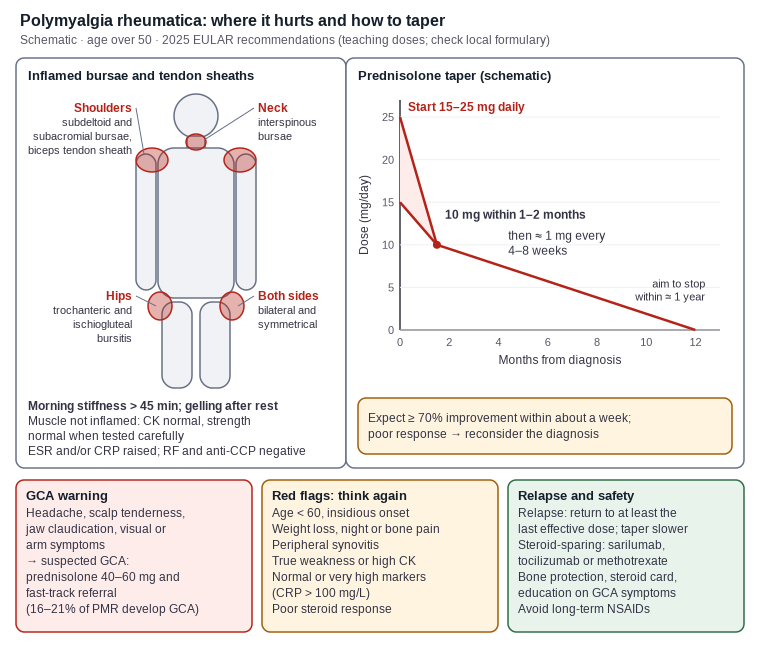
Polymyalgia rheumatica is a common inflammatory disorder of people aged over 50 that causes bilateral pain and prolonged morning stiffness of the shoulder and hip girdles and neck, with raised ESR or CRP. Inflammation is centred on bursae, tendon sheaths and joint capsules (subdeltoid bursitis, biceps tenosynovitis) rather than muscle, so creatine kinase is normal and true weakness is absent. It is closely linked to giant cell arteritis: up to a fifth of people with PMR develop GCA, and many with GCA have polymyalgic symptoms. Because the symptoms are non-specific, PMR is a diagnosis of exclusion: late-onset rheumatoid arthritis, myeloma and other cancers, infection, hypothyroidism, myositis and drug reactions must be considered, and red flags prompt specialist review. Treatment is moderate-dose prednisolone (15–25 mg daily), which typically produces dramatic improvement within days, tapered to 10 mg within 1–2 months and stopped within about a year where possible. Relapses are common. Methotrexate or IL-6 receptor inhibitors (sarilumab, tocilizumab) reduce steroid exposure, and bone protection is essential.
Patient case, mechanism, investigations, management, flashcards and exam-style questions.Open the lesson →
Key facts
- Age over 50 (usually over 60), bilateral shoulder and/or hip girdle pain with morning stiffness lasting more than 45 minutes
- ESR and/or CRP raised in most patients; CK normal; rheumatoid factor and anti-CCP negative
- Inflammation of bursae and tendon sheaths: ultrasound shows subdeltoid bursitis, biceps tenosynovitis and trochanteric bursitis
- About 16–21% of people with PMR develop GCA: always ask about headache, jaw claudication and visual symptoms
- Prednisolone 15–25 mg daily usually brings 70% or more improvement within 1 week; a poor response should prompt reconsideration of the diagnosis
- 2025 EULAR: taper to 10 mg within 1–2 months and aim to stop within 1 year; relapse treated with at least the last effective dose
- Sarilumab (licensed for relapsing PMR) or tocilizumab and methotrexate are steroid-sparing options
- Red flags for an alternative diagnosis: age under 60, weight loss, night pain, peripheral synovitis, neurological signs, very high or normal markers
Differential diagnosis
| Condition | Clues | Key test |
|---|---|---|
| Late-onset (elderly-onset) rheumatoid arthritis | Peripheral synovitis of hands and wrists, erosions | RF and anti-CCP; hand X-rays or ultrasound |
| Giant cell arteritis | Headache, jaw claudication, visual symptoms | Temporal/axillary ultrasound or biopsy |
| Multiple myeloma or metastatic cancer | Weight loss, bone pain, anaemia, hypercalcaemia, renal impairment | Protein electrophoresis, free light chains, imaging |
| Hypothyroidism | Fatigue, weight gain, myalgia, normal ESR | TSH |
| Inflammatory myopathy | True proximal weakness, raised CK | CK, myositis antibodies, MRI |
| Calcium pyrophosphate deposition disease | Acute or chronic polyarthritis with chondrocalcinosis | Joint aspiration; X-ray chondrocalcinosis |
| Bilateral rotator cuff disease or adhesive capsulitis | Mechanical shoulder pain, normal markers | Normal ESR/CRP; imaging |
| Infection (infective endocarditis, septic arthritis, spinal infection) | Fever, murmur, very high CRP | Blood cultures, echocardiography |
Exam pearls
Guideline
2025 EULAR recommendations for the management of polymyalgia rheumatica and primary large vessel vasculitis (published 2026), 2015 EULAR/ACR PMR recommendations and 2012 EULAR/ACR provisional PMR classification criteria
References
- Mukhtyar CB, Nikiphorou E, Bartoletti A, Dey M, et al.. 2025 EULAR recommendations for the management of polymyalgia rheumatica and primary large vessel vasculitis. Ann Rheum Dis 2026.
- Dejaco C, Singh YP, Perel P, et al.. 2015 recommendations for the management of polymyalgia rheumatica: a European League Against Rheumatism/American College of Rheumatology collaborative initiative. Ann Rheum Dis 2015.
- Dasgupta B, Cimmino MA, Maradit-Kremers H, et al.. 2012 provisional classification criteria for polymyalgia rheumatica: a European League Against Rheumatism/American College of Rheumatology collaborative initiative. Ann Rheum Dis 2012.
- Spiera RF, Unizony S, Warrington KJ, et al.. Sarilumab for relapse of polymyalgia rheumatica during glucocorticoid taper. N Engl J Med 2023.
- Toyoda T, et al.. Treatment of polymyalgia rheumatica: British Society for Rheumatology guideline scope. Rheumatol Adv Pract 2024.
- Dasgupta B, Borg FA, Hassan N, et al.. BSR and BHPR guidelines for the management of polymyalgia rheumatica. Rheumatology (Oxford) 2010.
Related topics
By Dr Khalid Seidi (B.Sc., M.D.) · MedEd World Clinical Knowledge library. Original teaching content checked against current guidelines (November 2026); confirm the latest local guidance before clinical use. Not a substitute for clinical judgement.