Clinical Knowledge › Internal medicine › Rheumatology and immunology › Vasculitis
Takayasu arteritis
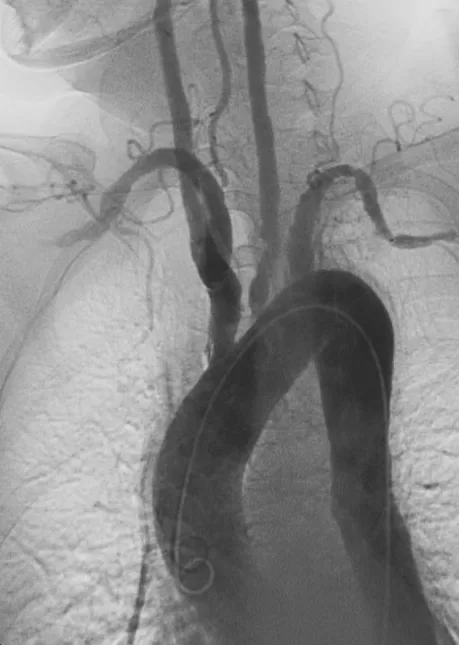
Takayasu arteritis is a rare granulomatous large-vessel vasculitis of the aorta, its major branches and the pulmonary arteries that typically begins in women under 40, most often in Asia, the Middle East and Latin America. Transmural inflammation leads to wall thickening, stenosis, occlusion and sometimes aneurysm. An early systemic phase of fever, weight loss, night sweats and arthralgia is often missed; later, ischaemic features dominate: arm claudication, weak or absent pulses ('pulseless disease'), a systolic blood pressure difference between the arms, bruits over the subclavian, carotid and abdominal arteries, carotodynia, dizziness, visual disturbance and stroke. Renal artery or mid-aortic stenosis causes hypertension, and aortic root disease causes aortic regurgitation and heart failure. Inflammatory markers can be normal despite active disease, so diagnosis rests on vascular imaging with MR or CT angiography, FDG-PET or ultrasound. Treatment combines glucocorticoids with a conventional immunosuppressant from the start, tocilizumab or TNF inhibitors for refractory disease, careful blood pressure control and revascularisation during remission.
Patient case, mechanism, investigations, management, flashcards and exam-style questions.Open the lesson →
Key facts
- Large-vessel granulomatous vasculitis of the aorta and its branches; onset usually before 40 (2022 criteria: age ≤60 at diagnosis)
- About 80–90% are women; highest incidence in Japan, Korea, China, India, Southeast Asia, Turkey and Mexico
- Classic signs: absent or weak upper limb pulses, arm claudication, systolic BP difference ≥10–20 mmHg between arms and arterial bruits
- Subclavian artery is the commonest stenosed branch; renal artery or mid-aortic stenosis causes secondary hypertension
- ESR and CRP may be normal in active disease: imaging (MRA, CTA, FDG-PET, Doppler 'macaroni sign') is essential for diagnosis and follow-up
- 2025 EULAR: prednisolone 40–60 mg/day plus a non-biologic DMARD (methotrexate, azathioprine, mycophenolate or leflunomide) from the start
- Tocilizumab or a TNF inhibitor for relapsing or refractory disease; elective revascularisation only during stable remission
- Measure BP in an unaffected limb (often the legs): bilateral subclavian stenosis hides hypertension
Differential diagnosis
| Condition | Clues | Key test |
|---|---|---|
| Giant cell arteritis | Age over 50, cranial symptoms, Northern European | Age at onset; temporal artery ultrasound |
| Fibromuscular dysplasia | Young woman with renal artery stenosis but 'string of beads', no inflammation | CTA or catheter angiography pattern |
| Atherosclerosis | Older age, vascular risk factors, calcified plaques | Imaging shows plaque, not concentric wall thickening |
| Tuberculous or syphilitic aortitis | Endemic setting, positive TB or syphilis tests | IGRA, treponemal serology |
| IgG4-related aortitis | Older men, periaortitis, other organ involvement | Serum IgG4; biopsy |
| Marfan or Loeys–Dietz syndrome | Aortic root dilatation without inflammation, tall habitus | Genetic testing; normal markers |
| Coarctation of the aorta | Radio-femoral delay since childhood, hypertension | Echocardiography; MRA showing discrete narrowing |
| Behçet disease or Cogan syndrome | Oral ulcers or interstitial keratitis with vasculitis | Clinical criteria |
Exam pearls
Guideline
2025 EULAR recommendations for the management of polymyalgia rheumatica and primary large vessel vasculitis (published 2026), 2022 ACR/EULAR Takayasu classification criteria, ACR/VF 2021 GCA and Takayasu guideline and EULAR 2023 imaging recommendations
References
- Mukhtyar CB, Nikiphorou E, Bartoletti A, Dey M, et al.. 2025 EULAR recommendations for the management of polymyalgia rheumatica and primary large vessel vasculitis. Ann Rheum Dis 2026.
- Grayson PC, Ponte C, Suppiah R, et al.. 2022 American College of Rheumatology/EULAR classification criteria for Takayasu arteritis. Ann Rheum Dis 2022.
- Maz M, Chung SA, Abril A, et al.. 2021 American College of Rheumatology/Vasculitis Foundation guideline for the management of giant cell arteritis and Takayasu arteritis. Arthritis Rheumatol 2021.
- Dejaco C, Ramiro S, Bond M, et al.. EULAR recommendations for the use of imaging in large vessel vasculitis in clinical practice: 2023 update. Ann Rheum Dis 2024.
- Hellmich B, Agueda A, Monti S, et al.. 2018 update of the EULAR recommendations for the management of large vessel vasculitis. Ann Rheum Dis 2020.
- Nakaoka Y, Isobe M, Takei S, et al.. Efficacy and safety of tocilizumab in patients with refractory Takayasu arteritis: results from a randomised, double-blind, placebo-controlled, phase 3 trial in Japan (the TAKT study). Ann Rheum Dis 2018.
Related topics
By Dr Khalid Seidi (B.Sc., M.D.) · MedEd World Clinical Knowledge library. Original teaching content checked against current guidelines (November 2026); confirm the latest local guidance before clinical use. Not a substitute for clinical judgement.