Clinical Knowledge › Internal medicine › Endocrinology › Clinical problems
Gynaecomastia: approach to the patient
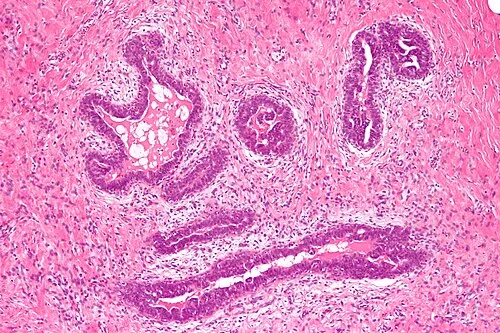
Gynaecomastia is benign proliferation of glandular breast tissue in males, felt as a rubbery or firm disc concentric with the nipple. It results from an imbalance between oestrogen action, which stimulates ductal growth, and androgen action, which inhibits it. It is physiological in newborns, in about half of boys in mid-puberty (over 90% regress within 2 years) and common in older men, but in adults an underlying cause is found in about half. Key causes are drugs (spironolactone, antiandrogens, 5α-reductase inhibitors, anabolic steroids), cirrhosis, primary and secondary hypogonadism (including Klinefelter syndrome), hyperthyroidism, CKD and, rarely, hCG- or oestrogen-secreting testicular, adrenal or other tumours. Assessment separates true gynaecomastia from fat (pseudogynaecomastia) and from breast cancer, examines the testes with ultrasound, and measures testosterone, oestradiol, SHBG, LH, FSH, prolactin, TSH, hCG, AFP and liver and kidney function. Treatment targets the cause; long-standing fibrotic tissue needs surgery.
Patient case, mechanism, investigations, management, flashcards and exam-style questions.Open the lesson →
Key facts
- True gynaecomastia is a palpable subareolar glandular disc; pseudogynaecomastia (lipomastia) is fat without a disc
- Physiological peaks: neonatal (maternal oestrogen), pubertal (about half of boys; over 90% regress within 2 years) and older age
- Mechanism: increased oestrogen, reduced androgen, androgen receptor blockade or raised SHBG (binds testosterone more than oestradiol)
- In adults, an underlying cause is found in about 45–50%; medicines are among the commonest
- Red flags for breast cancer: unilateral, hard, eccentric or fixed mass, skin or nipple change, bloody discharge, axillary nodes
- EAA 2019: examine the testes and add testicular ultrasound; measure testosterone, oestradiol, SHBG, LH, FSH, TSH, prolactin, hCG, AFP, liver and renal function
- Raised hCG means a germ-cell tumour (testicular or extragonadal) until proven otherwise
- Gynaecomastia is not premalignant; surgery is reserved for long-standing tissue that does not regress
Differential diagnosis
| Condition | Clues | Key test |
|---|---|---|
| Pseudogynaecomastia (lipomastia) | Soft, diffuse fat without a subareolar disc; obesity | Pinch test; ultrasound if unsure |
| Male breast cancer | Unilateral, hard, eccentric, fixed mass; nipple retraction, bloody discharge, axillary nodes | Mammography or ultrasound and core biopsy |
| Physiological pubertal gynaecomastia | Mid-puberty boy, tender discs, normal testes and examination | Clinical review in 6–12 months |
| Drug-induced gynaecomastia | Started after spironolactone, antiandrogen, finasteride, anabolic steroids, etc. | Drug history; regression after withdrawal |
| Testicular or extragonadal tumour | Testicular mass, raised hCG or oestradiol with suppressed LH | Testicular ultrasound, hCG, AFP; CT if testes normal |
| Primary hypogonadism (e.g. Klinefelter) | Small firm testes, tall stature, infertility; low testosterone with high LH and FSH | Karyotype |
| Systemic disease | Cirrhosis, CKD, hyperthyroidism, refeeding after malnutrition | Liver and renal function, TSH |
| Lipoma, dermoid or haematoma | Discrete mass not centred on the nipple | Ultrasound |
Exam pearls
Guideline
European Academy of Andrology (EAA) clinical practice guideline on gynaecomastia evaluation and management (2019), Endocrine Society testosterone therapy guideline (2018) and EAU Guidelines on Sexual and Reproductive Health (2026 edition)
References
- Kanakis GA, Nordkap L, Bang AK, et al.. EAA clinical practice guidelines – gynecomastia evaluation and management. Andrology 2019.
- Braunstein GD.. Clinical practice. Gynecomastia. N Engl J Med 2007.
- Bhasin S, Brito JP, Cunningham GR, et al.. Testosterone therapy in men with hypogonadism: an Endocrine Society clinical practice guideline. J Clin Endocrinol Metab 2018.
- European Association of Urology (EAU). EAU Guidelines on Sexual and Reproductive Health. EAU Guidelines Office, Arnhem 2026.
- Melmed S, Casanueva FF, Hoffman AR, et al.. Diagnosis and treatment of hyperprolactinemia: an Endocrine Society clinical practice guideline. J Clin Endocrinol Metab 2011.
- Groth KA, Skakkebæk A, Høst C, Gravholt CH, Bojesen A.. Klinefelter syndrome — a clinical update. J Clin Endocrinol Metab 2013.
Related topics
By Dr Khalid Seidi (B.Sc., M.D.) · MedEd World Clinical Knowledge library. Original teaching content checked against current guidelines (November 2026); confirm the latest local guidance before clinical use. Not a substitute for clinical judgement.