Clinical Knowledge › Internal medicine › Endocrinology › Clinical problems
Hirsutism and virilisation: approach to the patient
Hirsutism is excess terminal hair in a male pattern in a woman, scored with the modified Ferriman–Gallwey scale (abnormal from about 4–8 depending on ethnicity). It affects 5–10% of women and is usually caused by polycystic ovary syndrome (PCOS) or idiopathic hirsutism. Virilisation (clitoromegaly, deepening voice, temporal balding, increased muscle bulk, breast atrophy) indicates much higher androgen levels and suggests an androgen-secreting ovarian or adrenal tumour, ovarian hyperthecosis or severe congenital adrenal hyperplasia. Key clues are speed of onset, menstrual history, age and drugs. Measure early-morning total testosterone (ideally by mass spectrometry) with SHBG; very high testosterone (above about 5 nmol/L or 150 ng/dL) or DHEAS needs pelvic and adrenal imaging. A follicular-phase 17-hydroxyprogesterone screens for non-classic CAH; prolactin, TSH and Cushing tests are added when features suggest them. Most women are treated with a combined oral contraceptive, adding an antiandrogen with contraception after 6 months, plus laser or other direct hair removal.
Patient case, mechanism, investigations, management, flashcards and exam-style questions.Open the lesson →
Key facts
- Hirsutism: androgen-dependent terminal hair in male-pattern sites (upper lip, chin, chest, linea alba, back); hypertrichosis is diffuse, non-androgenic hair growth
- Modified Ferriman–Gallwey score ≥8 is the traditional cut-off; lower thresholds (≥4–6) apply in many populations, including East Asian women
- PCOS causes about 70–80% of hirsutism; idiopathic hirsutism and non-classic CAH are next
- Rapid onset (months), virilisation or onset after menopause suggests an androgen-secreting tumour or ovarian hyperthecosis
- Testosterone above about 5 nmol/L (150 ng/dL) or more than twice the upper limit, or very high DHEAS, warrants imaging of ovaries and adrenals
- Non-classic CAH: early-morning follicular 17-OHP above about 6 nmol/L (200 ng/dL) → ACTH stimulation; stimulated ≥30 nmol/L (1000 ng/dL) confirms
- First-line treatment for most: combined oral contraceptive; add an antiandrogen (spironolactone) after 6 months if needed, always with reliable contraception
- Hair grows in cycles: allow at least 6 months before judging the response to any drug
Differential diagnosis
| Condition | Clues | Key test |
|---|---|---|
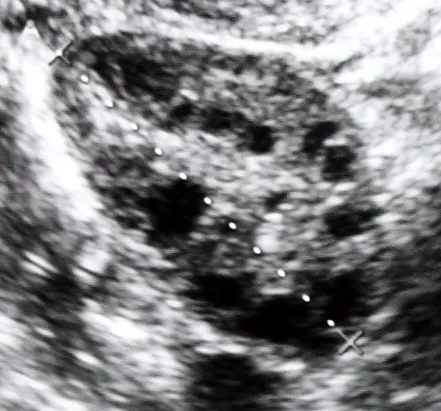
| Polycystic ovary syndrome | Peri-pubertal onset, slow progression, oligomenorrhoea, acne, obesity, acanthosis | Rotterdam criteria; testosterone, SHBG; ultrasound or AMH (adults) |
| Idiopathic hirsutism | Regular ovulatory cycles, normal androgen levels | Normal testosterone; exclusion of other causes |
| Non-classic congenital adrenal hyperplasia (21-hydroxylase) | Family history, Ashkenazi Jewish, Mediterranean or Hispanic ancestry, early pubarche | Follicular 17-OHP, ACTH-stimulated 17-OHP |
| Androgen-secreting ovarian tumour (Sertoli–Leydig, Leydig cell) | Rapid virilisation; testosterone very high, DHEAS normal | Transvaginal ultrasound, pelvic MRI |
| Androgen-secreting adrenal tumour (usually carcinoma) | Rapid virilisation, very high DHEAS, may co-secrete cortisol | Adrenal CT or MRI |
| Ovarian hyperthecosis | Postmenopausal, gradual virilisation, insulin resistance | Bilaterally enlarged solid ovaries; GnRH analogue suppresses testosterone |
| Cushing syndrome | Striae, bruising, proximal myopathy, hypertension | Overnight dexamethasone test or late-night salivary cortisol |
| Drugs and exogenous androgens | Testosterone gel exposure from a partner, anabolic steroids, danazol, valproate | Drug and contact history; testosterone pattern |
Exam pearls
Guideline
Endocrine Society hirsutism in premenopausal women guideline (2018), 2023 International evidence-based PCOS guideline and Endocrine Society congenital adrenal hyperplasia guideline (2018)
References
- Martin KA, Anderson RR, Chang RJ, et al.. Evaluation and treatment of hirsutism in premenopausal women: an Endocrine Society clinical practice guideline. J Clin Endocrinol Metab 2018.
- Teede HJ, Tay CT, Laven JJE, et al.. Recommendations from the 2023 international evidence-based guideline for the assessment and management of polycystic ovary syndrome. J Clin Endocrinol Metab 2023.
- Speiser PW, Arlt W, Auchus RJ, et al.. Congenital adrenal hyperplasia due to steroid 21-hydroxylase deficiency: an Endocrine Society clinical practice guideline. J Clin Endocrinol Metab 2018.
- Nieman LK, Biller BM, Findling JW, et al.. The diagnosis of Cushing's syndrome: an Endocrine Society clinical practice guideline. J Clin Endocrinol Metab 2008.
- Petersenn S, Fleseriu M, Casanueva FF, et al.. Diagnosis and management of prolactin-secreting pituitary adenomas: a Pituitary Society international consensus statement. Nat Rev Endocrinol 2023.
- Barrionuevo P, Nabhan M, Altayar O, et al.. Treatment options for hirsutism: a systematic review and network meta-analysis. J Clin Endocrinol Metab 2018.
Related topics
By Dr Khalid Seidi (B.Sc., M.D.) · MedEd World Clinical Knowledge library. Original teaching content checked against current guidelines (November 2026); confirm the latest local guidance before clinical use. Not a substitute for clinical judgement.