Clinical Knowledge › Internal medicine › Endocrinology › Clinical problems
Thyroid nodule and goitre: approach to the patient
Thyroid nodules are extremely common: about 5% of adults have a palpable nodule and up to half have nodules on ultrasound, yet only about 5–10% of clinically evaluated nodules are malignant. A goitre is any enlargement of the thyroid, diffuse or nodular; worldwide the commonest cause is iodine deficiency. The approach answers three questions: is the gland over- or under-active, is the nodule likely to be cancer, and is it compressing the neck? Measure TSH first: a low TSH calls for a radionuclide scan, because a 'hot' autonomous nodule is almost never malignant and does not need biopsy. Otherwise, ultrasound risk patterns (ATA, ACR TI-RADS, EU-TIRADS or BTA U-grades) combined with size decide which nodules need fine-needle aspiration, reported with the 2023 Bethesda system. Indeterminate cytology may be refined by molecular testing or diagnostic lobectomy. Stridor, rapid growth, hoarseness, fixed nodes or a hard fixed mass are red flags for anaplastic cancer or lymphoma.
Patient case, mechanism, investigations, management, flashcards and exam-style questions.Open the lesson →
Key facts
- Palpable nodules in about 5% of women and 1% of men; ultrasound finds nodules in up to 50–60% of adults; about 5–10% of evaluated nodules are cancers
- First test: TSH. Low TSH → radionuclide scan; a hot (hyperfunctioning) nodule rarely needs FNA
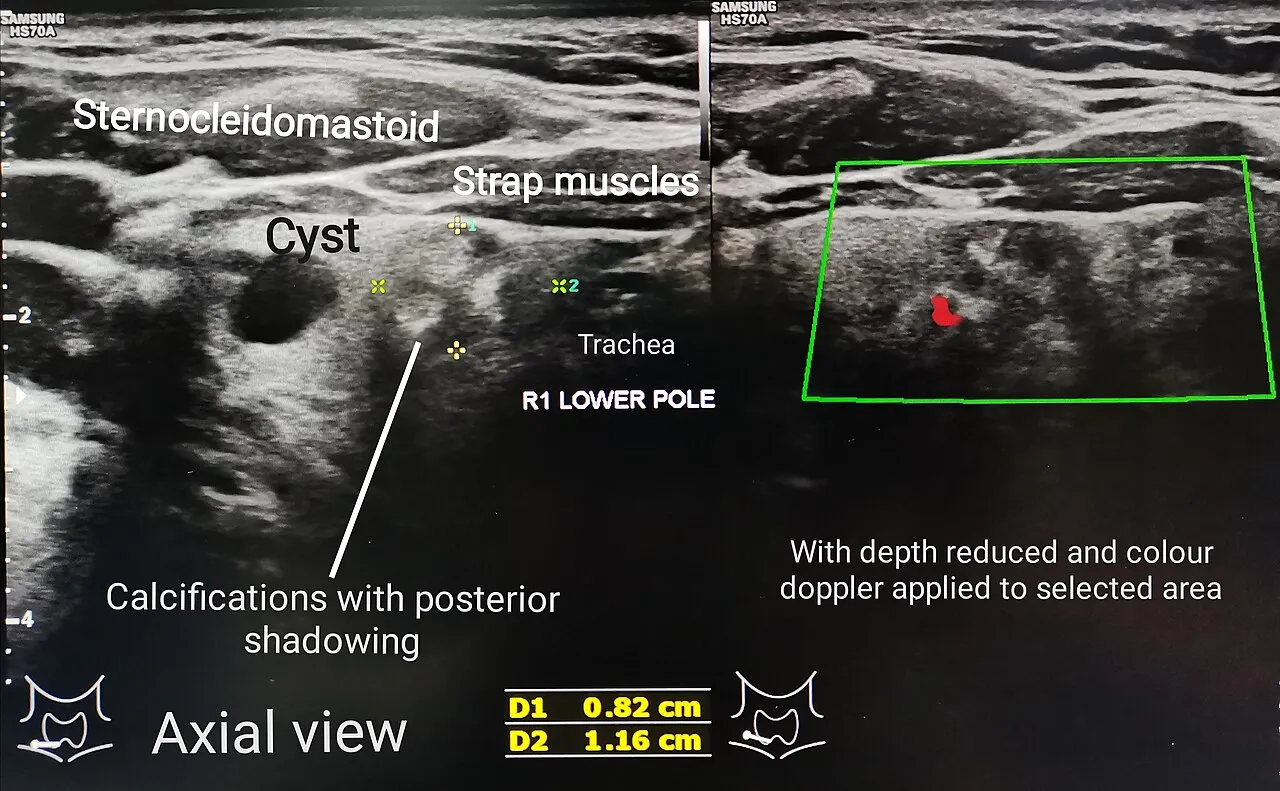
- Ultrasound features of malignancy: solid, hypoechoic, irregular or infiltrative margins, microcalcifications, taller-than-wide shape, extrathyroidal extension, abnormal lymph nodes
- ATA FNA thresholds: high or intermediate suspicion ≥1 cm; low suspicion ≥1.5 cm; very low suspicion ≥2 cm or observe; pure cysts no FNA
- Bethesda 2023: I non-diagnostic, II benign (~4% malignant), III AUS (~22%), IV follicular neoplasm (~30%), V suspicious (~74%), VI malignant (~97%)
- Follicular carcinoma cannot be diagnosed on FNA: capsular or vascular invasion needs histology
- Red flags: rapid growth, stridor, hoarseness (recurrent laryngeal nerve), hard fixed mass, cervical lymphadenopathy, childhood neck irradiation, family history of thyroid cancer or MEN2
- Retrosternal goitre causes tracheal or venous compression (Pemberton sign); assess with CT and flow-volume loops
Differential diagnosis
| Condition | Clues | Key test |
|---|---|---|
| Benign colloid or hyperplastic nodule (multinodular goitre) | Multiple nodules, spongiform or isoechoic, slow growth | Ultrasound; FNA of dominant suspicious nodule (Bethesda II) |
| Toxic adenoma or toxic multinodular goitre | Low TSH, thyrotoxic symptoms, older patient | Radionuclide scan: hot nodule(s) with suppressed background |
| Thyroid cyst or haemorrhage into a nodule | Sudden painful swelling | Ultrasound: anechoic or mixed cystic; aspirate if symptomatic |
| Papillary thyroid carcinoma | Solid hypoechoic nodule with microcalcifications; cervical nodes | FNA: Bethesda V–VI; node ultrasound |
| Follicular neoplasm (adenoma or carcinoma) | Solid isoechoic or hypoechoic, often smooth | FNA Bethesda IV; molecular testing or lobectomy |
| Medullary thyroid carcinoma | Family history of MEN2, diarrhoea, flushing | Raised calcitonin and CEA; RET testing |
| Anaplastic carcinoma or thyroid lymphoma | Older patient, rapidly enlarging hard mass, stridor; lymphoma with Hashimoto background | Urgent core biopsy, CT neck and chest |
| Non-thyroid neck lump (thyroglossal cyst, branchial cyst, lymph node) | Midline lump moving with tongue protrusion; lateral cyst; node | Ultrasound |
Exam pearls
Guideline
ATA 2015 guidelines for thyroid nodules and differentiated thyroid cancer with the ATA 2025 differentiated thyroid cancer guideline, ACR TI-RADS (2017), EU-TIRADS (2017), the 2023 Bethesda System for Reporting Thyroid Cytopathology and NICE NG230 Thyroid cancer (2022)
References
- Haugen BR, Alexander EK, Bible KC, et al.. 2015 American Thyroid Association management guidelines for adult patients with thyroid nodules and differentiated thyroid cancer. Thyroid 2016.
- Praw SS, Gigliotti BJ, Tessnow A, et al.. Executive summary of the 2025 American Thyroid Association management guidelines for adult patients with differentiated thyroid cancer. Thyroid 2025.
- Tessler FN, Middleton WD, Grant EG, et al.. ACR Thyroid Imaging, Reporting and Data System (TI-RADS): white paper of the ACR TI-RADS Committee. J Am Coll Radiol 2017.
- Russ G, Bonnema SJ, Erdogan MF, et al.. European Thyroid Association guidelines for ultrasound malignancy risk stratification of thyroid nodules in adults: the EU-TIRADS. Eur Thyroid J 2017.
- Ali SZ, Baloch ZW, Cochand-Priollet B, et al.. The 2023 Bethesda System for Reporting Thyroid Cytopathology. Thyroid 2023.
- National Institute for Health and Care Excellence (NICE). Thyroid cancer: assessment and management (NG230). NICE guideline 2022.
Related topics
By Dr Khalid Seidi (B.Sc., M.D.) · MedEd World Clinical Knowledge library. Original teaching content checked against current guidelines (November 2026); confirm the latest local guidance before clinical use. Not a substitute for clinical judgement.