Clinical Knowledge › Internal medicine › Endocrinology › Clinical problems
Unintentional weight loss: approach to the patient
Unintentional weight loss of more than 5% of body weight over 6–12 months is clinically important, especially in older adults, in whom it predicts disability and death. Cancer accounts for up to a third of cases, and in primary care a coded weight loss in people aged 60 or over carries a cancer risk above the 3% threshold that justifies urgent investigation. Other common causes are gastrointestinal disease, depression and dementia, chronic heart, lung, kidney and liver disease, endocrine disorders (hyperthyroidism, uncontrolled or new diabetes, adrenal insufficiency), infections such as tuberculosis and HIV, medicines, alcohol and social factors; no cause is found in up to a quarter. Confirm the loss by weighing, then take a careful history and examine fully. Baseline tests include FBC, renal, liver and bone profile, glucose or HbA1c, TSH, CRP, ferritin, urinalysis, chest X-ray, FIT and age-appropriate screening, with targeted imaging when clues exist. Treat the cause, screen for malnutrition (GLIM, MUST), support nutrition and watch for refeeding syndrome.
Patient case, mechanism, investigations, management, flashcards and exam-style questions.Open the lesson →
Key facts
- Clinically significant unintentional weight loss: >5% of body weight over 6–12 months (for example 3.5 kg in a 70 kg person)
- Malignancy causes up to one-third of cases; non-malignant GI disease, psychiatric illness and chronic organ disease together cause most of the rest
- In primary care, weight loss in people aged 60 or over has a positive predictive value for cancer above 3%, enough to warrant urgent investigation
- Increased appetite with weight loss suggests hyperthyroidism, uncontrolled diabetes or malabsorption
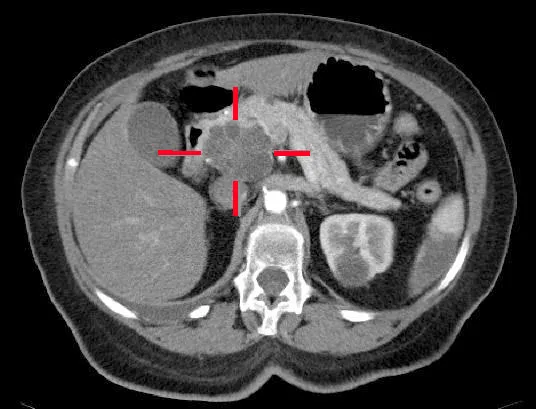
- Weight loss with new-onset diabetes in people aged 60 or over: arrange urgent CT to look for pancreatic cancer (NICE NG12)
- Baseline tests: FBC, U&E, LFTs, calcium, glucose/HbA1c, TSH, CRP/ESR, ferritin, urinalysis, chest X-ray, FIT; HIV and coeliac serology when relevant
- If the initial evaluation is normal, a period of 3–6 months of watchful waiting with reweighing is reasonable; extensive blind imaging rarely helps
- GLIM malnutrition: at least one phenotypic criterion (weight loss, low BMI, low muscle mass) plus one aetiological criterion (reduced intake or absorption, inflammation or disease)
Differential diagnosis
| Condition | Clues | Key test |
|---|---|---|
| Malignancy (GI, pancreas, lung, haematological, prostate, ovary) | Age over 60, smoking, anorexia, anaemia, raised platelets or CRP, focal symptoms | Targeted tests: FIT, chest X-ray, endoscopy, CT chest–abdomen–pelvis |
| Hyperthyroidism | Increased appetite, tremor, palpitations, heat intolerance; apathetic in older people | TSH, FT4, FT3 |
| Uncontrolled or new diabetes | Polyuria, polydipsia, ketones; new diabetes in older people may signal pancreatic cancer | Glucose, HbA1c, ketones; CT pancreas if 60+ with new diabetes |
| Depression or dementia | Low mood, anhedonia, poor memory, reduced intake | PHQ-9 or GDS, cognitive screen |
| Malabsorption (coeliac disease, pancreatic insufficiency, IBD) | Diarrhoea, steatorrhoea, anaemia, deficiency states | Coeliac serology, faecal elastase, faecal calprotectin, endoscopy |
| Chronic infection (tuberculosis, HIV, endocarditis) | Fever, night sweats, cough, risk factors, new murmur | Chest X-ray, sputum, HIV test, blood cultures, echocardiogram |
| Chronic organ failure (heart failure, COPD, CKD, cirrhosis) | Known disease, breathlessness, oedema | NT-proBNP, spirometry, eGFR, LFTs and imaging |
| Adrenal insufficiency | Fatigue, anorexia, pigmentation, postural hypotension, hyponatraemia, hyperkalaemia | Morning cortisol, short Synacthen test |
Exam pearls
Guideline
NICE NG12 Suspected cancer: recognition and referral (2015, with later amendments; full update in progress), GLIM criteria for malnutrition (2019), NICE CG32 Nutrition support for adults (2006, updated 2017) and ESPEN geriatric nutrition guideline (2022)
References
- Gaddey HL, Holder KK.. Unintentional weight loss in older adults. Am Fam Physician 2021.
- Nicholson BD, Hamilton W, O'Sullivan J, Aveyard P, Hobbs FR.. Weight loss as a predictor of cancer in primary care: a systematic review and meta-analysis. Br J Gen Pract 2018.
- National Institute for Health and Care Excellence (NICE). Suspected cancer: recognition and referral (NG12). NICE guideline 2015.
- Cederholm T, Jensen GL, Correia MITD, et al.. GLIM criteria for the diagnosis of malnutrition: a consensus report from the global clinical nutrition community. Clin Nutr 2019.
- National Institute for Health and Care Excellence (NICE). Nutrition support for adults: oral nutrition support, enteral tube feeding and parenteral nutrition (CG32). NICE clinical guideline 2006.
- Volkert D, Beck AM, Cederholm T, et al.. ESPEN practical guideline: clinical nutrition and hydration in geriatrics. Clin Nutr 2022.
Related topics
By Dr Khalid Seidi (B.Sc., M.D.) · MedEd World Clinical Knowledge library. Original teaching content checked against current guidelines (November 2026); confirm the latest local guidance before clinical use. Not a substitute for clinical judgement.