Clinical Knowledge › Surgery › Elective orthopaedics
Hallux valgus
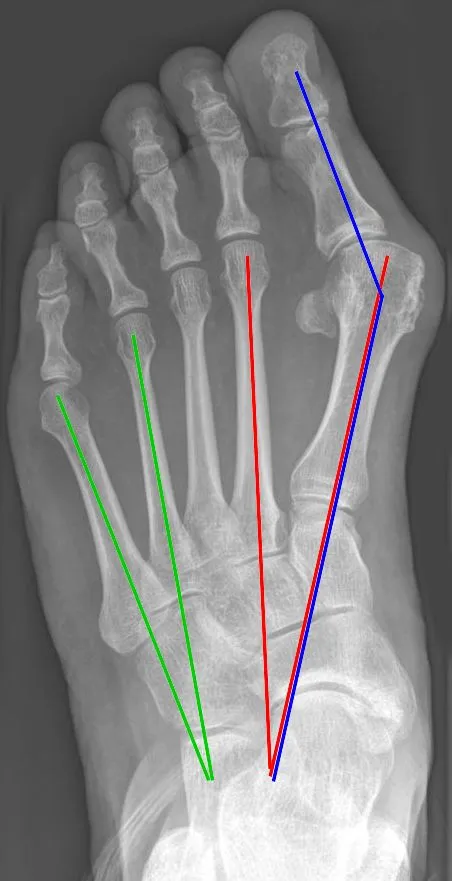
Hallux valgus is a progressive deformity of the first ray in which the great toe deviates laterally at the metatarsophalangeal (MTP) joint while the first metatarsal drifts medially (metatarsus primus varus), producing a painful medial prominence or bunion. It affects about a quarter of adults and a third of people over 65, mostly women, with strong family history and aggravation by narrow, high-heeled footwear. Patients describe bunion pain, shoe-fitting problems, metatarsalgia and lesser-toe deformities. Weight-bearing radiographs measure the hallux valgus angle (normal under 15 degrees) and intermetatarsal angle (normal under 9 degrees). Wide footwear, pads and orthoses relieve symptoms but do not correct the deformity. Surgery is for persistent pain, not cosmetic concern: distal (chevron), shaft (Scarf) or proximal osteotomies, Lapidus fusion for hypermobility, or first MTP arthrodesis for severe or arthritic deformity. Key risks are recurrence, transfer metatarsalgia, stiffness, nerve injury, non-union and hallux varus.
Patient case, mechanism, investigations, management, flashcards and exam-style questions.Open the lesson →
Key facts
- Pooled prevalence about 23% in adults aged 18–65 and about 36% over 65; women are affected more than twice as often as men
- Normal hallux valgus angle (HVA) is under 15° and intermetatarsal angle (IMA) under 9°; severity is graded by these angles
- Always use weight-bearing AP and lateral foot X-rays; non-weight-bearing films underestimate the deformity
- Causes: genetic predisposition, narrow and high-heeled footwear, female sex, ligamentous laxity, first ray hypermobility, rheumatoid arthritis, pes planus
- Conservative care (wide toe box, bunion pads, toe spacers, orthoses) relieves pain but does not correct the deformity
- Surgery is indicated for pain and functional limitation, not cosmesis; in an RCT, osteotomy reduced pain more than orthoses or waiting
- Procedure choice depends on IMA and joint health: distal chevron (mild), Scarf (moderate), proximal osteotomy or Lapidus (severe or hypermobile), MTP arthrodesis (arthritic or severe)
- Complications: recurrence, transfer metatarsalgia, stiffness, hallux varus, avascular necrosis of the metatarsal head, non-union, dorsomedial cutaneous nerve injury
Differential diagnosis
| Condition | Clues | Key test |
|---|---|---|
| Hallux rigidus (first MTP osteoarthritis) | Painful stiff great toe, dorsal osteophyte, limited dorsiflexion | Weight-bearing X-ray: joint space loss, dorsal osteophyte |
| Gout | Acute hot, red, swollen first MTP joint | Joint aspiration: negatively birefringent urate crystals |
| Rheumatoid forefoot | Bilateral deformity, MTP synovitis, lesser-toe dislocation | Rheumatoid factor, anti-CCP; X-ray erosions |
| Septic arthritis or infected bursa | Fever, warmth, erythema, diabetes | Aspiration and culture |
| Morton neuroma | Burning pain between third and fourth toes, Mulder click | Ultrasound |
| Sesamoiditis | Plantar pain under the first metatarsal head | X-ray sesamoid views; MRI |
| Bunionette (tailor's bunion) | Prominence over the fifth metatarsal head | Clinical; X-ray |
Exam pearls
Guideline
No single international guideline; recommendations based on randomised evidence (Torkki 2001), systematic reviews of surgical outcomes (EFORT Open Reviews 2021–2025) and national interventional procedures guidance on minimally invasive techniques
References
- Nix S, Smith M, Vicenzino B.. Prevalence of hallux valgus in the general population: a systematic review and meta-analysis. J Foot Ankle Res 2010.
- Torkki M, Malmivaara A, Seitsalo S, Hoikka V, Laippala P, Paavolainen P.. Surgery vs orthosis vs watchful waiting for hallux valgus: a randomized controlled trial. JAMA 2001.
- Trnka HJ.. Percutaneous, MIS and open hallux valgus surgery. EFORT Open Rev 2021.
- Lalevee M, Saffarini M, van Rooij F, Nover L, Nogier A, Beaudet P.. Recurrence rates with long-term follow-up after hallux valgus surgical treatment using shaft metatarsal osteotomies: a systematic review and meta-analysis. EFORT Open Rev 2024.
- Füssenich W, Seeber GH, Zwoferink JR, Somford MP, Stevens M.. Non-union incidence of different joint preparation types, joint fixation techniques, and postoperative weightbearing protocols for arthrodesis of the first metatarsophalangeal joint in moderate-to-severe hallux valgus: a systematic review. EFORT Open Rev 2023.
- Chong XL, Drittenbass L, Dubois-Ferriere V, Assal M.. Iatrogenic transfer metatarsalgia after hallux valgus surgery: a comprehensive treatment algorithm. EFORT Open Rev 2022.
Related topics
By Dr Khalid Seidi (B.Sc., M.D.) · MedEd World Clinical Knowledge library. Original teaching content checked against current guidelines (November 2026); confirm the latest local guidance before clinical use. Not a substitute for clinical judgement.