Clinical Knowledge › Surgery › Elective orthopaedics
Spinal stenosis
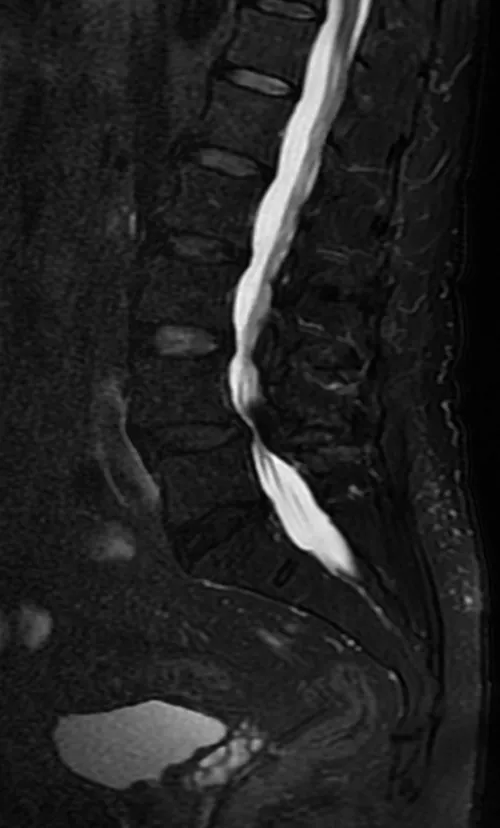
Spinal stenosis is narrowing of the spinal canal, lateral recesses or foramina that compresses neural tissue. Lumbar stenosis is usually degenerative, caused by facet hypertrophy, thickened ligamentum flavum, disc bulging and degenerative spondylolisthesis, and affects older adults. It causes neurogenic claudication: bilateral buttock and leg pain, heaviness or paraesthesia on standing and walking, relieved slowly by sitting or bending forward, with normal pulses. MRI confirms the diagnosis; flexion–extension radiographs show instability and ABPI excludes vascular claudication. Most patients are managed with exercise, analgesia and activity modification, and epidural injections give short-term relief. Decompression is offered for persistent disabling symptoms, progressive deficit or cauda equina syndrome; trials show adding fusion usually gives no extra benefit, even with degenerative spondylolisthesis. Cervical stenosis causes degenerative cervical myelopathy with clumsy hands, gait ataxia and upper motor neurone signs, and moderate or severe disease needs surgical decompression.
Patient case, mechanism, investigations, management, flashcards and exam-style questions.Open the lesson →
Key facts
- Neurogenic claudication: bilateral leg pain on standing and walking, relieved by sitting or flexing, normal pulses
- Walking uphill and cycling are better tolerated than walking downhill because flexion widens the canal
- MRI is the imaging test of choice; CT myelography if MRI is contraindicated
- Degenerative spondylolisthesis classically affects L4/5 in older women; graded by Meyerding (I–V)
- Most patients are managed non-surgically; surgery and physiotherapy gave similar 2-year outcomes in one trial
- Adding fusion to decompression did not improve outcomes in the Swedish and NORDSTEN trials
- Decompression relieves leg pain more reliably than back pain
- Degenerative cervical myelopathy: clumsy hands, gait ataxia, Hoffmann sign, hyperreflexia; operate for moderate or severe disease
Differential diagnosis
| Condition | Clues | Key test |
|---|---|---|
| Peripheral arterial disease | Calf claudication relieved by standing still, absent pulses, cycling also painful | ABPI and arterial duplex |
| Lumbar disc herniation | Younger, unilateral sciatica, positive straight leg raise | MRI |
| Hip osteoarthritis | Groin pain, painful internal rotation | Hip radiograph |
| Peripheral neuropathy | Stocking sensory loss, constant symptoms, absent ankle jerks bilaterally | Nerve conduction studies, glucose, B12 |
| Degenerative cervical myelopathy | Clumsy hands, gait ataxia, upper motor neurone signs | MRI cervical spine |
| Spinal metastasis or myeloma | Night pain, weight loss, cancer history | MRI, myeloma screen |
| Greater trochanteric pain syndrome | Lateral hip pain, tenderness over trochanter | Clinical |
Exam pearls
Guideline
NASS evidence-based clinical guideline for degenerative lumbar spinal stenosis (2011 update), NICE NG59 Low back pain and sciatica (2016, updated 2020) and AO Spine/CSRS guideline for degenerative cervical myelopathy (2017)
References
- Kreiner DS, Shaffer WO, Baisden JL, et al.. An evidence-based clinical guideline for the diagnosis and treatment of degenerative lumbar spinal stenosis (update). Spine J 2013.
- Katz JN, Zimmerman ZE, Mass H, Makhni MC. Diagnosis and management of lumbar spinal stenosis: a review. JAMA 2022.
- Försth P, Ólafsson G, Carlsson T, et al.. A randomized, controlled trial of fusion surgery for lumbar spinal stenosis. N Engl J Med 2016.
- Austevoll IM, Hermansen E, Fagerland MW, et al.. Decompression with or without fusion in degenerative lumbar spondylolisthesis. N Engl J Med 2021.
- Delitto A, Piva SR, Moore CG, et al.. Surgery versus nonsurgical treatment of lumbar spinal stenosis: a randomized trial. Ann Intern Med 2015.
- National Institute for Health and Care Excellence. Low back pain and sciatica in over 16s: assessment and management (NG59). NICE 2016.
Related topics
By Dr Khalid Seidi (B.Sc., M.D.) · MedEd World Clinical Knowledge library. Original teaching content checked against current guidelines (November 2026); confirm the latest local guidance before clinical use. Not a substitute for clinical judgement.