Clinical Knowledge › Surgery › Elective orthopaedics
Osteoarthritis and joint replacement
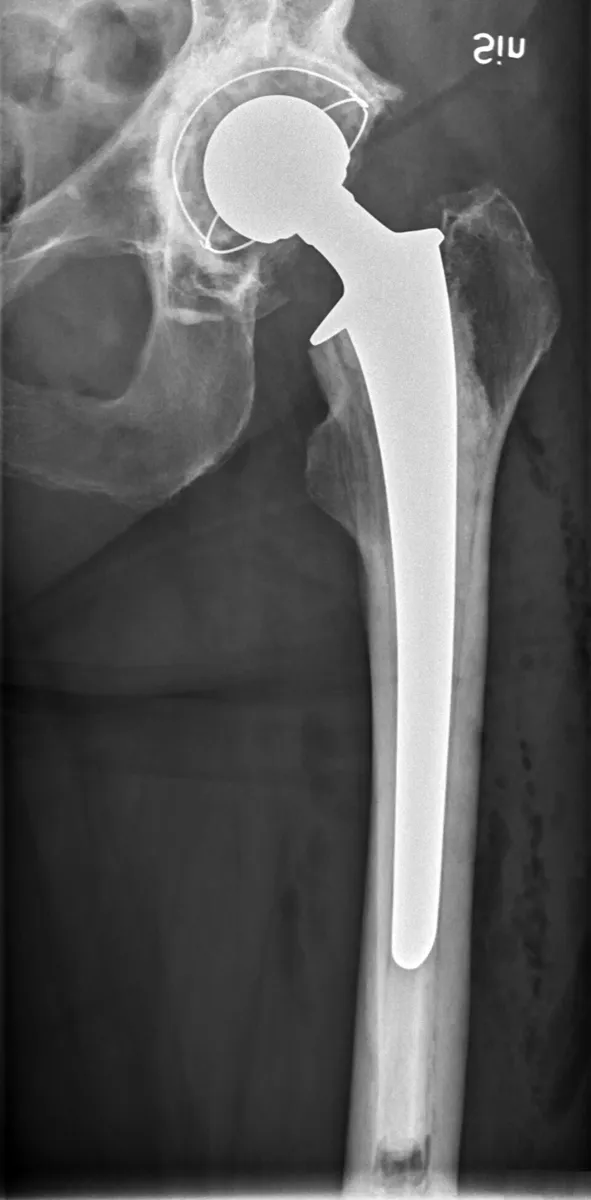
Joint replacement is the definitive treatment for end-stage osteoarthritis of the hip and knee when pain and loss of function substantially affect quality of life despite exercise, weight loss, education and analgesia. Referral should not be withheld because of age, BMI, smoking or comorbidity alone; these are optimised instead. Options are chosen by joint and pattern of disease: total hip replacement, total or unicompartmental knee replacement, high tibial osteotomy for younger patients with medial disease, arthrodesis for the ankle and small joints, and anatomical or reverse shoulder replacement. Arthroscopic washout is not recommended for knee osteoarthritis without true locking. Preparation includes diagnosis confirmation, medical optimisation, infection screening and enhanced recovery. Key complications are dislocation, venous thromboembolism, periprosthetic joint infection, periprosthetic fracture, nerve injury and late aseptic loosening from wear-particle osteolysis. Most implants last 15–25 years, but about one in five knee patients has persistent pain.
Patient case, mechanism, investigations, management, flashcards and exam-style questions.Open the lesson →
Key facts
- Refer for arthroplasty when symptoms substantially affect quality of life despite core non-surgical treatment
- Age, BMI, smoking and comorbidity should not alone exclude patients from referral; optimise them
- Do not offer arthroscopic lavage or debridement for knee OA unless there is true mechanical locking
- Unicompartmental knee replacement gives outcomes similar to TKR for isolated medial OA (TOPKAT) and is more cost-effective
- Posterior hip dislocation after THR: shortened, internally rotated limb; avoid deep flexion with adduction and internal rotation
- Periprosthetic joint infection affects about 1%; aspirate before giving antibiotics
- Aseptic loosening from polyethylene wear-particle osteolysis is the commonest late cause of revision
- Extended VTE prophylaxis: about 28 days after hip and 14 days after knee replacement (NICE NG89)
Differential diagnosis
| Condition | Clues | Key test |
|---|---|---|
| Referred pain from lumbar spine | Buttock pain radiating below knee, back pain, normal hip rotation | Lumbar MRI; diagnostic hip injection |
| Avascular necrosis of femoral head | Younger, steroids or alcohol, groin pain, early normal radiographs | MRI |
| Inflammatory arthritis | Morning stiffness > 1 h, symmetrical small joints, raised CRP | RF, anti-CCP, CRP; concentric joint-space loss |
| Greater trochanteric pain syndrome | Lateral hip pain, tenderness over trochanter, pain lying on side | Clinical; ultrasound |
| Septic arthritis or PJI | Acute pain, fever, effusion, raised CRP | Joint aspiration and culture |
| Meniscal tear with locking | Younger, twisting injury, true locking | MRI knee |
| Pathological fracture or metastasis | Night pain, weight loss, cancer history | Radiograph, MRI, bone scan |
Exam pearls
Guideline
NICE NG157 Joint replacement (primary): hip, knee and shoulder (2020), NICE NG226 Osteoarthritis in over 16s (2022), AAOS hip osteoarthritis guideline (2023) and AAOS knee osteoarthritis guideline (2021), with NICE NG89 VTE prophylaxis
References
- National Institute for Health and Care Excellence. Joint replacement (primary): hip, knee and shoulder (NG157). NICE 2020.
- National Institute for Health and Care Excellence. Osteoarthritis in over 16s: diagnosis and management (NG226). NICE 2022.
- American Academy of Orthopaedic Surgeons. Management of Osteoarthritis of the Hip: Evidence-Based Clinical Practice Guideline. AAOS 2023.
- American Academy of Orthopaedic Surgeons. Management of Osteoarthritis of the Knee (Non-Arthroplasty): Evidence-Based Clinical Practice Guideline, 3rd edition. AAOS 2021.
- Skou ST, Roos EM, Laursen MB, et al.. A randomized, controlled trial of total knee replacement. N Engl J Med 2015.
- Beard DJ, Davies LJ, Cook JA, et al.. The clinical and cost-effectiveness of total versus partial knee replacement in patients with medial compartment osteoarthritis (TOPKAT): 5-year outcomes of a randomised controlled trial. Lancet 2019.
Related topics
By Dr Khalid Seidi (B.Sc., M.D.) · MedEd World Clinical Knowledge library. Original teaching content checked against current guidelines (November 2026); confirm the latest local guidance before clinical use. Not a substitute for clinical judgement.