Clinical Knowledge › Surgery › Elective orthopaedics
Lumbar disc prolapse and sciatica
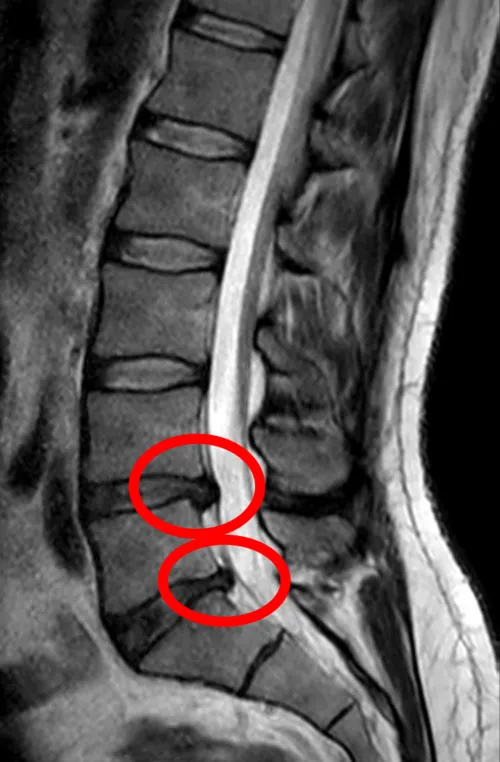
Lumbar disc prolapse is herniation of nucleus pulposus through a torn annulus, most often at L4/5 or L5/S1. A posterolateral herniation compresses the traversing root (L4/5 affects L5; L5/S1 affects S1), whereas a far-lateral herniation affects the exiting root. Patients have leg pain worse than back pain radiating below the knee, positive straight leg raise and dermatomal sensory, myotomal and reflex changes. Most improve within 6–12 weeks with staying active, NSAIDs and exercise; gabapentinoids, oral steroids, benzodiazepines and long-term opioids are not recommended. MRI is reserved for red flags or when an injection or operation is planned. Cauda equina syndrome (bilateral sciatica, saddle anaesthesia, sphincter dysfunction) needs emergency MRI and decompression, and progressive motor deficit needs urgent surgery. Microdiscectomy for persistent disabling sciatica gives faster relief than continued conservative care, with similar long-term results; key risks are dural tear, root injury, infection and recurrence.
Patient case, mechanism, investigations, management, flashcards and exam-style questions.Open the lesson →
Key facts
- Around 90–95% of lumbar disc herniations occur at L4/5 or L5/S1
- Posterolateral herniation compresses the traversing root (L4/5 → L5); far-lateral compresses the exiting root (L4/5 → L4)
- L5: weak great-toe extension and foot dorsiflexion, no reliable reflex; S1: weak plantarflexion, absent ankle jerk
- Straight leg raise is sensitive; crossed straight leg raise is highly specific for disc herniation
- Most sciatica improves within 6–12 weeks; sequestrated fragments often resorb
- Cauda equina syndrome: bilateral sciatica, saddle anaesthesia, sphincter dysfunction → emergency MRI and decompression
- NICE NG59: no gabapentinoids, oral steroids or benzodiazepines for sciatica; consider epidural steroid for acute severe sciatica
- Microdiscectomy gives faster leg-pain relief than prolonged conservative care; outcomes converge at 1–2 years
Differential diagnosis
| Condition | Clues | Key test |
|---|---|---|
| Lumbar spinal stenosis | Older, bilateral neurogenic claudication relieved by flexion | MRI: canal or lateral recess narrowing |
| Cauda equina syndrome | Saddle anaesthesia, retention, bilateral symptoms | Emergency MRI |
| Spinal infection (discitis, epidural abscess) | Fever, IV drug use, diabetes, raised CRP | MRI with contrast, blood cultures |
| Spinal metastasis or nerve sheath tumour | Night pain, cancer history, weight loss | MRI with contrast |
| Hip osteoarthritis | Groin pain, lost internal rotation, pain above knee | Hip radiograph |
| Common peroneal nerve palsy | Foot drop with preserved inversion and hip abduction, fibular neck trauma | Nerve conduction studies |
| Peripheral arterial disease | Calf claudication relieved by standing still, absent pulses | ABPI, duplex |
| Herpes zoster (pre-eruptive) | Burning dermatomal pain, later vesicles | Clinical |
Exam pearls
Guideline
NICE NG59 Low back pain and sciatica in over 16s (2016, updated 2020) and NASS evidence-based guideline for lumbar disc herniation with radiculopathy (2012; published 2014), with the GIRFT national suspected cauda equina syndrome pathway (2023)
References
- National Institute for Health and Care Excellence. Low back pain and sciatica in over 16s: assessment and management (NG59). NICE 2016.
- Kreiner DS, Hwang SW, Easa JE, et al.. An evidence-based clinical guideline for the diagnosis and treatment of lumbar disc herniation with radiculopathy. Spine J 2014.
- Peul WC, van Houwelingen HC, van den Hout WB, et al.. Surgery versus prolonged conservative treatment for sciatica. N Engl J Med 2007.
- Bailey CS, Rasoulinejad P, Taylor D, et al.. Surgery versus conservative care for persistent sciatica lasting 4 to 12 months. N Engl J Med 2020.
- Weinstein JN, Tosteson TD, Lurie JD, et al.. Surgical vs nonoperative treatment for lumbar disk herniation: the Spine Patient Outcomes Research Trial (SPORT): a randomized trial. JAMA 2006.
- Deyo RA, Mirza SK. Herniated lumbar intervertebral disk. N Engl J Med 2016.
Related topics
By Dr Khalid Seidi (B.Sc., M.D.) · MedEd World Clinical Knowledge library. Original teaching content checked against current guidelines (November 2026); confirm the latest local guidance before clinical use. Not a substitute for clinical judgement.