Clinical Knowledge › Internal medicine › Pulmonology › Respiratory infections
Invasive pulmonary aspergillosis and aspergilloma
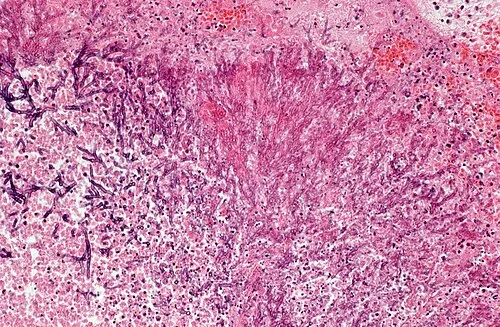
Aspergillus species, mainly A. fumigatus, are moulds whose small airborne conidia are inhaled every day. Disease depends on the host. In people with profound immune suppression, especially prolonged neutropenia, allogeneic stem-cell transplantation, high-dose steroids, or severe influenza or COVID-19 in intensive care, hyphae invade blood vessels and cause invasive pulmonary aspergillosis (IPA), with nodules, a halo sign on CT, haemorrhagic infarction and high mortality. In people with normal immunity but damaged lungs, the fungus colonises old cavities from tuberculosis or sarcoidosis to form an aspergilloma (fungal ball) or causes slowly progressive chronic pulmonary aspergillosis (CPA), presenting with weight loss, cough and haemoptysis. IPA is diagnosed by early CT and galactomannan in serum or bronchoalveolar lavage, with PCR and culture, and is treated urgently with voriconazole or isavuconazole. Aspergilloma and CPA are diagnosed by imaging and Aspergillus IgG. Symptomatic aspergilloma needs surgery or bronchial artery embolisation, and CPA needs months of oral azole therapy.
Patient case, mechanism, investigations, management, flashcards and exam-style questions.Open the lesson →
Key facts
- A. fumigatus causes most disease; hyphae are septate and branch at acute (about 45°) angles
- IPA risk: neutrophils below 0.5 × 10⁹/L for more than 10 days, allogeneic stem-cell transplant with graft-versus-host disease, high-dose steroids, lung transplant, severe influenza or COVID-19 in ICU
- CT in neutropenic IPA: nodules with a halo of ground glass (early), then an air-crescent sign as neutrophils recover
- Serum galactomannan (index 0.5 or more) or BAL galactomannan (1.0 or more) with compatible CT supports probable IPA
- First-line IPA treatment: voriconazole or isavuconazole; liposomal amphotericin B is the main alternative; monitor voriconazole levels
- Aspergilloma: fungal ball in a pre-existing cavity (often old TB) that moves with posture; main risk is haemoptysis
- Chronic pulmonary aspergillosis: at least 3 months of symptoms, cavities on imaging and positive Aspergillus IgG; treat with oral itraconazole or voriconazole for at least 6 months
- Rising azole resistance (TR34/L98H cyp51A mutations linked to agricultural fungicides) makes susceptibility testing important
Differential diagnosis
| Condition | Clues | Key test |
|---|---|---|
| Mucormycosis | Diabetic ketoacidosis, iron overload, voriconazole breakthrough, reverse halo sign, sinus involvement | Biopsy: broad ribbon-like pauci-septate hyphae; galactomannan negative |
| Bacterial pneumonia or septic emboli | Rapid onset, positive blood cultures, cavitating nodules | Blood cultures, response to antibiotics |
| Pulmonary tuberculosis | Upper-lobe cavity, weight loss, AFB | Sputum NAAT and culture |
| Lung cancer | Spiculated mass, smoker, enlarging nodule | Biopsy |
| Pneumocystis pneumonia | Diffuse ground glass rather than nodules, raised beta-D-glucan | BAL PCR |
| Granulomatosis with polyangiitis | Cavitating nodules with sinus and renal disease | PR3-ANCA, urinalysis, biopsy |
| Allergic bronchopulmonary aspergillosis | Asthma, high IgE, central bronchiectasis, mucus plugs | Total IgE, Aspergillus-specific IgE, eosinophils |
Exam pearls
Guideline
IDSA practice guidelines for aspergillosis (2016; prevention section for solid organ transplant updated 2026), ESCMID–ECMM–ERS guideline on Aspergillus diseases (2017/2018), ESCMID/ERS chronic pulmonary aspergillosis guideline (2016) and EORTC/MSGERC definitions (2020)
References
- Patterson TF, Thompson GR 3rd, Denning DW, et al.. Practice guidelines for the diagnosis and management of aspergillosis: 2016 update by the Infectious Diseases Society of America. Clin Infect Dis 2016.
- Ullmann AJ, Aguado JM, Arikan-Akdagli S, et al.. Diagnosis and management of Aspergillus diseases: executive summary of the 2017 ESCMID-ECMM-ERS guideline. Clin Microbiol Infect 2018.
- Denning DW, Cadranel J, Beigelman-Aubry C, et al.. Chronic pulmonary aspergillosis: rationale and clinical guidelines for diagnosis and management. Eur Respir J 2016.
- Donnelly JP, Chen SC, Kauffman CA, et al.. Revision and update of the consensus definitions of invasive fungal disease from the European Organization for Research and Treatment of Cancer and the Mycoses Study Group Education and Research Consortium. Clin Infect Dis 2020.
- Herbrecht R, Denning DW, Patterson TF, et al.. Voriconazole versus amphotericin B for primary therapy of invasive aspergillosis. N Engl J Med 2002.
- Maertens JA, Raad II, Marr KA, et al.. Isavuconazole versus voriconazole for primary treatment of invasive mould disease caused by Aspergillus and other filamentous fungi (SECURE): a phase 3, randomised-controlled, non-inferiority trial. Lancet 2016.
Related topics
By Dr Khalid Seidi (B.Sc., M.D.) · MedEd World Clinical Knowledge library. Original teaching content checked against current guidelines (November 2026); confirm the latest local guidance before clinical use. Not a substitute for clinical judgement.