Clinical Knowledge › Anaesthesiology › Pain medicine
Pain assessment tools
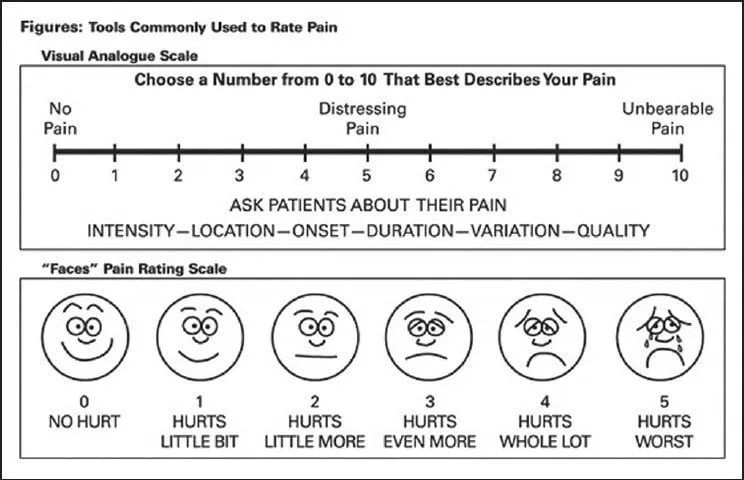
Pain is subjective, so the patient's own report is the reference standard whenever it can be obtained. For acute pain, unidimensional scales measure intensity: the 0–10 numerical rating scale (NRS), the 100 mm visual analogue scale, verbal rating scales and, for children aged about 4 and over, the Faces Pain Scale–Revised. Pain should be scored at rest and on movement or coughing, linked to function, and reassessed after every intervention together with sedation and respiratory rate when opioids are used. Chronic pain needs multidimensional tools such as the Brief Pain Inventory, screening questionnaires for neuropathic pain (DN4, LANSS) and measures of mood, beliefs and disability. When self-report is impossible, validated behavioural scales are used: CPOT or BPS in critically ill adults, PAINAD or Abbey in advanced dementia, and FLACC, NIPS or PIPP-R in young children and neonates. Vital signs alone are unreliable. Tools support, never replace, clinical judgement and must be used with attention to language, culture and bias.
Patient case, mechanism, investigations, management, flashcards and exam-style questions.Open the lesson →
Key facts
- Self-report is the reference standard: NRS 0–10 (1–3 mild, 4–6 moderate, 7–10 severe) is the most widely used and easiest scale
- A reduction of about 2 points or 30% on the NRS is considered clinically meaningful
- Score pain at rest and on movement or deep breathing; function (can the patient cough, mobilise, sleep?) matters more than a number
- CPOT: facial expression, body movements, muscle tension, ventilator compliance or vocalisation; each 0–2, total 0–8; above 2 suggests pain
- BPS: facial expression, upper limb movements, ventilator compliance; each 1–4, total 3–12; above 5 suggests pain
- PAINAD (dementia): breathing, negative vocalisation, facial expression, body language, consolability; each 0–2, total 0–10
- FLACC (Face, Legs, Activity, Cry, Consolability) for children 2 months to 7 years and for cognitively impaired patients; FPS-R for ages about 4–12
- Neuropathic screening: DN4 4 or more out of 10, or LANSS 12 or more out of 24, suggests neuropathic pain
Differential diagnosis
| Condition | Clues | Key test |
|---|---|---|
| Delirium or agitation without pain | Restlessness persists after analgesia; inattention on CAM-ICU | CAM-ICU or 4AT; analgesic trial |
| Anxiety or fear | Distress linked to procedures or separation; settles with reassurance | Talk to patient, family input |
| Hypoxaemia or hypercapnia | Agitation with sweating, tachypnoea, falling SpO2 | ABG, oxygen saturation |
| Urinary retention or constipation | Lower abdominal distress, restlessness in dementia | Bladder scan, abdominal examination |
| Opioid withdrawal | Yawning, sweating, piloerection, diarrhoea after stopping opioids | History, Clinical Opiate Withdrawal Scale |
| Sedation masking pain | Low behavioural scores but deep sedation (RASS −4/−5) | Assess sedation level first; scores unreliable |
Exam pearls
Guideline
SCCM PADIS guideline (2018) with 2025 focused update, IASP revised definition of pain (2020) and NICE NG193 Chronic pain (2021)
References
- Devlin JW, Skrobik Y, Gélinas C, et al.. Clinical Practice Guidelines for the Prevention and Management of Pain, Agitation/Sedation, Delirium, Immobility, and Sleep Disruption in Adult Patients in the ICU. Crit Care Med 2018.
- Gélinas C, Fillion L, Puntillo KA, et al.. Validation of the critical-care pain observation tool in adult patients. Am J Crit Care 2006.
- Payen JF, Bru O, Bosson JL, et al.. Assessing pain in critically ill sedated patients by using a behavioral pain scale. Crit Care Med 2001.
- Warden V, Hurley AC, Volicer L. Development and psychometric evaluation of the Pain Assessment in Advanced Dementia (PAINAD) scale. J Am Med Dir Assoc 2003.
- Merkel SI, Voepel-Lewis T, Shayevitz JR, et al.. The FLACC: a behavioral scale for scoring postoperative pain in young children. Pediatr Nurs 1997.
- Hjermstad MJ, Fayers PM, Haugen DF, et al.. Studies comparing Numerical Rating Scales, Verbal Rating Scales, and Visual Analogue Scales for assessment of pain intensity in adults: a systematic literature review. J Pain Symptom Manage 2011.
Related topics
By Dr Khalid Seidi (B.Sc., M.D.) · MedEd World Clinical Knowledge library. Original teaching content checked against current guidelines (November 2026); confirm the latest local guidance before clinical use. Not a substitute for clinical judgement.