Clinical Knowledge › Anaesthesiology › Pain medicine
Patient-controlled analgesia
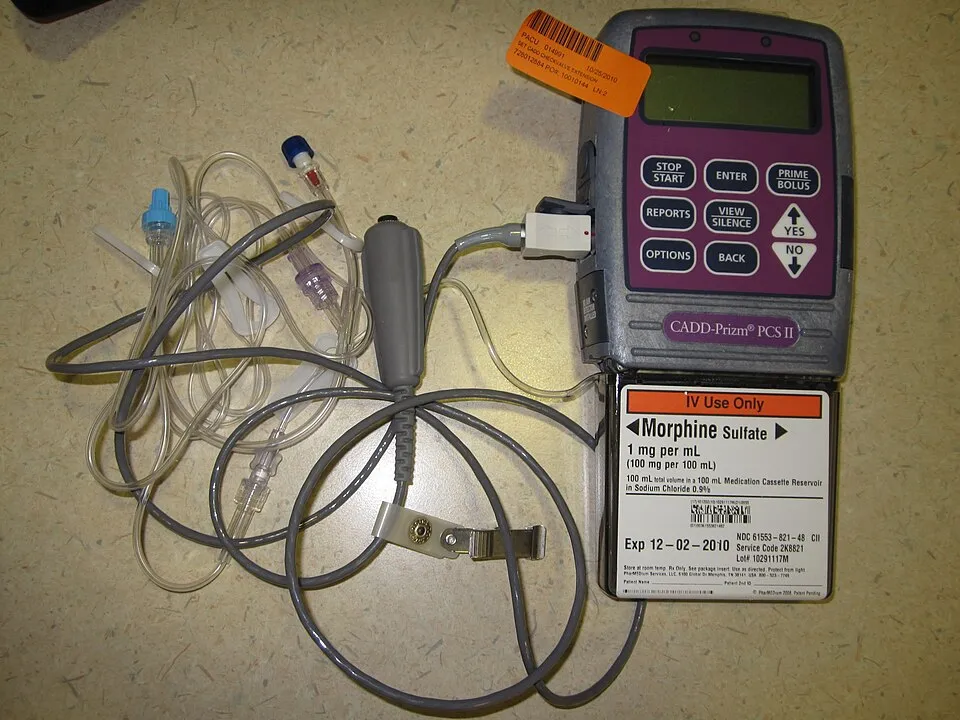
Patient-controlled analgesia (PCA) lets a patient give themselves small, preset doses of analgesic, usually an IV opioid, by pressing a button on a programmable pump. It works because a small bolus with a lockout keeps plasma levels inside the narrow band between pain and toxicity, and the patient's own drowsiness acts as a safety brake: a sedated patient stops pressing. A typical adult morphine PCA is a 1 mg bolus with a 5-minute lockout and no background infusion, after a nurse- or doctor-titrated loading dose. Compared with nurse-given opioid, PCA gives slightly better pain relief and more satisfaction but more opioid use and pruritus. Safety depends on patient selection (able to understand and press), standard concentrations, a dedicated line with anti-reflux and anti-siphon valves, regular sedation and respiratory observations, prescribed naloxone and antiemetics, and a ban on 'PCA by proxy'. Variants include epidural (PCEA), regional catheter, intranasal and remifentanil PCA in labour, and nurse-controlled analgesia in young children.
Patient case, mechanism, investigations, management, flashcards and exam-style questions.Open the lesson →
Key facts
- Components: loading dose (clinician), bolus (demand) dose, lockout interval, optional background infusion, optional 1- or 4-hour maximum
- Adult teaching settings: morphine 1 mg/5 min, oxycodone 1 mg/5 min, fentanyl 10–20 microgram/5 min, hydromorphone 0.2 mg/5 min; no background in opioid-naive patients (check local protocol)
- Lockout should be longer than the time to near-peak effect of each bolus so doses do not stack
- Background infusions increase respiratory depression without improving analgesia in opioid-naive adults
- Only the patient presses the button: 'PCA by proxy' by relatives or staff bypasses the sedation safety brake
- Monitor pain, sedation score, respiratory rate and SpO2 hourly at first; increasing sedation is the earliest warning
- Cochrane: PCA gives slightly lower pain scores and higher satisfaction than non-PCA opioid, with more opioid use and pruritus
- Dedicated IV line or anti-reflux valve prevents opioid pooling back up a shared line and being flushed as a large bolus
Differential diagnosis
| Condition | Clues | Key test |
|---|---|---|
| Inadequate PCA dose | Many demands, few good doses, pain persists, alert patient | Check demand:delivered ratio on pump history; increase bolus |
| Patient not using PCA properly | Few demands but high pain; fear of addiction or confusion | Pump history; reinforce teaching; consider alternative |
| Equipment fault or disconnection | Sudden pain with normal demand count | Check line, cannula, syringe, valve; tissued cannula |
| Surgical complication | New or rising pain after day 2, fever, tachycardia | Examine; bloods; imaging |
| Opioid toxicity | Sedation, low RR, pinpoint pupils, hallucinations | Sedation score, RR, renal function; stop PCA |
| Opioid withdrawal in tolerant patient | Agitation, yawning, rhinorrhoea, diarrhoea despite PCA | Baseline opioid omitted; restart regular dose |
Exam pearls
Guideline
American Pain Society/ASRA/ASA postoperative pain guideline (2016); international consensus on prevention of opioid-related harm in surgical patients (2021); RCoA GPAS inpatient pain management (2025); Cochrane review of PCA versus non-PCA opioid (2015)
References
- McNicol ED, Ferguson MC, Hudcova J.. Patient controlled opioid analgesia versus non-patient controlled opioid analgesia for postoperative pain. Cochrane Database Syst Rev 2015.
- Chou R, Gordon DB, de Leon-Casasola OA, et al.. Management of postoperative pain: a clinical practice guideline from the American Pain Society, the American Society of Regional Anesthesia and Pain Medicine, and the American Society of Anesthesiologists' Committee on Regional Anesthesia, Executive Committee, and Administrative Council. J Pain 2016.
- Levy N, Quinlan J, El-Boghdadly K, et al.. An international multidisciplinary consensus statement on the prevention of opioid-related harm in adult surgical patients. Anaesthesia 2021.
- Khanna AK, Bergese SD, Jungquist CR, et al.. Prediction of Opioid-Induced Respiratory Depression on Inpatient Wards Using Continuous Capnography and Oximetry: An International Prospective, Observational Trial. Anesth Analg 2020.
- Royal College of Anaesthetists. Guidelines for the Provision of Anaesthesia Services (GPAS): Guidelines for the provision of anaesthesia services for inpatient pain management. RCoA, London 2025.
- Wilson MJA, MacArthur C, Hewitt CA, et al.. Intravenous remifentanil patient-controlled analgesia versus intramuscular pethidine for pain relief in labour (RESPITE): an open-label, multicentre, randomised controlled trial. Lancet 2018.
Related topics
By Dr Khalid Seidi (B.Sc., M.D.) · MedEd World Clinical Knowledge library. Original teaching content checked against current guidelines (November 2026); confirm the latest local guidance before clinical use. Not a substitute for clinical judgement.