Clinical Knowledge › Anaesthesiology › Pain medicine
Physiology and classification of pain
Pain is defined by the IASP (2020) as an unpleasant sensory and emotional experience associated with, or resembling that associated with, actual or potential tissue damage; it is always personal and distinct from nociception. Nociception has four steps: transduction at nociceptors (TRPV1, Nav1.7 and inflammatory mediators such as prostaglandins and bradykinin), transmission along fast Aδ and slow C fibres to the dorsal horn, ascending projection in the spinothalamic and spinoreticular pathways to thalamus, somatosensory, insular and cingulate cortex, and modulation by spinal gating and descending inhibition from the periaqueductal grey using opioids, serotonin and noradrenaline. Peripheral and central sensitisation produce hyperalgesia and allodynia. Pain is classified by duration (acute, or chronic beyond 3 months), by mechanism (nociceptive somatic or visceral, neuropathic, nociplastic, or mixed) and, for chronic pain, by the ICD-11 IASP scheme. Each step is a drug target, which is the basis of multimodal analgesia.
Patient case, mechanism, investigations, management, flashcards and exam-style questions.Open the lesson →
Key facts
- IASP 2020: pain is an unpleasant sensory and emotional experience associated with, or resembling that associated with, actual or potential tissue damage
- Aδ fibres (thinly myelinated, about 5–30 m/s) carry sharp, well-localised first pain; C fibres (unmyelinated, about 0.5–2 m/s) carry dull, burning second pain
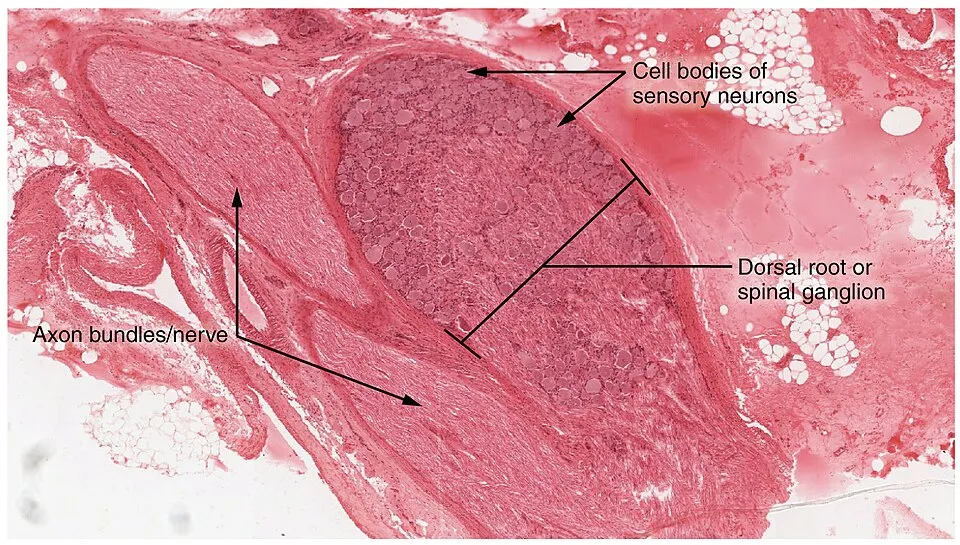
- First-order neurons synapse in dorsal horn laminae I, II (substantia gelatinosa) and V using glutamate, substance P and CGRP
- The lateral spinothalamic tract crosses within 1–2 segments in the anterior white commissure and ascends to the ventral posterolateral thalamus
- Descending inhibition: periaqueductal grey to rostral ventromedial medulla to dorsal horn, using endogenous opioids, serotonin and noradrenaline
- Central sensitisation: repeated C-fibre input removes the Mg2+ block of NMDA receptors (wind-up), causing secondary hyperalgesia and allodynia
- Mechanistic categories: nociceptive (somatic, visceral), neuropathic (lesion or disease of the somatosensory system), nociplastic (altered nociception without either), mixed
- Chronic pain is pain persisting or recurring for longer than 3 months; ICD-11 separates chronic primary pain from six chronic secondary pain categories
Differential diagnosis
| Condition | Clues | Key test |
|---|---|---|
| Nociceptive somatic pain | Well localised, sharp or aching, worse on movement, tender site | Clinical; imaging of injured tissue |
| Nociceptive visceral pain | Poorly localised, dull, cramping, referred, with nausea and sweating | Imaging or endoscopy of the organ |
| Peripheral neuropathic pain | Burning, shooting, electric pain in a nerve or dermatomal territory with sensory change | DN4 or LANSS, examination, nerve conduction studies |
| Central neuropathic pain | Pain after stroke, spinal cord injury or multiple sclerosis in an area of sensory loss | MRI brain or spine |
| Nociplastic pain | Widespread pain, fatigue, poor sleep, hypersensitivity without tissue or nerve damage | Clinical criteria (e.g. fibromyalgia); exclude other causes |
| Referred visceral pain mistaken for musculoskeletal pain | Shoulder-tip pain from diaphragmatic irritation; arm or jaw pain in myocardial ischaemia | ECG, troponin, abdominal imaging |
Exam pearls
Guideline
IASP revised definition of pain (2020), IASP classification of chronic pain for ICD-11 (2019; ICD-11 in force from 2022), IASP nociplastic pain descriptor (2017) and NICE NG193 Chronic pain (2021)
References
- Raja SN, Carr DB, Cohen M, et al.. The revised International Association for the Study of Pain definition of pain: concepts, challenges, and compromises. Pain 2020.
- Treede RD, Rief W, Barke A, et al.. Chronic pain as a symptom or a disease: the IASP Classification of Chronic Pain for the International Classification of Diseases (ICD-11). Pain 2019.
- Kosek E, Cohen M, Baron R, et al.. Do we need a third mechanistic descriptor for chronic pain states?. Pain 2016.
- Woolf CJ. Central sensitization: implications for the diagnosis and treatment of pain. Pain 2011.
- Basbaum AI, Bautista DM, Scherrer G, et al.. Cellular and molecular mechanisms of pain. Cell 2009.
- Finnerup NB, Haroutounian S, Kamerman P, et al.. Neuropathic pain: an updated grading system for research and clinical practice. Pain 2016.
Related topics
By Dr Khalid Seidi (B.Sc., M.D.) · MedEd World Clinical Knowledge library. Original teaching content checked against current guidelines (November 2026); confirm the latest local guidance before clinical use. Not a substitute for clinical judgement.