Clinical Knowledge › Internal medicine › Haematology and oncology › Clinical problems
Raised white cell count: approach to the patient
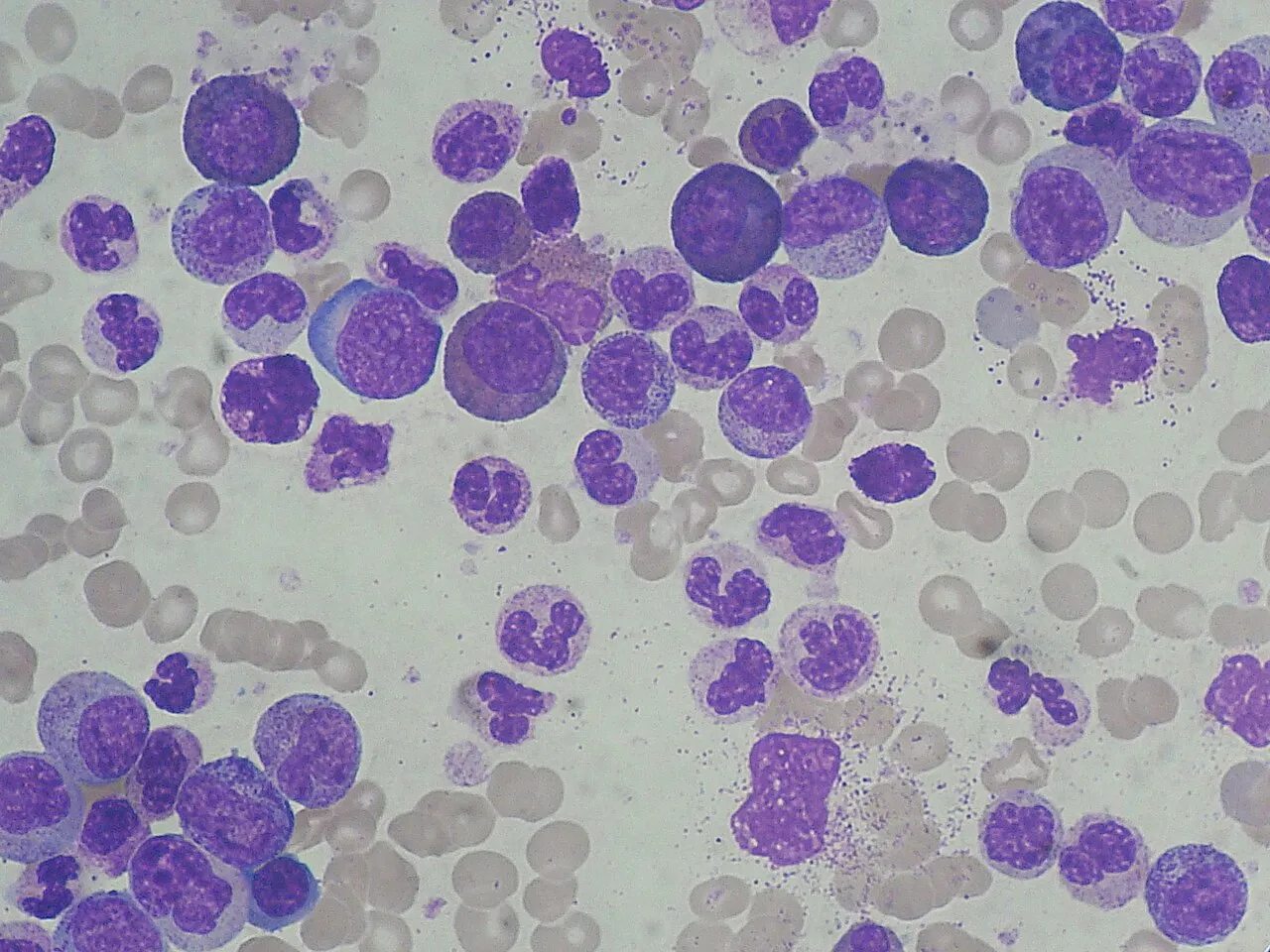
A raised white cell count (leucocytosis) is a total count above the upper reference limit, usually about 11 × 10⁹/L in adults. It is a sign, not a diagnosis, and most cases are reactive. The approach starts by asking which cell type is increased – neutrophils, lymphocytes, monocytes, eosinophils or basophils – and whether the cells are mature. Neutrophilia is commonly caused by bacterial infection, inflammation, tissue damage, corticosteroids, smoking, pregnancy, exercise or asplenia. Lymphocytosis suggests viral infection or, in older adults, chronic lymphocytic leukaemia. Blasts, a very high count, a left shift down to myelocytes with basophilia, splenomegaly or abnormal other cell lines point towards leukaemia or a myeloproliferative neoplasm. The blood film is the key test, followed by flow cytometry for lymphocytosis and BCR::ABL1 testing for suspected CML. A count above 100 × 10⁹/L (hyperleucocytosis), or blasts with breathlessness, confusion or visual change (leukostasis), is a haematological emergency needing same-day specialist care.
Patient case, mechanism, investigations, management, flashcards and exam-style questions.Open the lesson →
Key facts
- Leucocytosis: WBC >11 × 10⁹/L in adults; leukaemoid reaction: reactive count >50 × 10⁹/L; hyperleucocytosis: >100 × 10⁹/L (usually leukaemia)
- Neutrophilia is the commonest type; causes include infection, inflammation, steroids, smoking, pregnancy, surgery, burns, myocardial infarction and post-splenectomy
- Reactive neutrophilia: toxic granulation, Döhle bodies, vacuolation and left shift to band forms, without basophilia or blasts
- CML: very high WBC with a full spectrum of myeloid cells (myelocyte and neutrophil 'peaks'), basophilia, splenomegaly; confirm BCR::ABL1
- Lymphocytosis in adults over about 50 with smear cells: suspect CLL; diagnosis needs ≥5 × 10⁹/L clonal B cells (CD5+, CD19+, CD23+, dim CD20 and light chain)
- Eosinophilia >1.5 × 10⁹/L (hypereosinophilia) needs a search for parasites, drugs, allergy, vasculitis and myeloid/lymphoid neoplasms
- Persistent monocytosis ≥0.5 × 10⁹/L and ≥10% of WBC in an older adult raises suspicion of CMML (threshold lowered from 1.0 in WHO-HAEM5)
- Pseudoleucocytosis: nucleated red cells, platelet clumps and cryoglobulins can be counted as white cells by analysers
Differential diagnosis
| Condition | Clues | Key test |
|---|---|---|
| Bacterial infection or sepsis | Fever, focal source, neutrophilia with left shift and toxic granulation | CRP, cultures, imaging of the source |
| Corticosteroid-induced neutrophilia | Started steroids in the last days; no left shift; lymphopenia and eosinopenia | Drug history; resolves on dose reduction |
| Chronic myeloid leukaemia | Splenomegaly, basophilia, myelocytes, sweats, weight loss | BCR::ABL1 by RT-qPCR or FISH |
| Chronic lymphocytic leukaemia | Older adult, lymphocytosis, smear cells, lymphadenopathy | Peripheral blood flow cytometry |
| Acute leukaemia | Blasts on film, anaemia, thrombocytopenia, bleeding, infections | Urgent film review, flow cytometry, marrow |
| Infectious mononucleosis | Young adult, sore throat, atypical lymphocytes, splenomegaly | Heterophile antibody or EBV serology |
| Polycythaemia vera or other MPN | Raised Hb or platelets with neutrophilia, splenomegaly, itch | JAK2 V617F, CALR, MPL |
| Eosinophilia (parasitic, allergic, drug, neoplastic) | Travel, asthma, rash, new drug, organ damage | Stool microscopy, Strongyloides serology, IgE, tryptase, FIP1L1::PDGFRA |
Exam pearls
Guideline
WHO-HAEM5 (2022) and ICC 2022 classifications of myeloid and lymphoid neoplasms, iwCLL 2018 diagnostic criteria and European LeukemiaNet CML recommendations (2025)
References
- Riley LK, Rupert J.. Evaluation of patients with leukocytosis. Am Fam Physician 2015.
- Khoury JD, Solary E, Abla O, et al.. The 5th edition of the World Health Organization Classification of Haematolymphoid Tumours: Myeloid and Histiocytic/Dendritic Neoplasms. Leukemia 2022.
- Arber DA, Orazi A, Hasserjian RP, et al.. International Consensus Classification of Myeloid Neoplasms and Acute Leukemias: integrating morphologic, clinical, and genomic data. Blood 2022.
- Alaggio R, Amador C, Anagnostopoulos I, et al.. The 5th edition of the World Health Organization Classification of Haematolymphoid Tumours: Lymphoid Neoplasms. Leukemia 2022.
- Hallek M, Cheson BD, Catovsky D, et al.. iwCLL guidelines for diagnosis, indications for treatment, response assessment, and supportive management of CLL. Blood 2018.
- Apperley JF, Milojkovic D, Cross NCP, et al.. 2025 European LeukemiaNet recommendations for the management of chronic myeloid leukemia. Leukemia 2025.
Related topics
By Dr Khalid Seidi (B.Sc., M.D.) · MedEd World Clinical Knowledge library. Original teaching content checked against current guidelines (November 2026); confirm the latest local guidance before clinical use. Not a substitute for clinical judgement.