Clinical Knowledge › Internal medicine › Haematology and oncology › Clinical problems
Splenomegaly: approach to the patient
Splenomegaly is enlargement of the spleen, usually defined on ultrasound as a length over about 12–13 cm. A normal spleen is not palpable; one that can be felt is generally at least twice normal size. The spleen enlarges by five mechanisms: immune hyperplasia (infection, autoimmune disease), work hypertrophy from removing abnormal red cells (haemolytic anaemias, thalassaemia), congestion (portal hypertension, hepatic vein obstruction, heart failure), infiltration (leukaemia, lymphoma, myeloproliferative neoplasms, storage diseases, amyloid) and extramedullary haematopoiesis (myelofibrosis). Worldwide, malaria, leishmaniasis, schistosomiasis and cirrhosis lead; massive splenomegaly suggests CML, myelofibrosis, visceral leishmaniasis, chronic malaria or lymphoma. The approach combines examination, blood count and film, liver tests, ultrasound and targeted tests for infection, haemolysis, portal hypertension and malignancy. Complications include hypersplenism with cytopenias, infarction and rupture; after splenectomy, vaccination and antibiotic advice prevent overwhelming infection.
Patient case, mechanism, investigations, management, flashcards and exam-style questions.Open the lesson →
Key facts
- Normal spleen: about 150 g and up to 12–13 cm long on ultrasound; it must enlarge about 2–3 times before it is palpable
- Mechanisms: immune hyperplasia, red cell destruction, congestion, infiltration and extramedullary haematopoiesis
- Massive splenomegaly (crossing the midline or reaching the right iliac fossa): CML, myelofibrosis, visceral leishmaniasis, chronic malaria (hyperreactive malarial splenomegaly), lymphoma, Gaucher disease, thalassaemia major
- Spleen on examination: left upper quadrant mass that moves down with inspiration, has a notch, cannot be got above and is dull to percussion
- Hypersplenism: splenomegaly with one or more cytopenias, compensatory marrow hyperplasia and correction after splenectomy
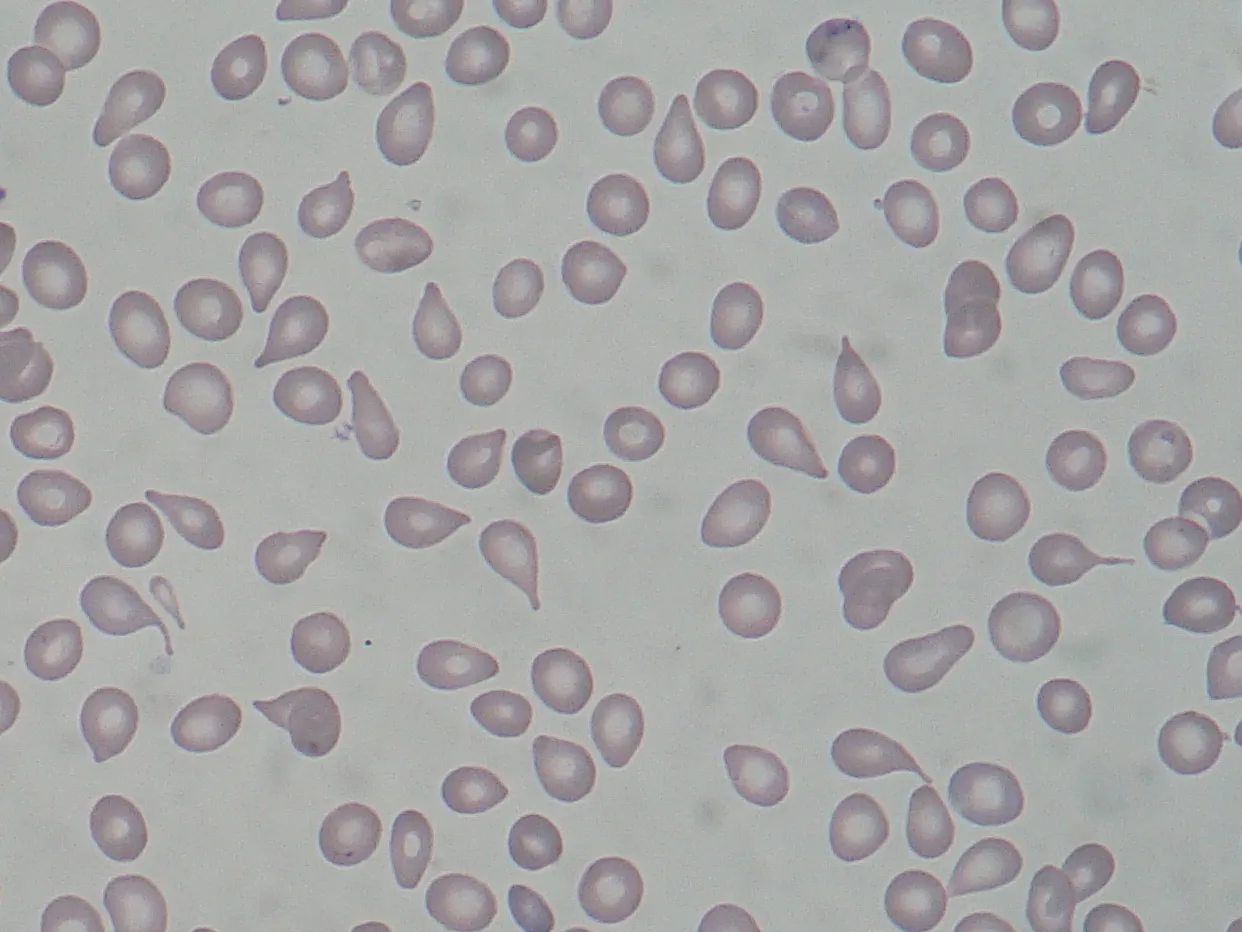
- Teardrop cells and a leucoerythroblastic film suggest myelofibrosis; JAK2, CALR and MPL testing and marrow trephine confirm
- Infectious mononucleosis: avoid contact sports for at least 3–4 weeks (often longer) because of splenic rupture risk
- Before elective splenectomy: pneumococcal, meningococcal (ACWY and B) and annual influenza vaccination at least 2 weeks beforehand, plus antibiotic prophylaxis and an alert card (BSH 2024)
Differential diagnosis
| Condition | Clues | Key test |
|---|---|---|
| Portal hypertension (cirrhosis, portal vein thrombosis, schistosomiasis) | Stigmata of liver disease, varices, ascites, thrombocytopenia | Liver tests, ultrasound with Doppler, elastography |
| Chronic myeloid leukaemia | Massive spleen, high WBC with basophilia and full spectrum of myeloid cells | BCR::ABL1 by PCR or FISH |
| Primary myelofibrosis | Massive spleen, teardrop cells, leucoerythroblastic film, older adult | JAK2/CALR/MPL, marrow trephine (fibrosis) |
| Visceral leishmaniasis (kala-azar) | Fever, weight loss, massive spleen, pancytopenia, endemic region (East Africa, South Asia, Brazil, Mediterranean) | rK39 rapid test; splenic or marrow aspirate for amastigotes |
| Malaria (acute or hyperreactive malarial splenomegaly) | Fever, travel or residence in endemic area; very high IgM in HMS | Thick and thin films or rapid diagnostic test |
| Haemolytic anaemia (hereditary spherocytosis, thalassaemia) | Jaundice, gallstones, family history, reticulocytosis | Film, reticulocytes, haemolysis screen, Hb electrophoresis |
| Lymphoma or CLL | Lymphadenopathy, B symptoms, lymphocytosis | Blood flow cytometry, node biopsy, CT |
| Infectious mononucleosis | Young adult, sore throat, posterior cervical nodes, atypical lymphocytes | Heterophile antibody or EBV serology |
Exam pearls
Guideline
BSH guideline on prevention and treatment of infection in patients with an absent or hypofunctional spleen (2024), WHO Classification of Haematolymphoid Tumours 5th edition and International Consensus Classification of myeloid neoplasms (2022), and Baveno VII consensus on portal hypertension (2022)
References
- Ladhani SN, Fernandes S, Garg M, et al.. Prevention and treatment of infection in patients with an absent or hypofunctional spleen: A British Society for Haematology guideline. Br J Haematol 2024.
- Pozo AL, Godfrey EM, Bowles KM.. Splenomegaly: investigation, diagnosis and management. Blood Rev 2009.
- Khoury JD, Solary E, Abla O, et al.. The 5th edition of the World Health Organization Classification of Haematolymphoid Tumours: Myeloid and Histiocytic/Dendritic Neoplasms. Leukemia 2022.
- Arber DA, Orazi A, Hasserjian RP, et al.. International Consensus Classification of Myeloid Neoplasms and Acute Leukemias: integrating morphologic, clinical, and genomic data. Blood 2022.
- de Franchis R, Bosch J, Garcia-Tsao G, et al.; Baveno VII Faculty.. Baveno VII – Renewing consensus in portal hypertension. J Hepatol 2022.
- Tefferi A.. Primary myelofibrosis: 2023 update on diagnosis, risk-stratification, and management. Am J Hematol 2023.
Related topics
By Dr Khalid Seidi (B.Sc., M.D.) · MedEd World Clinical Knowledge library. Original teaching content checked against current guidelines (November 2026); confirm the latest local guidance before clinical use. Not a substitute for clinical judgement.