Clinical Knowledge › Internal medicine › Cardiology and angiology › Diseases of the aorta and arteries
Subclavian steal syndrome
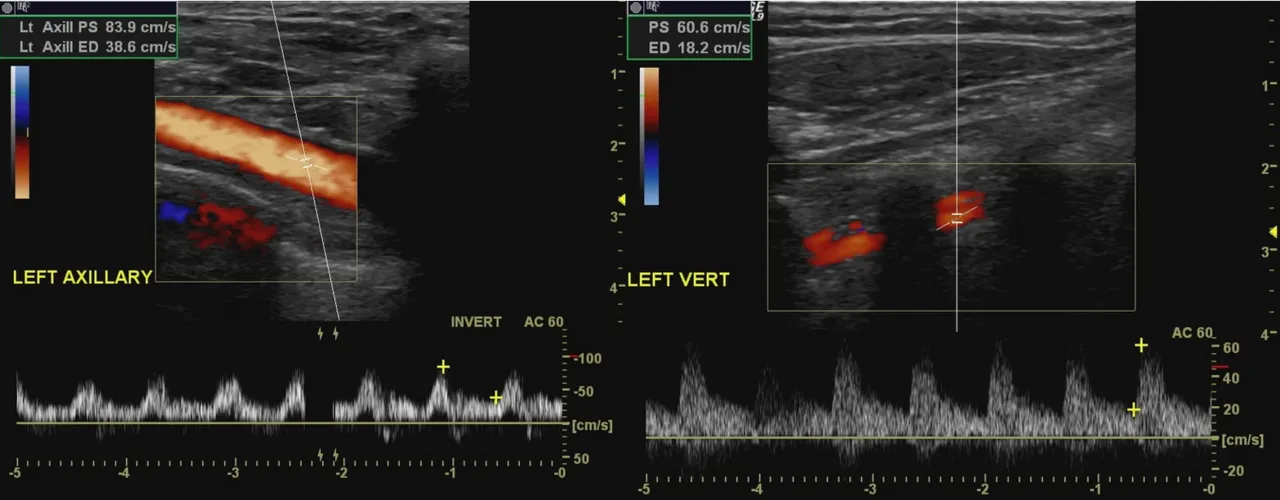
Subclavian steal describes reversal of blood flow in the vertebral artery caused by severe stenosis or occlusion of the subclavian artery (or innominate artery) proximal to the vertebral origin. Blood is drawn up the opposite vertebral artery, across the basilar junction and down the ipsilateral vertebral artery to supply the arm. The 'steal phenomenon' on duplex is common and usually silent; the syndrome means symptoms: arm claudication, fatigue or paraesthesia with use, and less often vertebrobasilar symptoms such as dizziness, vertigo, diplopia, ataxia or syncope provoked by arm exercise. In patients with an internal mammary artery bypass graft, a proximal left subclavian stenosis can cause angina (coronary–subclavian steal). Atherosclerosis is by far the commonest cause, and the left side is affected about three times more often than the right. The key bedside sign is a systolic blood pressure difference of 15 mmHg or more between the arms. Duplex shows reversed vertebral flow; symptomatic patients have stenting or bypass, and all receive antiplatelet and statin therapy.
Patient case, mechanism, investigations, management, flashcards and exam-style questions.Open the lesson →
Key facts
- Subclavian steal = retrograde vertebral flow due to subclavian or innominate stenosis proximal to the vertebral origin
- Steal phenomenon on imaging is common and usually asymptomatic; the syndrome needs symptoms
- Left subclavian is involved about three times as often as the right; atherosclerosis is the commonest cause
- Inter-arm systolic difference of 15 mmHg or more is the key sign and a marker of cardiovascular risk
- Symptoms: arm claudication; vertebrobasilar symptoms (dizziness, diplopia, ataxia, syncope) on arm exercise
- Coronary–subclavian steal: angina with arm exercise in a patient with a left internal mammary artery graft
- Duplex shows reversed or alternating vertebral flow; CT or MR angiography defines the lesion
- All patients: antiplatelet, statin, risk factor control; symptomatic: stenting first, bypass or transposition if unsuitable
Differential diagnosis
| Condition | Clues | Key test |
|---|---|---|
| Posterior circulation TIA from vertebrobasilar atherosclerosis or embolism | Symptoms not linked to arm use; no inter-arm BP difference | MR or CT angiography of vertebrobasilar system |
| Arterial thoracic outlet syndrome | Young patient, symptoms with arm elevation, cervical rib, post-stenotic aneurysm | Positional duplex, chest X-ray |
| Takayasu arteritis | Young woman, constitutional symptoms, raised ESR, bilateral pulse deficits | CRP/ESR, CT/MR angiography, PET |
| Benign paroxysmal positional vertigo | Brief vertigo with head movement, positive Dix–Hallpike | Dix–Hallpike manoeuvre |
| Cervical radiculopathy | Neck pain radiating in a dermatome, normal pulses | Neurological examination, MRI of spine |
| Aortic dissection | Acute tearing chest pain with new pulse or BP differential | CT aortography |
| Graft failure or native coronary disease after CABG | Angina unrelated to arm exercise | Coronary angiography |
Exam pearls
Guideline
2024 ESC guidelines for peripheral arterial and aortic diseases, ESVS 2023 guidelines on carotid and vertebral artery disease and 2011 multisociety guideline on extracranial carotid and vertebral artery disease
References
- Mazzolai L, Teixido-Tura G, Lanzi S, et al.. 2024 ESC Guidelines for the management of peripheral arterial and aortic diseases. Eur Heart J 2024.
- Naylor R, Rantner B, Ancetti S, et al.. European Society for Vascular Surgery (ESVS) 2023 Clinical Practice Guidelines on the Management of Atherosclerotic Carotid and Vertebral Artery Disease. Eur J Vasc Endovasc Surg 2023.
- Brott TG, Halperin JL, Abbara S, et al.. 2011 ASA/ACCF/AHA/AANN/AANS/ACR/ASNR/CNS/SAIP/SCAI/SIR/SNIS/SVM/SVS guideline on the management of patients with extracranial carotid and vertebral artery disease. Circulation 2011.
- Aboyans V, Ricco JB, Bartelink MEL, et al.. 2017 ESC Guidelines on the Diagnosis and Treatment of Peripheral Arterial Diseases, in collaboration with the European Society for Vascular Surgery (ESVS). Eur Heart J 2018.
- Potter BJ, Pinto DS.. Subclavian steal syndrome. Circulation 2014.
- Shadman R, Criqui MH, Bundens WP, et al.. Subclavian artery stenosis: prevalence, risk factors, and association with cardiovascular diseases. J Am Coll Cardiol 2004.
Related topics
By Dr Khalid Seidi (B.Sc., M.D.) · MedEd World Clinical Knowledge library. Original teaching content checked against current guidelines (November 2026); confirm the latest local guidance before clinical use. Not a substitute for clinical judgement.