Clinical Knowledge › Obstetrics and gynaecology › Clinical problems
Abnormal uterine bleeding: approach to the patient
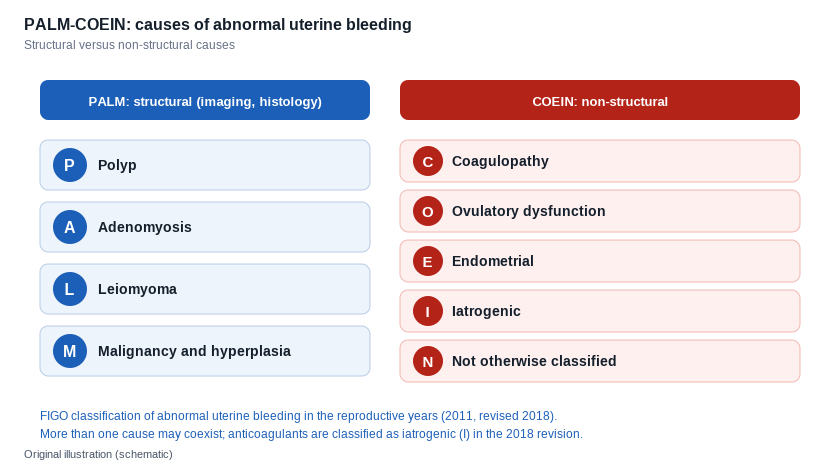
Abnormal uterine bleeding (AUB) is bleeding from the uterine corpus that is abnormal in frequency, duration, regularity or volume, or occurs between periods, in a non-pregnant woman of reproductive age. It affects about a third of women and is a major cause of iron deficiency anaemia. FIGO AUB System 1 defines normal menstruation (cycle 24–38 days, bleeding up to 8 days, limited variation) and System 2 classifies causes with the PALM-COEIN acronym: structural Polyp, Adenomyosis, Leiomyoma and Malignancy/hyperplasia; and non-structural Coagulopathy, Ovulatory dysfunction, Endometrial, Iatrogenic and Not otherwise classified. The approach is: exclude pregnancy, assess haemodynamic stability and anaemia, take a menstrual, bleeding-disorder, contraceptive and drug history, examine (including speculum), and target tests – FBC for everyone, hysteroscopy or ultrasound when structural disease is suspected, and endometrial sampling when hyperplasia or cancer is possible. The 52 mg levonorgestrel IUS is first-line treatment for heavy menstrual bleeding without major structural disease.
Patient case, mechanism, investigations, management, flashcards and exam-style questions.Open the lesson →
Key facts
- Always exclude pregnancy first in any woman of reproductive age with abnormal bleeding
- FIGO normal menstruation: frequency 24–38 days, duration up to 8 days, cycle-to-cycle variation up to 7–9 days; heavy bleeding is defined by its impact on quality of life
- PALM-COEIN: Polyp, Adenomyosis, Leiomyoma, Malignancy/hyperplasia (structural); Coagulopathy, Ovulatory, Endometrial, Iatrogenic, Not otherwise classified
- Offer FBC to every woman with heavy menstrual bleeding; test for coagulopathy (e.g. von Willebrand disease) if HMB since menarche or a bleeding history
- Outpatient hysteroscopy is first-line when submucosal fibroids, polyps or endometrial pathology are suspected; ultrasound for a large uterus or suspected adenomyosis (NICE NG88)
- Endometrial biopsy is needed for persistent intermenstrual bleeding, age 45 or over with treatment failure, or risk factors for hyperplasia (obesity, PCOS, unopposed oestrogen, tamoxifen, Lynch syndrome)
- First-line for HMB without major structural pathology: 52 mg levonorgestrel IUS; alternatives are tranexamic acid, NSAIDs, combined hormonal contraception or cyclical progestogens
- Acute heavy bleeding: resuscitate, then tranexamic acid and high-dose progestogen or oestrogen; tamponade or surgery if refractory
Differential diagnosis
| Condition | Clues | Key test |
|---|---|---|
| Endometrial polyp | Intermenstrual bleeding, regular cycle, often 40s | Outpatient hysteroscopy or saline infusion sonography |
| Submucosal leiomyoma (fibroid) | Heavy prolonged periods, clots, enlarged irregular uterus, anaemia | Pelvic ultrasound and hysteroscopy |
| Adenomyosis | Heavy painful periods in a parous woman, bulky tender globular uterus | Transvaginal ultrasound or MRI |
| Endometrial hyperplasia or cancer | Age 45+, obesity, PCOS, tamoxifen, irregular or intermenstrual bleeding | Endometrial biopsy (Pipelle) or hysteroscopy |
| Ovulatory dysfunction (PCOS, perimenopause, thyroid, hyperprolactinaemia) | Irregular, unpredictable cycles, hirsutism, weight change | TSH, prolactin, androgens, day 21 progesterone |
| Coagulopathy (von Willebrand disease) | HMB since menarche, PPH, dental or surgical bleeding, family history | Von Willebrand screen, clotting, haematology referral |
| Iatrogenic (anticoagulants, copper IUD, progestogen-only methods) | Bleeding started after a new drug or device | Drug and contraceptive history |
| Pregnancy complication | Missed period, positive hCG, pain | Urine or serum hCG, transvaginal ultrasound |
Exam pearls
Guideline
NICE NG88 Heavy menstrual bleeding: assessment and management (2018, updated 2021); FIGO AUB Systems 1 and 2 (PALM-COEIN), 2018 revision; ACOG guidance on AUB in reproductive-aged women and acute AUB; NICE TA832 relugolix combination therapy for fibroids (2022)
References
- National Institute for Health and Care Excellence (NICE). Heavy menstrual bleeding: assessment and management (NG88). NICE guideline 2018.
- Munro MG, Critchley HOD, Fraser IS; FIGO Menstrual Disorders Committee.. The two FIGO systems for normal and abnormal uterine bleeding symptoms and classification of causes of abnormal uterine bleeding in the reproductive years: 2018 revisions. Int J Gynaecol Obstet 2018.
- American College of Obstetricians and Gynecologists (ACOG). Committee Opinion No. 557: Management of acute abnormal uterine bleeding in nonpregnant reproductive-aged women. Obstet Gynecol 2013.
- American College of Obstetricians and Gynecologists (ACOG). Practice Bulletin No. 128: Diagnosis of abnormal uterine bleeding in reproductive-aged women. Obstet Gynecol 2012.
- National Institute for Health and Care Excellence (NICE). Relugolix–estradiol–norethisterone acetate for treating moderate to severe symptoms of uterine fibroids (TA832). NICE technology appraisal 2022.
- National Institute for Health and Care Excellence (NICE). Suspected cancer: recognition and referral (NG12). NICE guideline 2015.
Related topics
By Dr Khalid Seidi (B.Sc., M.D.) · MedEd World Clinical Knowledge library. Original teaching content checked against current guidelines (November 2026); confirm the latest local guidance before clinical use. Not a substitute for clinical judgement.