Clinical Knowledge › Obstetrics and gynaecology › Clinical problems
Antepartum haemorrhage: approach to the patient
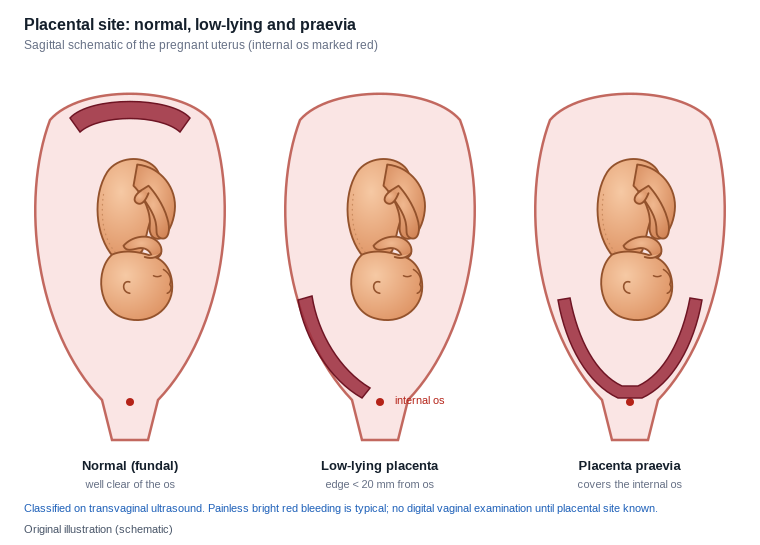
Antepartum haemorrhage (APH) is bleeding from or into the genital tract from 24 weeks of pregnancy until birth (20 weeks in some countries). It complicates 3–5% of pregnancies and is a leading cause of perinatal death. The main causes are placenta praevia (painless, often recurrent, soft uterus, high or abnormal presenting part) and placental abruption (pain, tense tender uterus, shock out of proportion to visible loss, fetal compromise and coagulopathy). Rarer causes include vasa praevia, uterine rupture and local lesions; many remain unexplained. Assessment is simultaneous: ABCDE resuscitation in left lateral tilt, quantification of blood loss, fetal heart and CTG, bloods including fibrinogen, crossmatch and Kleihauer, and ultrasound for placental site. Digital vaginal examination is avoided until placenta praevia is excluded. Management depends on maternal stability, fetal condition and gestation: emergency delivery for compromise, otherwise admission, corticosteroids, magnesium sulfate for neuroprotection when preterm, anti-D if RhD-negative and planned delivery.
Patient case, mechanism, investigations, management, flashcards and exam-style questions.Open the lesson →
Key facts
- APH: bleeding from or into the genital tract from 24+0 weeks to birth (RCOG); some countries use 20 weeks
- RCOG volume categories: spotting; minor <50 mL; major 50–1000 mL without shock; massive >1000 mL and/or clinical shock
- Placenta praevia: painless, bright red, recurrent bleeding; soft non-tender uterus; malpresentation or high head; never perform a digital vaginal examination
- Placental abruption: painful, tense 'woody' uterus; bleeding may be concealed; maternal shock, fetal distress or death and DIC
- Vasa praevia: bleeding at rupture of membranes with sudden fetal bradycardia or sinusoidal CTG while the mother is stable – category 1 caesarean
- Corticosteroids when preterm birth is likely: offer at 24+0–33+6 weeks, consider to 35+6 (NICE); magnesium sulfate neuroprotection before 30 weeks (consider to 33+6)
- RhD-negative women: anti-D at least 500 IU with a Kleihauer test after any APH from 20 weeks
- Placenta praevia without bleeding: planned caesarean at 36+0–37+0 weeks; after bleeding episodes, 34+0–36+6 weeks (RCOG 27a)
Differential diagnosis
| Condition | Clues | Key test |
|---|---|---|
| Placenta praevia | Painless bright red bleeding, soft uterus, malpresentation, previous caesarean | Transvaginal ultrasound for placental edge |
| Placental abruption | Pain, tense tender uterus, hypertension, trauma or cocaine, fetal distress | Clinical diagnosis; CTG, FBC, coagulation, fibrinogen |
| Vasa praevia | Bleeding at membrane rupture with acute fetal bradycardia | Antenatal TVS with colour Doppler; in labour clinical |
| Uterine rupture | Previous caesarean, sudden severe pain, loss of contractions, abnormal CTG, shock | Clinical; immediate laparotomy |
| Show (labour) | Mucoid blood-stained discharge with contractions | Speculum and cervical assessment once praevia excluded |
| Cervical ectropion, polyp or cervicitis | Postcoital spotting, visible lesion, normal fetal condition | Speculum, swabs |
| Cervical cancer | Irregular friable lesion, contact bleeding | Speculum and colposcopic biopsy |
| Unexplained APH (often marginal placental bleed) | No cause found; small recurrent bleeds | Diagnosis of exclusion; growth scans |
Exam pearls
Guideline
RCOG Green-top Guideline No. 63 Antepartum haemorrhage (2011, current); RCOG Green-top No. 27a Placenta praevia and placenta accreta (2018; revised edition June 2026) and No. 27b Vasa praevia (2018); NICE NG25 Preterm labour and birth (2015, updated 2022); BSH anti-D guideline (2014); SOGC placenta praevia guideline (2020)
References
- Royal College of Obstetricians and Gynaecologists. Antepartum haemorrhage. Green-top Guideline No. 63. RCOG 2011.
- Jauniaux E, Alfirevic Z, Bhide AG, et al.. Placenta praevia and placenta accreta: diagnosis and management. Green-top Guideline No. 27a. BJOG 2019.
- Jauniaux E, Alfirevic Z, Bhide AG, et al.. Vasa praevia: diagnosis and management. Green-top Guideline No. 27b. BJOG 2019.
- Oyelese Y, Ananth CV.. Placental abruption. Obstet Gynecol 2006.
- National Institute for Health and Care Excellence (NICE). Preterm labour and birth (NG25). NICE guideline 2015.
- British Society for Haematology. BCSH guideline for the use of anti-D immunoglobulin for the prevention of haemolytic disease of the fetus and newborn. Transfus Med 2014.
Related topics
By Dr Khalid Seidi (B.Sc., M.D.) · MedEd World Clinical Knowledge library. Original teaching content checked against current guidelines (November 2026); confirm the latest local guidance before clinical use. Not a substitute for clinical judgement.