Clinical Knowledge › Obstetrics and gynaecology › Clinical problems
Reduced fetal movements: approach to the patient
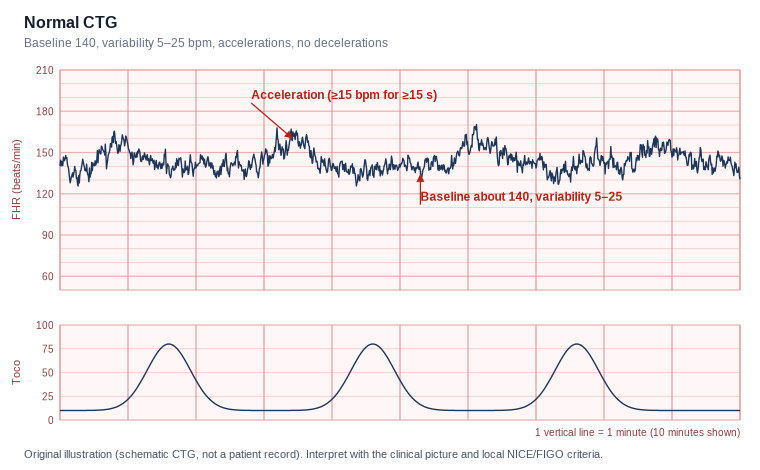
Reduced fetal movements (RFM) means a woman perceives that her baby is moving less than usual, or that the pattern has changed. It is common – up to about one in seven pregnancies – and usually benign, but it can be the first sign of placental insufficiency, fetal growth restriction, fetomaternal haemorrhage or impending stillbirth; about half of women who have a stillbirth report RFM beforehand. Movements are first felt at 16–24 weeks and increase until about 32 weeks, then plateau; they do not normally decrease towards term. Women should know their own baby's pattern and report a reduction the same day rather than waiting or using home Doppler devices. Assessment is gestation-based: confirm the fetal heart, review risk factors for stillbirth, measure symphysis–fundal height and perform a CTG (computerised where available) from 26 weeks. Ultrasound for growth and liquor is arranged within 24 hours when there are risk factors, recurrent episodes or abnormal findings. Induction for a single episode of RFM alone before 39 weeks is not routinely offered.
Patient case, mechanism, investigations, management, flashcards and exam-style questions.Open the lesson →
Key facts
- Movements are first felt between 16 and 24 weeks (earlier in multiparous women) and should not decline towards term
- RFM affects up to about 15% of pregnancies; about half of stillbirths are preceded by a period of reduced movements
- Formal kick-counting with a fixed alarm limit is not recommended; women should report any reduction in their baby's usual pattern the same day
- First step: confirm the fetal heart with a handheld Doppler or ultrasound; absent heart beat needs real-time ultrasound to confirm fetal death
- From 26 weeks, perform CTG (computerised analysis with Dawes–Redman criteria where available) and measure symphysis–fundal height
- Ultrasound (growth, liquor, umbilical artery Doppler) within 24 hours if risk factors for FGR or stillbirth, recurrent RFM or concern
- A sinusoidal CTG with RFM suggests fetal anaemia: check Kleihauer for fetomaternal haemorrhage and MCA Doppler
- Advise going to sleep on the side after 28 weeks; supine going-to-sleep position is associated with late stillbirth
Differential diagnosis
| Condition | Clues | Key test |
|---|---|---|
| Normal fetal sleep cycle or maternal inattention | Single short episode, movements return with focus, no risk factors | Normal CTG and clinical assessment |
| Fetal growth restriction (placental insufficiency) | Small symphysis–fundal height, hypertension, smoking, previous SGA baby | Ultrasound biometry, liquor and umbilical artery Doppler |
| Intrauterine fetal death | No movements for many hours, no fetal heart on Doppler | Real-time ultrasound confirmation |
| Fetomaternal haemorrhage or fetal anaemia | Sinusoidal CTG, recent trauma or abruption, Rh-alloimmunisation | Kleihauer test, MCA peak systolic velocity Doppler |
| Drug effect | Recent maternal opioids, benzodiazepines, alcohol or antenatal corticosteroids | Drug history; repeat CTG after effect wears off |
| Placental abruption | Pain, uterine tenderness, bleeding, abnormal CTG | CTG, clinical assessment, FBC and coagulation |
| Oligohydramnios or polyhydramnios | Small or large-for-dates uterus | Ultrasound amniotic fluid assessment |
| Fetal anomaly (neuromuscular or CNS) | Movements never felt by 24 weeks, polyhydramnios | Detailed fetal medicine ultrasound |
Exam pearls
Guideline
RCOG Green-top Guideline No.57 Reduced fetal movements (revised edition 2026, replacing 2011) and NHS England Saving Babies' Lives Care Bundle version 3 (2023), with RCOG Green-top No.31 SGA/FGR (2024), NICE NG201 antenatal care (2021) and ACOG Practice Bulletin 229 antepartum fetal surveillance (2021)
References
- Whitworth M, Fisher M, Heazell A; Royal College of Obstetricians and Gynaecologists.. Reduced fetal movements: Green-top Guideline No. 57. BJOG 2026.
- NHS England. Saving Babies' Lives Care Bundle, version 3. NHS England 2023.
- National Institute for Health and Care Excellence (NICE). Antenatal care (NG201). NICE guideline 2021.
- Norman JE, Heazell AEP, Rodriguez A, et al.. Awareness of fetal movements and care package to reduce fetal mortality (AFFIRM): a stepped wedge, cluster-randomised trial. Lancet 2018.
- American College of Obstetricians and Gynecologists (ACOG). Practice Bulletin No. 229: Antepartum fetal surveillance. Obstet Gynecol 2021.
- Centre of Research Excellence in Stillbirth / Perinatal Society of Australia and New Zealand. Clinical practice guideline for the care of women with decreased fetal movements. Stillbirth CRE 2019.
Related topics
By Dr Khalid Seidi (B.Sc., M.D.) · MedEd World Clinical Knowledge library. Original teaching content checked against current guidelines (November 2026); confirm the latest local guidance before clinical use. Not a substitute for clinical judgement.