Clinical Knowledge › Obstetrics and gynaecology › Clinical problems
Vaginal discharge: approach to the patient
Vaginal discharge is one of the commonest reasons women attend primary care, sexual health and gynaecology clinics. Physiological discharge varies with the menstrual cycle, pregnancy and hormonal contraception, and needs only reassurance. Abnormal discharge is most often caused by bacterial vaginosis (BV) or vulvovaginal candidiasis, which are not sexually transmitted infections, and less often by Trichomonas vaginalis, chlamydia or gonorrhoea, which are. Non-infective causes include a retained tampon or foreign body, cervical ectropion or polyp, atrophic vaginitis, allergy and, importantly, cervical or endometrial cancer. The approach combines a focused history (colour, odour, itch, pelvic pain, bleeding, sexual risk), speculum examination, vaginal pH, whiff test and microscopy (Amsel or Nugent criteria), and NAAT for chlamydia, gonorrhoea and Trichomonas when STI risk exists. Treatment follows the cause; pregnancy, adolescents (safeguarding), postmenopausal women and recurrent infection need particular care.
Patient case, mechanism, investigations, management, flashcards and exam-style questions.Open the lesson →
Key facts
- Normal premenopausal vaginal pH is 3.8–4.5 (lactobacilli produce lactic acid); pH above 4.5 suggests BV or Trichomonas, a normal pH suggests candida
- BV is the commonest cause of abnormal discharge in women of reproductive age; candida is second; neither is an STI
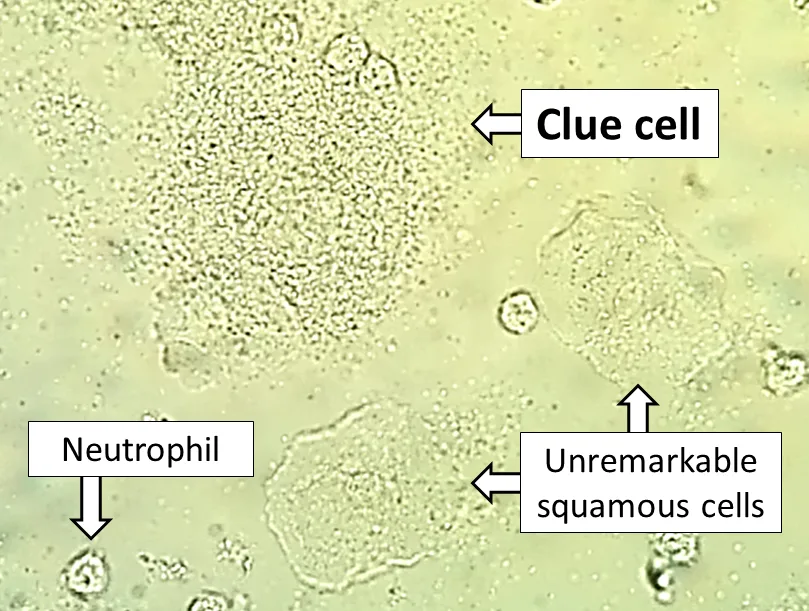
- Amsel criteria (3 of 4): thin white homogeneous discharge, pH above 4.5, positive whiff (amine) test with 10% KOH, clue cells above 20% of epithelial cells
- Nugent Gram-stain score: 0–3 normal, 4–6 intermediate, 7–10 BV
- Trichomonas: frothy yellow-green discharge, vulvitis, 'strawberry' cervix in a minority; NAAT is the test of choice; treat partners
- BV: oral metronidazole 400–500 mg twice daily for 5–7 days, or vaginal metronidazole gel or clindamycin cream (teaching doses; check local formulary)
- Candida: clotrimazole 500 mg pessary once or fluconazole 150 mg orally once; in pregnancy use topical azoles for 7 days, not oral fluconazole
- Red flags: postcoital or intermenstrual bleeding, postmenopausal discharge, pelvic pain or fever, and a child or young person (safeguarding)
Differential diagnosis
| Condition | Clues | Key test |
|---|---|---|
| Bacterial vaginosis | Thin grey-white fishy-smelling discharge, no itch, pH above 4.5 | Amsel criteria or Gram stain (Nugent 7–10) |
| Vulvovaginal candidiasis | Thick white curdy discharge, itch, soreness, superficial dyspareunia, pH normal | Microscopy for hyphae/spores; culture with speciation if recurrent |
| Trichomoniasis | Frothy yellow-green discharge, vulval soreness, dysuria, pH above 4.5 | NAAT of vulvovaginal swab; wet mount less sensitive |
| Chlamydia or gonorrhoea cervicitis | Mucopurulent cervical discharge, contact bleeding, pelvic pain | NAAT of vulvovaginal swab; culture for gonococcal sensitivities |
| Retained tampon or foreign body | Offensive discharge, sometimes blood-stained, after menses | Speculum examination and removal |
| Cervical ectropion or polyp | Clear mucoid discharge or postcoital bleeding | Speculum examination; check cervical screening history |
| Atrophic vaginitis (GSM) | Postmenopausal, dryness, thin watery discharge, dyspareunia | Clinical; exclude malignancy if bleeding |
| Cervical or endometrial cancer | Blood-stained watery discharge, postcoital or postmenopausal bleeding | Speculum, colposcopy/biopsy or ultrasound and endometrial sampling |
Exam pearls
Guideline
CDC STI Treatment Guidelines 2021; IUSTI/WHO European vaginal discharge guideline 2018; WHO symptomatic STI guidelines 2021; BASHH BV guideline 2012 (UK revision in progress; check for update); ACOG Practice Bulletin 215 (2020)
References
- Workowski KA, Bachmann LH, Chan PA, et al.. Sexually Transmitted Infections Treatment Guidelines, 2021. MMWR Recomm Rep 2021.
- Sherrard J, Wilson J, Donders G, et al.. 2018 European (IUSTI/WHO) International Union against sexually transmitted infections (IUSTI) World Health Organisation (WHO) guideline on the management of vaginal discharge. Int J STD AIDS 2018.
- American College of Obstetricians and Gynecologists. Vaginitis in Nonpregnant Patients: ACOG Practice Bulletin, Number 215. Obstet Gynecol 2020.
- Amsel R, Totten PA, Spiegel CA, et al.. Nonspecific vaginitis. Diagnostic criteria and microbial and epidemiologic associations. Am J Med 1983.
- Nugent RP, Krohn MA, Hillier SL. Reliability of diagnosing bacterial vaginosis is improved by a standardized method of gram stain interpretation. J Clin Microbiol 1991.
- Vodstrcil LA, Plummer EL, Fairley CK, et al.. Male-Partner Treatment to Prevent Recurrence of Bacterial Vaginosis. N Engl J Med 2025.
Related topics
By Dr Khalid Seidi (B.Sc., M.D.) · MedEd World Clinical Knowledge library. Original teaching content checked against current guidelines (November 2026); confirm the latest local guidance before clinical use. Not a substitute for clinical judgement.