Clinical Knowledge › Obstetrics and gynaecology › Clinical problems
Acute pelvic pain: approach to the patient
Acute pelvic pain is one of the commonest gynaecological emergencies. The first question in any woman of reproductive age is 'could she be pregnant?', because a ruptured ectopic pregnancy is the leading cause of early pregnancy maternal death. The second is 'is she stable?'. Gynaecological causes include ectopic pregnancy and miscarriage, ovarian torsion, haemorrhagic or ruptured ovarian cyst, pelvic inflammatory disease and tubo-ovarian abscess, degenerating fibroids and mittelschmerz; non-gynaecological causes include appendicitis, urinary tract infection and stones, diverticulitis and bowel obstruction. Assessment combines a menstrual and sexual history, observations, abdominal, speculum and bimanual examination, urine hCG, urinalysis, NAATs for chlamydia and gonorrhoea, bloods and transvaginal ultrasound. Laparoscopy is both diagnostic and therapeutic when torsion, rupture or diagnostic doubt persists. Treatment is cause-specific: surgery or methotrexate for ectopic pregnancy, prompt detorsion for torsion and empirical antibiotics for PID.
Patient case, mechanism, investigations, management, flashcards and exam-style questions.Open the lesson →
Key facts
- First test in every woman of reproductive age with pelvic pain: urine hCG
- Pain + positive hCG + no intrauterine pregnancy = ectopic until proven otherwise; shock = theatre
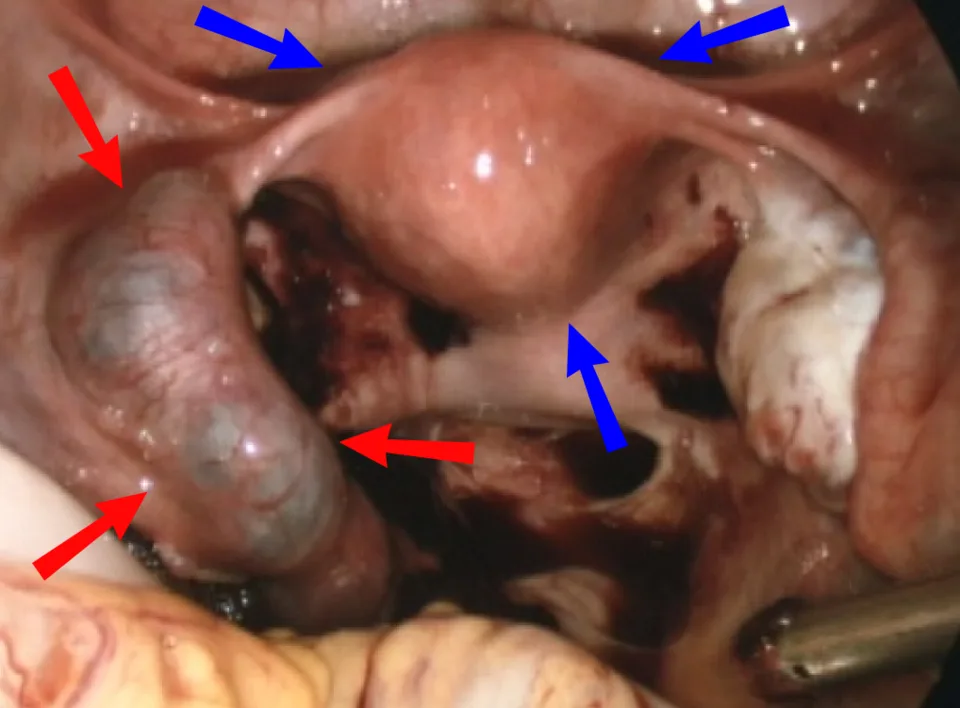
- Ovarian torsion: sudden severe unilateral pain with nausea and vomiting, usually an enlarged ovary or cyst over 5 cm; normal Doppler flow does not exclude it
- Torsion treatment: urgent laparoscopic detorsion with ovarian conservation, even if the ovary looks dark
- PID: treat empirically if a sexually active woman has pelvic pain with cervical motion, uterine or adnexal tenderness and no other cause
- PID regimens (teaching doses): BASHH – ceftriaxone 1 g IM once + doxycycline 100 mg twice daily + metronidazole 400 mg twice daily for 14 days; CDC – ceftriaxone 500 mg IM + doxycycline + metronidazole 500 mg for 14 days
- Methotrexate for ectopic (NICE NG126): no significant pain, unruptured mass under 35 mm, no visible heartbeat, hCG under 1500 IU/L (option up to 5000) and able to attend follow-up
- Haemorrhagic corpus luteum rupture is usually managed conservatively unless haemodynamically unstable
Differential diagnosis
| Condition | Clues | Key test |
|---|---|---|
| Ectopic pregnancy | Amenorrhoea, positive hCG, unilateral pain, shoulder tip pain, scant bleeding | Transvaginal ultrasound with serum hCG |
| Ovarian torsion | Sudden severe pain with vomiting, adnexal mass, often after exercise | Ultrasound with Doppler (whirlpool sign); laparoscopy |
| Ruptured or haemorrhagic ovarian cyst | Sudden pain in luteal phase or after intercourse, free fluid | Transvaginal ultrasound, Hb |
| Pelvic inflammatory disease / tubo-ovarian abscess | Bilateral pain, fever, discharge, cervical motion tenderness | NAATs, CRP, ultrasound for abscess |
| Acute appendicitis | Migratory periumbilical to right iliac fossa pain, anorexia | Clinical, ultrasound or CT |
| Miscarriage | Positive hCG, cramping, bleeding, open os | Transvaginal ultrasound |
| Renal colic or pyelonephritis | Loin-to-groin colic, haematuria, fever, renal angle tenderness | Urinalysis, CT KUB or ultrasound |
| Mittelschmerz | Mid-cycle short-lived unilateral pain, recurrent | Clinical; normal tests |
Exam pearls
Guideline
NICE NG126 Ectopic pregnancy and miscarriage (2019, updated 2023); BASHH UK national guideline for the management of pelvic inflammatory disease (2018, updated 2019); CDC Sexually Transmitted Infections Treatment Guidelines (2021); RCOG Green-top No.62 suspected ovarian masses in premenopausal women (2011); ACOG Practice Bulletin 193 tubal ectopic pregnancy (2018)
References
- National Institute for Health and Care Excellence (NICE). Ectopic pregnancy and miscarriage: diagnosis and initial management (NG126). NICE guideline 2019.
- British Association for Sexual Health and HIV (BASHH). UK national guideline for the management of pelvic inflammatory disease. BASHH 2019.
- Workowski KA, Bachmann LH, Chan PA, et al.. Sexually transmitted infections treatment guidelines, 2021. MMWR Recomm Rep 2021.
- Royal College of Obstetricians and Gynaecologists (RCOG). Management of suspected ovarian masses in premenopausal women (Green-top Guideline No. 62). RCOG 2011.
- American College of Obstetricians and Gynecologists (ACOG). Practice Bulletin No. 193: Tubal ectopic pregnancy. Obstet Gynecol 2018.
- American College of Obstetricians and Gynecologists (ACOG). Committee Opinion No. 783: Adnexal torsion in adolescents. Obstet Gynecol 2019.
Related topics
By Dr Khalid Seidi (B.Sc., M.D.) · MedEd World Clinical Knowledge library. Original teaching content checked against current guidelines (November 2026); confirm the latest local guidance before clinical use. Not a substitute for clinical judgement.