Clinical Knowledge › Internal medicine › Rheumatology and immunology › Allergy and hypersensitivity disorders
Angioedema and hereditary angioedema
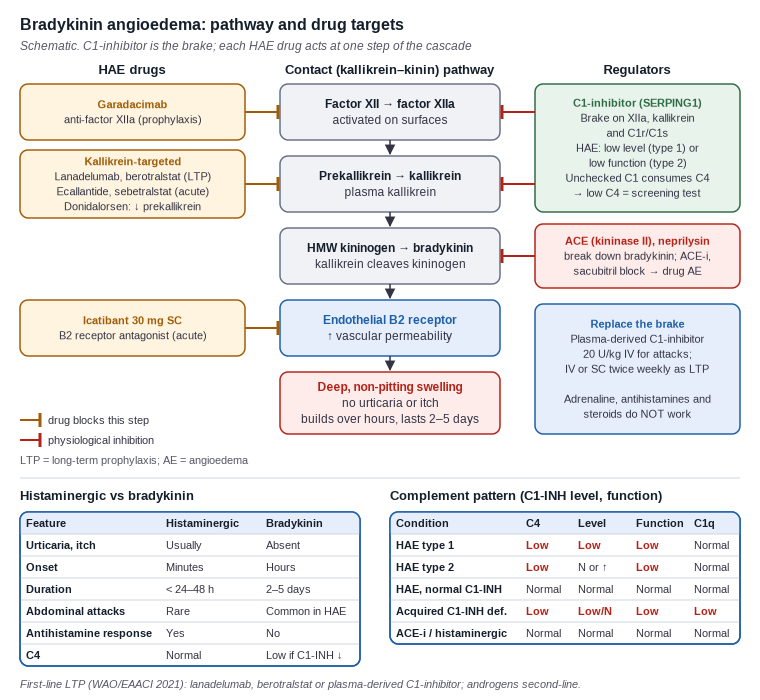
Angioedema is localised, non-pitting swelling of the deep dermis, subcutaneous or submucosal tissues, affecting the lips, eyelids, tongue, genitals, bowel wall and larynx. It has two main mechanisms. Histaminergic (mast cell) angioedema usually occurs with urticaria and itch, is allergic or part of chronic spontaneous urticaria, and responds to antihistamines, steroids and adrenaline. Bradykinin-mediated angioedema occurs without urticaria, develops over hours, lasts 2–5 days and does not respond to those drugs. Its causes are hereditary angioedema (HAE) from C1-inhibitor deficiency or dysfunction, HAE with normal C1-inhibitor, acquired C1-inhibitor deficiency linked to lymphoproliferative disease, and drugs, above all ACE inhibitors. A low C4 is the screening test for C1-inhibitor deficiency, confirmed by low C1-inhibitor level or function; a low C1q points to the acquired form. HAE attacks, including painful abdominal attacks and potentially fatal laryngeal swelling, are treated with C1-inhibitor concentrate or icatibant. Long-term prophylaxis with lanadelumab, berotralstat or C1-inhibitor, and newer agents, aims for complete control.
Patient case, mechanism, investigations, management, flashcards and exam-style questions.Open the lesson →
Key facts
- Two mechanisms: histaminergic (with urticaria and itch; responds to antihistamines and adrenaline) and bradykinin-mediated (no urticaria; does not respond)
- ACE inhibitors are the commonest cause of bradykinin angioedema (0.1–0.7% of users), more frequent in people of Black African ancestry, and can start years after the drug was begun
- HAE type 1 (about 85%) = low C1-inhibitor level and function; type 2 = normal level but low function; both autosomal dominant (SERPING1)
- Low C4 is the best screening test for C1-inhibitor deficiency; C1q is normal in HAE but low in acquired C1-inhibitor deficiency
- HAE attacks: recurrent swelling of skin, bowel (severe abdominal pain, vomiting, ascites) and larynx; triggers include trauma, dental work, oestrogens and stress
- Acute HAE attack treatment: plasma-derived C1-inhibitor IV 20 U/kg or icatibant 30 mg SC; adrenaline, antihistamines and steroids do not work
- First-line long-term prophylaxis (WAO/EAACI 2021): lanadelumab, berotralstat or plasma-derived C1-inhibitor; attenuated androgens are second-line
- Avoid ACE inhibitors and oestrogen-containing contraception/HRT in HAE; sacubitril/valsartan is contraindicated after ACE-inhibitor angioedema
Differential diagnosis
| Condition | Clues | Key test |
|---|---|---|
| Allergic (IgE) angioedema | Minutes after food, drug or sting; urticaria, itch; may progress to anaphylaxis | Clinical; tryptase; specific IgE |
| Angioedema with chronic spontaneous urticaria | Wheals for over 6 weeks plus episodic swelling; responds to antihistamines | Normal C4; clinical |
| ACE-inhibitor angioedema | No urticaria, lips and tongue, on ACE inhibitor | Drug history; normal C4 |
| Hereditary angioedema | Family history, onset in childhood or adolescence, abdominal attacks | Low C4, low C1-inhibitor level or function |
| Acquired C1-inhibitor deficiency | Onset after 40, no family history, lymphoma or MGUS | Low C4, low C1q, anti-C1-inhibitor antibodies |
| Facial cellulitis or dental abscess | Painful, warm, red, fever | CRP, white cell count, dental review |
| Superior vena cava obstruction | Facial and arm swelling, distended neck veins | CT chest |
| Hypothyroid myxoedema or nephrotic oedema | Persistent pitting or generalised oedema | TSH, urine protein, albumin |
Exam pearls
Guideline
International WAO/EAACI guideline for the management of hereditary angioedema (2021 revision) and US HAEA Medical Advisory Board guidelines (2020)
References
- Maurer M, Magerl M, Betschel S, et al.. The international WAO/EAACI guideline for the management of hereditary angioedema—the 2021 revision and update. Allergy 2022.
- Busse PJ, Christiansen SC, Riedl MA, et al.. US HAEA Medical Advisory Board 2020 guidelines for the management of hereditary angioedema. J Allergy Clin Immunol Pract 2021.
- Cicardi M, Aberer W, Banerji A, et al.. Classification, diagnosis, and approach to treatment for angioedema: consensus report from the Hereditary Angioedema International Working Group. Allergy 2014.
- Banerji A, Riedl MA, Bernstein JA, et al.. Effect of lanadelumab compared with placebo on prevention of hereditary angioedema attacks: a randomized clinical trial. JAMA 2018.
- Craig TJ, Reshef A, Li HH, et al.. Efficacy and safety of garadacimab, a factor XIIa inhibitor for hereditary angioedema prevention (VANGUARD): a global, multicentre, randomised, double-blind, placebo-controlled, phase 3 trial. Lancet 2023.
- Riedl MA, Farkas H, Aygören-Pürsün E, et al.. Oral sebetralstat for on-demand treatment of hereditary angioedema attacks. N Engl J Med 2024.
Related topics
By Dr Khalid Seidi (B.Sc., M.D.) · MedEd World Clinical Knowledge library. Original teaching content checked against current guidelines (November 2026); confirm the latest local guidance before clinical use. Not a substitute for clinical judgement.